The first night we stayed in Carbis Bay just outside St Ives, and on Sunday morning we set off in the direction of St Ives. The first part of the walk was under cliffs on a nice path, not a sign of what was to come once we got up onto the cliffs. The skies were grey but thankfully it was dry. St Ives itself appeared to have it's own climate, and despite the lack of sun one or two individuals had taken to the beach

We walked through the town, and finally found the coast path, bordered with lots of pink thrift.

Up to now the dominant flowers had been the spikes of the Navelwort growing around the damp walls, the leaves having a very fleshy look, and the very pretty Three Cornered Leek, which is a little like a cross of a snowdrop, and the wild garlic, but with definite green veins on the white petals. The leek was also very partial to damp wet ground.


The walk was extremely difficult, with many steep climbs accompanied by very boggy patches, this did though have it's upside as in the wet areas we found quite a few orchids. Mainly Common Spotted Orchids, there were also a few Marsh Orchids. These flowers have several sub species, that have variations on the colour and pattern of the petals, but looking closely the flowers are beautiful, and in some places the side of the cliff was carpeted with them.
 |
| Common Spotted Orchid |
 |
| Early Marsh Orchid |

The weather varied on the first day from sunny periods to light drizzle, but always with a brisk wind, that made the walking even more difficult as you became more exposed on the cliffs. Other than the gulls and stray Gannets out to see there was not much bird life, however you would constantly hear the song of the Wren from on top and within the bracken, and the clacking call of the Stonechat families. Every so often they would show themselves, and provide the opportunity for a photo, and a breather!


When we dared to look down at the sea, we could see grey shapes poking out of the water, most of the time these were rocks, but every so often the "rock" would disappear and then come up again a little further on. Closer examination revealed these rocks to be Atlantic Grey Seals, in one or two bays we counted up to ten animals just bobbing about in the surf and waves. This particular one was showing the lovely pebbled grey spots on its chest.

Our destination was Gurnards's Head, which was a little further on from Zennor, and as we passed the path to Zennor we thought we were almost there, but the path continued to be difficult, and after another hour we finally rolled up at the Gurnard's Head pub. Having settled in to our lovely room we enjoyed a good rest along with a few drinks, and later a lovely dinner.
On Monday morning the 4th, following a really wonderful breakfast we set out for Pendeen. It had rained during the night, but fortunately the morning was dry, but the grass and paths wet from the overnight rain. We had been told the next walk would be easier than the walk from St Ives, but even so we set off with some trepidation.
On picking up the coastal path a Peregrine flew along the cliffs, and we paused to look at the coast line. This is Gurnard's Head, so called because it resembles the shape of a Gurnard fish.

As we stopped to look at the sea, from somewhere a pipit called. The calling bird was a juvenile Meadow Pipit, and was revealed when the parent came down to pass some food. It continued to call after the parent left, and stayed in full view.

As well as the orchids and thrift another dominant flower of the cliff top was the Foxglove. The flower spikes would line the path, and as we passed them we became very impressed with the patterns shown on the sepals as the flower bells develop. The appearance is silky and the mix of dark green, light green and produces a lovely composition. The best way to view them was from above, where you can fully appreciate the symmetry of the flower heads and patterns created as the petals develop. Unfortunately it was not possible to get the full effect with the camera, but this goes somewhere to sharing the beauty we could see.

Once again we would come across fields of common spotted and marsh orchids, but on one occasion we did manage to find an Earl Purple Orchid.

The meadow pipits were now joining the stonechats and wrens as the prominent bird life on the cliff, and as a result we were not surprised to hear the call of the Cuckoo. As always though they seemed some way off, until we came across a gorse area where we flushed a male that then flew off and perched on a rock alongside the path we had just walked. It sat there and continued to call.

There turned out to be several in the area, and as we climbed the path we flushed another from the rocks, this one though disappeared. While we paused for a break and to watch some climbers another Cuckoo called and we were then treated to a fly past of a male and female. I wonder if a poor Meadow Pipit had received a visitor. These were the best views of Cuckoo I have had for a long time, and surpassed the ones we saw in Wales in May.
Fulmars were all around the cliffs, using the uplift to glide effortlessly back and forth, stiff winged they would come up to the cliff, and then bank away at the last minute to glide around again. With the sun beginning to come out they looked very nice against the aqua green of the sea.


The cloud was now clearing and the sun was coming through, the cliff tops were now quite warm, and as a result we began to see butterflies. Speckled Woods were the first, and a few other brown butterflies that just didn't stop frustrated us, but finally one sat still long enough to identify as a Pearl-bordered Fritillary, a first for us, and a lovely butterfly.

The next find was quite amazing as i have no idea why I looked at the particular bluebell, but I am glad I did as it had another first for me in a Green Hairstreak. It never showed itself completely, but the characteristic green hue, and the white spots on the underwing were sufficient clearly visible.

With the sun now shining brightly the sea and the flowers on the cliff tops were transformed. We came across a large bed of foxgloves growing in amongst burnt bracken branches which made for a nice composition, the red flowered stems of the foxgloves bending along with the black branches.

A surprise find on the cliff path was a Common Shrew, clearly not well we were not sure what to do with it, and rather leave it out in the open we ushered it back into the longer grass, hoping that maybe it would recover.

The views were becoming more and more spectacular, particularly impressive was to look north back to where we had come from, with Gurnard's Head in the distance. It doesn't look so far when you look in a straight line!

The path took us down into Portheras Cove, there was a beautiful beach here with a very nice stream coming down the valley. Unfortunately the beach seems to have been used as a tip for scrap metal, and warnings are posted to be careful of large metal objects beneath the waves. The stream was also littered with scrap including a few old wheels.
As the stream met the sandy beach, and made it's way to the sea, it created some lovely patterns from the sifting sand.

As we came down by the side of the stream, I noticed this pipit. When I first saw it and took the photos I thought it was a Rock Pipit, but on looking at the pictures now I am not sure if it might be a Water Pipit.


In the sheltered valley we came across some more butterflies, The Common Blues seem to have a liking for the birds foot trefoil, and could be guaranteed to settle on them to allow a photo.
.jpg)
We could see Pendeen Watch now, the lighthouse standing out on the point, our walk would take us beyond the point, and along Old Pendeen Cliffs. In the gardens around the Watch we found another Pearl Bordered Fritillary, this time showing the beautiful underwing.

The banks on the side of the road we covered in pink thrift, although some of the flower heads were showing signs of wind burn. These proved a big attraction to the butterflies and bees.

In order to get to our next overnight stop we had to take the path to the Geevor tin mine, this is not open for business but survives as a tourist attraction. In the grasses alongside the path there were lots of Five Spot Burnet Moths. As the sun caught them the colours on their wings would change from green to dark blue, but always highlighting the red spots. From the behaviour it was clear they were intent on breeding.


Looking south west beyond the mine chimneys, you could just make out the Scilly Isles. This archipeligo is about 25 - 30 miles from where were, so to be able to make them out was pretty impressive.

At the mine we turned inland heading back into Pendeen, the footpath went through fields and then followed a wall that was of interest to this Wall Brown.

Walking through the village of Lower Boscawell, I finally managed to catch up with a Painted Lady, we had seen several on the cliffs, but they did not settle and showed what strong fliers they were as they flew into the winds. This one was reluctant to give me a full view, but it frames a nice picture.

We spent the rest of the afternoon at the pub we were staying in overnight, the accommodation was fine, but the evening meal left a lot to be desired.
The next morning everything changed. We woke to howling wind, and heavy rain, but after breakfast we set off for Sennen. It rained most of the way to Cape Cornwall, and with the rain we had quite thick fog, which meant we could see very little. This meant that we took the wrong path, and we missed the old disused mine buildings.
At Cape Cornwall the fog was at it's thickest and we couldn't see the sea from the cliffs. Finally as we made our way into Sennen the rain eased and the fog lifted. The cove and beach stretches for some way, and out at sea Gannets and Shags could be seen on or above the sea.

We walked along the beach into the village, and was very pleased to get into our room for the night and to be able to get out of the wet clothes. In the afternoon we were able to take a walk around the village, and watch the surfers in the sea.

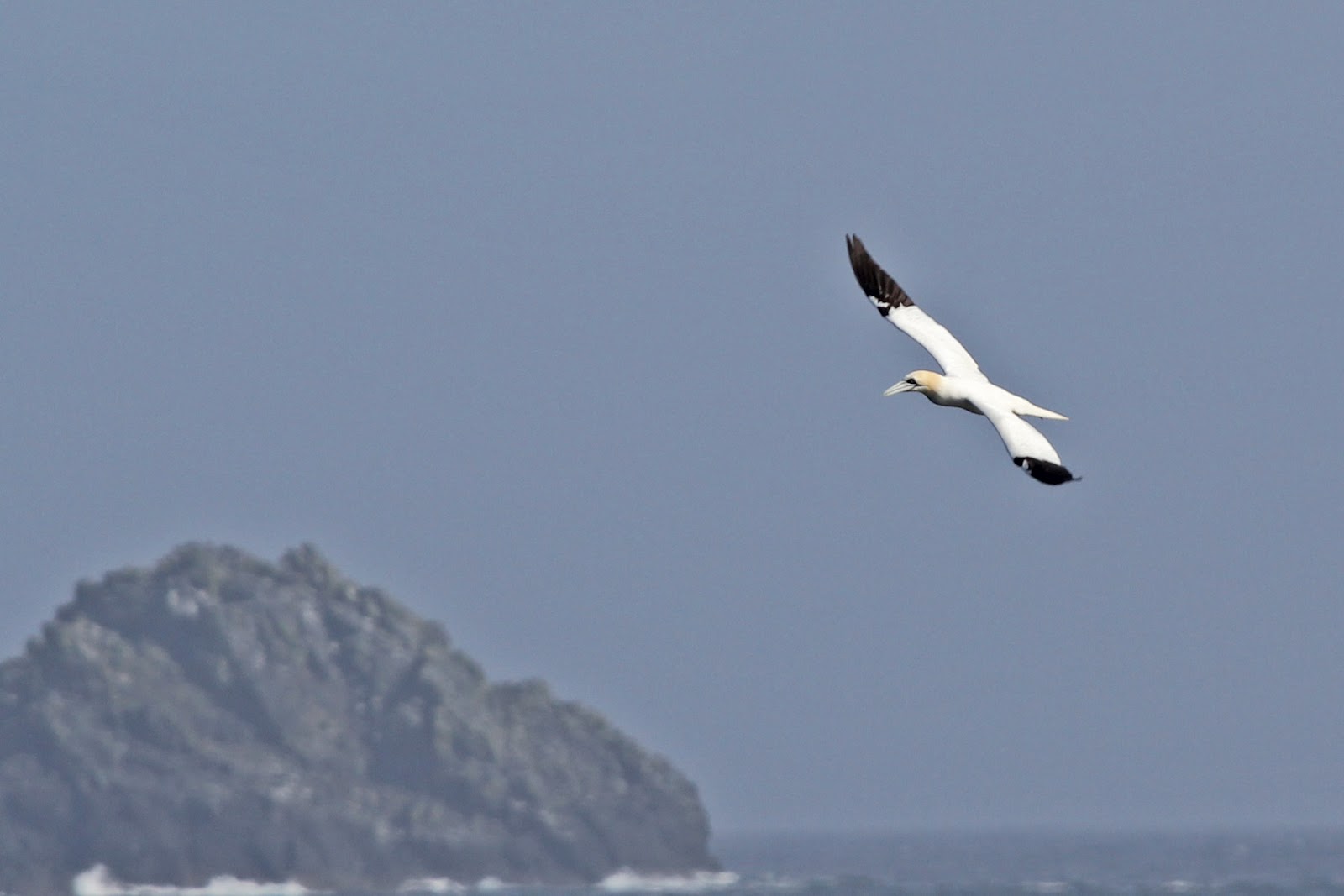
In the morning we were able to watch Gannets diving in the sea from our room, and we were encouraged by the fact that the sun was shining. We set off through the village, and paused a while to watch the fishermen around the boats, and a lone Gannet fishing just off the rocks.
Once up on the cliffs we could see the buildings at Land's End, and the Longships Rocks Lighthouse, which dominated the views. In this one the gathering clouds provide quite a dramatic effect.

As we walked towards Land's End a Hummingbird Hawk Moth was seen on the footpath, it seemed to be enjoying the morning sunshine rather than feeding, and would rest on the rocks on the path.

It was still early enough for the crowds to not be too large at Land's End, with the weather I suspect there were a lot more later in the day. The sea and the cliffs were the attraction, and down on the rocks you could make out Guillemots, Razorbills and Shags, although they were a little distant all three can be seen here.

Fulmars and Gannets could be seen below us and on the cliff tops Jackdaws fed amongst the thrift.

We left the area of Land's End and headed off towards Porthgwarra, at every turn there were lovely views of the cliffs and sea, many with the lighthouse in the distance. The rock here is granite, the rock has inherent areas of weakness, and these are eroded by the sea and the wind to produce large boulders and intricate rock shapes. In this case a boulder has broken off and lodged on others. I wonder how long it has been there?

The sea was looking fantastic with the varying greens and blues. No where was this more evident than in Nandijzal.

We walked around the bay, on one of the rocks overlooking the bay a Rock Pipit perched with food for a nest nearby.

We crossed a stream and climbed up the cliff into Porthgwarra area. At the top of the cliff we stopped for a rest, and looking back into the bay we watched a group of up to eight Atlantic Grey Seals swim into the bay, and then cruise quite close to shore around the rocks.

The area on the top of the cliffs at Porthgwarra was probably the easiest going of the whole walk. It was close cropped grass with gorse bushes scattered about. Intriguingly on top of some of the gorse was a mat of red vegetation. It wasn't clear where this came from, and whether it was attached to the gorse. Since coming back I have not been able to find anything that identifies what exactly it was, it was quite common and seen on most of the gorse in this area.

We walked past the look out station, and then stopped for cup of tea in the valley. From there it was short walk to Porthcurno. As we started to descend down into the valley, calls from the Herring Gulls alerted us to a Buzzard overhead. Looking closer we could see it was carrying prey. On the first day we had seen a buzzard flying across the cliffs with a rabbit in it's talons, this time though today I had the camera ready. The gulls were very persistent mobbing the buzzard, and preventing it from flying where it obviously wanted to go. In the end though the gulls got fed up and left it.

The bay and the beach at Porthcurno looked wonderful, so much so that once we had sorted ourselves out at the B&B we decided to head back to the beach for a walk along the sand. Unfortunately though when we go back the tide was coming in and the bays were cut off, so we had to make do with people watching. Here is the bay with the tide still out.

The next day Thursday we were presented with a completely different weather picture, very strong winds and rain, so once again we set off in the waterproofs. I decided on a short cut, that didn't really work, although we did surprise a fox in one of the fields. When we finally made it to the sea, the waves were incredible, and a feature of what was a very difficult walk. The path was overgrown, making it difficult to make out the path, and with the rain and wind, we found the going very difficult.
At one stage there was a breaks and the sun came out briefly, but this didn't last long, and the winds became stronger and stronger. This was the waves at Porthguranon

The path didn't get any easier, and at St Loy's Cove we were taken along the beach. This was made mainly of large boulders, and the sea was crashing in on the rocks attracting he gulls to what ever was thrown up by the force of the waves on the rocks.

The rain held off until we reached Lamorna Cove, but after that the path became a lot easier. Once we reached Mousehole though it was raining quite hard, but the wind was behind us as we made our way along the road to Penzance. We arrived soaking wet again, and very grateful for a wonderful room, a hot bath and lovely evening meal.
The original plan had been to walk from Penzance back up to St Ives along the St Michael's Way, however because the fog and rain had denied us the opportunity to see some of the most spectacular scenery from Pendeen to Cape Cornwall, we decided to go back to Cape Cornwall, and walk it again. After yesterday's storms the morning was dry and sunny but very windy. We took a taxi to St Just, and then walked down the Kendijack valley to Cape Cornwall.
The sea was incredible, a deep blue with many cresting white waves, at Cape Cornwall the waves crashed into the bay turning the water white.

Beyond Cape Cornwall it was possible to see the Longships Lighthouse, and also the waves hitting the rocks sending spray half way up the lighthouse.

Out to sea, Gannets, Fulmars and Manx Shearwaters passed all heading south west into the wind, groups of shearwaters would continuously pass all the time we were walking, and must have been in the hundreds.
From Cape Cornwall we headed towards Botallack. The engine houses and pump houses that were now derelict were all over the place, but the most scenic ones were located down the side of the cliff alongside the rocks. These mines were built in 1740, and finally stopped working in 1914. The shafts apparently go down as far as 500m below the sea bed, but in places were close enough for the miners to hear the boulders rolling around on the sea bed. Once the mines were closed the sea got into the shafts. Further up the coast at Levant Zawn, the shafts have been pumped clear, and apparently there are tons of tin ore still waiting to be brought to the surface.

Looking back up the cliff from the engine house the skyline is littered with old mine buildings and chimneys.

We headed along the path towards Pendeen, and was horrified to see the scree path we had wrongly taken on the Tuesday in the fog. If we had slipped it would have been very difficult to prevent us falling down the cliff. We were able to find the correct path this time, and finally arrived at Pendeen Watch.

We stopped at the Watch for a snack, and the opportunity to watch the birds moving past the headland. The wind was still incredibly strong and was throwing up some amazing waves, which demonstrated the awesome power they can create.


The Gannets and Fulmars passed quite close to the headland, while the Manx shearwaters would be a little further out. The shearwaters looked so small against the huge waves. As we watched them pass using the lift generated by the waves and the wind itself, we wondered if they found this fun, was it like surfing to them, because you had to wonder where they were going, did they just decide let's play today!


From the Watch we walked back into Pendeen, and finally after a long wait we got the bus back to Carbis Bay where we checked back into the guest house, changed and then walked back into St Ives. The wind had by now eased, and it was a lovely evening, with some nice sunshine.

The beach and the streets around the cottages in the harbour were very busy, with many people enjoying the sunshine.

We had completed what we had set out to do, and had dealt with every thing West Cornwall could throw at us, the wind, the rain, the fog and the sun, and enjoyed every moment of it!


+2.jpg)
+2.jpg)


