An early start saw us driving through the relatively empty streets of Chicago to O'Hare where we were catching the early flight to Salt Lake City. Despite some confusion over departure gates we arrived in Salt Lake City on time, but had an agonising one and a half hour wait for the hire car which meant we did not get on our way north to West
Yellowstone until well after midday. Consequently this meant we did not reach the
hotel until 17.30. The journey was
highway all the way through flat plains until about an hour from our
destination when we started to climb into the hills and the Targhee National Forest. Along the way we saw soaring Turkey Vultures and Red-tailed Hawks, but the highlight was an Osprey that flew over
the road as we arrived into West Yellowstone.
As a result there were no photographs from the journey and the day. After checking in we walked around the town, West Yellowstone is primarily a tourist town with plenty of souvenir shops and restaurants, but that said it wasn't in your face and it was pleasant to walk around. The climate was hot to start with but there were some threatening storm clouds around us. We had climbed to just above 6,000 feet in altitude, and this was noticeable as you moved about. Fortunately the heat was dry and not humid.
Our time in Yellowstone started properly on the 11th, with a relatively early start into the park at around 7.30, after the long journey yesterday there was no great appetite for an early start, but nevertheless we were still awake at 6.00am. As we set off there was a blue sky with a few clouds about, and a temperature of about 42 degrees F (apologies for the imperial measurements but these were all we had to work with from the car)
We arrived at the West Entrance about a mile from the town, and paid our $30 for a weeks entry, not a bad deal. Once we cleared the gate we headed east towards the Madison Junction following the Madison River. The roads are excellent in the park, and with plenty of places to pull off to view the area. We pulled off at one of these alongside the river where a pair of Ravens were sitting in a dead tree.
Our time in Yellowstone started properly on the 11th, with a relatively early start into the park at around 7.30, after the long journey yesterday there was no great appetite for an early start, but nevertheless we were still awake at 6.00am. As we set off there was a blue sky with a few clouds about, and a temperature of about 42 degrees F (apologies for the imperial measurements but these were all we had to work with from the car)
We arrived at the West Entrance about a mile from the town, and paid our $30 for a weeks entry, not a bad deal. Once we cleared the gate we headed east towards the Madison Junction following the Madison River. The roads are excellent in the park, and with plenty of places to pull off to view the area. We pulled off at one of these alongside the river where a pair of Ravens were sitting in a dead tree.

Our first encounter with Ravens raised the excitement levels but we quickly found out that they were the commonest birds to be seen around the park.
There was a mist hanging over the water as the air was quite cool despite the heat of yesterday, and looking west down the river I could just make out a distant Osprey sitting in a tree above the river, with mountains as the backdrop.

Another stop produced views of at least three Lesser Yellowlegs that were feeding on the floating vegetation in the river.
We were heading into the park along the western entrance, by all accounts the most popular route in. However it was still early and the traffic wasn't too bad, but you sensed that later the roads would become quite congested
As the river plain opened out we finally came across some large animals, a herd of Elk in the long grass and streams that were feeding into the river.
As the river plain opened out we finally came across some large animals, a herd of Elk in the long grass and streams that were feeding into the river.

Looking down river the mist could be seen hanging over the water as if steam were rising from the meadow..

At Madison Junction we turned right and headed south towards Old Faithful and the Geyser Basin The plan was to do the touristy bits today, and Old Faithful was up there as one of the top attractions in that area.
As the road came into open meadow we could see the steam from the many geysers in the area away off in the distance.

This area is known as Geyser Country holding the park's most spectacular hydrothermal activity, and almost everywhere you looked there was steam rising. The area has the world's densest concentration of geysers over 200 in an area of 1.5 square miles. It is this area that makes the Yellowstone Park globally unique
We pulled in once again as we drove across an open grassland, I had seen two large birds in the middle of the grass. A closer look revealed these to be Sandhill Cranes.

Sandhill Cranes prefer small open wet meadows but can also
be found in dry meadows and along the edge of aspen groves, willows and Lodgepole
pine stands.

In summer they feed more in marshy and wet meadows on a
variety of insects, amphibians and rodents. They are very good at walking and
may walk great distances while feeding.
During summer months, Sandhills are found in pairs and tend to be
reclusive.

This was one of the animals we had wanted to see coming here, and there was a lot of excitement around this first sighting.
Bison in the bag already we carried on. The geysers seemed to be everywhere, and the views were extremely dramatic.

We passed many spots where there were board walks and trails alongside steaming geysers. We were still very much in exploratory mode, recognising that we had several days in this wonderful park, and we did not have to try and see it all in a day.
We finally stopped at the Black Sand Basin, and left the car to wander the board walk around the geysers in this basin. The Little Firehole Rover meanders through the basin, and much of the run off from the geysers flow into it, warming the water.

Close up the deposited minerals and bacteria living on them produce some lovely patterns.

Through the steam on the far side of the basin we could hear birds calling and we found a Belted Kingfisher perched on one of the dead trees above the river.

One geyser, named Cliff Geyser was spouting as we arrived. It is called Cliff Geyser due to the wall that separates it from the creek. It is known to be a regular splasher.

Close by was the Emerald Pool, which looks like a flower and has a lovely orange lip. it gets its name from the yellow bacteria that blend with the blue reflections to create a green colour.

One feature of all the geyser sites are the bacterial mats, or microbial mats. Microbial mats are the earliest form of life on Earth and have been the most important members and maintainers of the planet's ecosystems. Originally they depended on hydrothermal vents for energy and chemical "food", but the development of photosynthesis gradually liberated them. A microbial mat consists of several layers, each of which is dominated by specific types of micro-organism, mainly bacteria.

It was still quite cool, and all around the hot geysers were sending steam up into the cool air creating a ghostly effect in the basin.

The final geyser of interest in this basin was Rainbow Pool. In the sunlight it reflects many colours, but as we walked around the sun was not out, but it was possible to see the different colours around the sides of the pool and in the clear water.

When we arrived at Old Faithful we were hit by a tidal wave of people, they seemed to be everywhere. Having just missed one eruption we decided to wait for the next, and passed the time with a coffee from the Old Faithful Lodge,
Old faithful Inn is known as a historic building, designed and built in 1904. It is considered to be the only building in the park that looks like it actually belongs there.

Built almost entirely of logs, the lobby rises to almost 80 feet.

With coffee in hand we set off walking around the many geyser pools close to Old Faithful.
A board walk leads you around the spouts and pools as the ground is extremely fragile and there is the potential to go through the crust and end up in extremely hot water. The pools though are extremely beautiful with wonderful colours and patterns.
This is the Blue Star Spring.

And with no particular identity from where they came from here are some of the beautiful patterns and colours produced by the bacterial mats and the mineral deposits.


Rather than join the masses around Old Faithful we decided to watch from the boardwalk. Though it is not the tallest nor the most predictable geyser in the park, Old Faithful is the most frequently erupting big geyser. The average time between shows these days is 90 minutes or so, and over the recent years the interval has got longer. There is though a plus and minus caveat to the predicted timings, and as a result we got into place in good time which was lucky as the geyser erupted about 15 minutes early, putting on quite an impressive show. From the first bubbles...

To a bit more water..

Then full power...

From a distance the water and steam rising to over 200 feet.

Then finally dying back.

As we made our way back off the boardwalk we passed the Anemone Geyser. Shaped like its namesake it fill with water just before it erupts, which it does every 15 minutes, as we passed it was filling.

And then it erupted.

Having seen the show we decided to continue on our way heading towards the West Thumb of Lake Yellowstone. After getting back onto the main road though we pulled into look at the Kepler Cascades, a series of waterfalls dropping 125 feet.

The falls were impressive but my attention was taken by a bird perched in a dead tree that turned out to be a Northern Mockingbird.

The road was lined with many trees and we both commented on the fact that we would not want to drive this way again as it was not the most interesting we had driven. The road climbs and goes through the Craig Pass and the Continental Divide between the Atlantic and Pacific basins. Further on, finally the Lake Yellowstone came into view. Apparently this is the largest lake at altitude in the US, and the views were amazing.

We pulled over to admire the lake, out on the water there were rafts of Barrows Goldeneye, and a several Red-breasted and Common Mergansers.
As we drove around the lake we continued to pull over to take in the views. At one pull in there was a small pool on the other side of the road from the lake. The first thing we saw were 3 Buffleheads, all in eclipse or juvenile plumage.

Dragonflies and frogs were also present around the edges of the water.

Then Helen picked out an animal swimming towards a dead tree in the water. At first we though maybe Beaver.
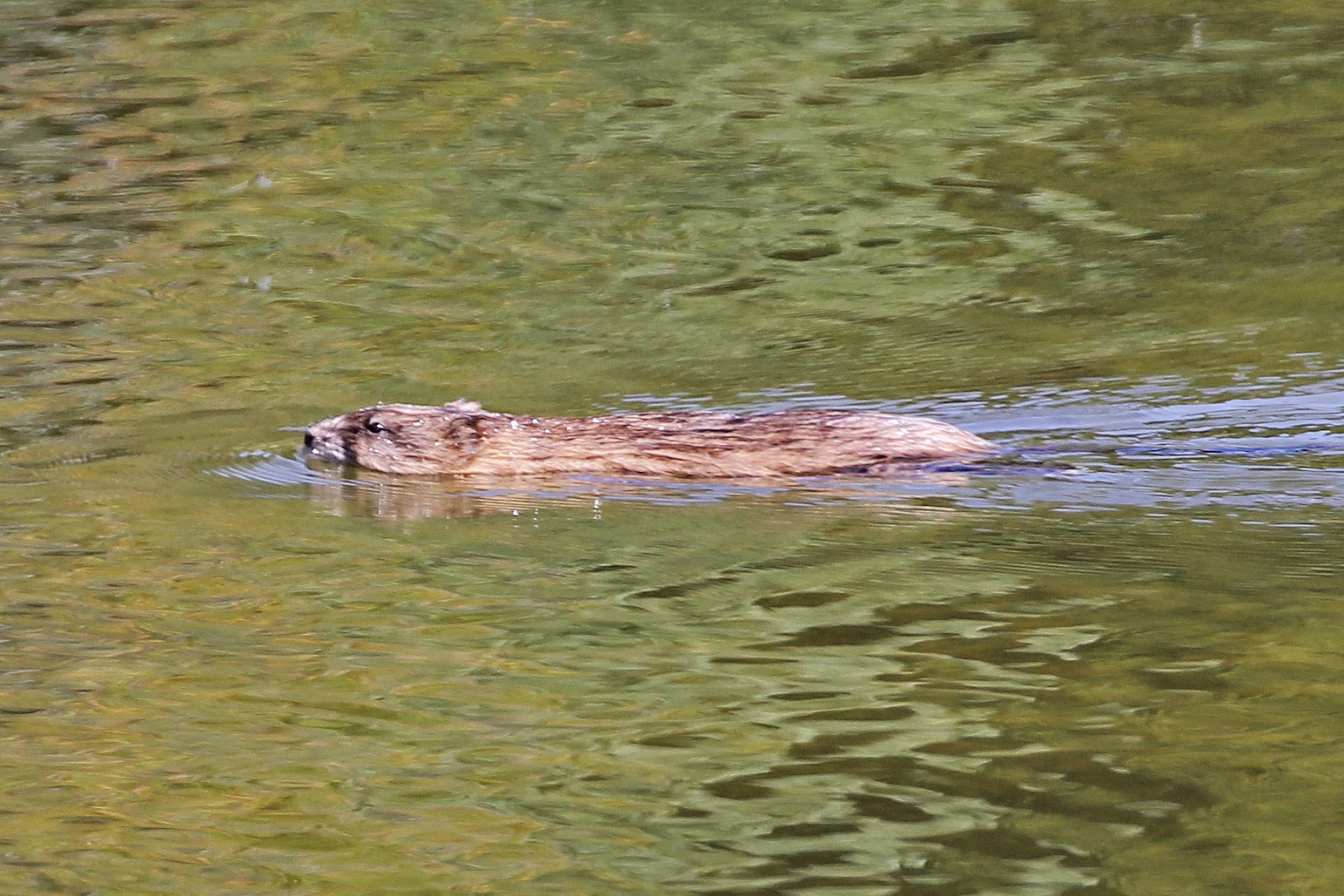
It showed several times, then Helen found one again closer in. We watched as this one swam towards the shore and came out to have a brush up, and to eat some pond weed it had brought up from the bottom.

We still were not sure what it was, but it gave some lovely views. Then another appeared from the dead tree again, and swam across the lake before diving and showing a black, but round tail, they were Musk Rats.

They will forever be know as Susie and Sam
We continued the drive around the lake, stopping to watch more Goldeneye, but this time with Ring-necked Ducks and Redheads.
we stopped at place where we could walk out onto a spit that stretched out into the lake. On the shore line of the spit we disturbed three Spotted Sandpipers, they all seemed to be young birds.

A little closer in and accessible were a family of Lesser Scaup.

Once again some lovely views out across the lake on a beautiful, clear and warm sunny day.

After Lunch at the Lake Lodge we headed north towards Canyon. This route takes you through the Hayden Valley, a wide glacial valley that at its heart the Yellowstone River meanders gently through.

The Hayden Valley is one of two prime spots for watching the larger wildlife of Yellowstone, and was created by a former lake bed that was formed in the last ice age. The fine silt and clay of the former lake bed prevents water from percolating into the ground preventing trees growing, but supporting the shrubs and grasses favoured by Bison
At first we came across a small group of Bison, but quite close to the side of the road.

They seemed unconcerned by the on lookers in the parked cars that built up.

As well as the small herds there were single male Bison choosing to be alone.

Further on though the road goes up the side of the valley, which widens out into a vast open meadow. From the turn out point there were lovely views across the meadows below, and a large herd of Bison.

This was what we had come to see, and as we watched them grazing and wading through the water, it was hard not to think how incredibly impressive the huge herds that used to roam this area must have looked like.

The American Bison are the largest terrestrial animals in
North . They are nomadic grazers and
travel in herds. The bulls leave the herds of females at two or three
years of age, and join a male herd, which are generally smaller than female
herds, the mature bulls rarely travel alone, single bulls seen are usually old.

Bison are good swimmers and can cross rivers over half a
mile wide. As we watched several males were following females around with only one thing on their mind.

The breeding season staring in the late summer, the bulls were keen to follow the many females

As we sat watching the Bison below us in the meadow the rain started to fall, it seemed like it would only be a shower, but as a result we decided to leave and head north into the Canyon country. A little further along though we stopped again by the side of the river, four swans was the reason, but these were not just any old Swans, these were Trumpeter Swans, and a new bird for me.

This is the largest living bird native to North America. Closely related to the Whooper Swan, the numbers of this swan are of concern. There are only currently two breeding pairs in Yellowstone, and up to ten non-breeding individuals. There is an ongoing programme to augment the swan population in the park.
Adult birds have dark black legs

While the sub adults retain the yellowy orange colour of the legs, although leucystic (white) birds retain the yellow colour into adulthood. I am not sure exactly what this bird is.

The traffic and the people now were beginning to get to us, The road continued on to the Canyon Junction at the head of the Yellowstone Canyon, all the major areas though were swamped with cars, and there were tail backs in many places. Mid afternoon is not the best time for wildlife watching, and with all the scenic places now full of people we decided to head back to West Yellowstone. We did though pull over along side the Madison River once again just before we left the park. There was nothing much to see though, other than a beautiful view that is.

Back in West Yellowstone we regrouped, and prepared for dinner and an early start the next day, when we were intending to make a big effort to cover the north eastern side of the park, in the hope of finding some of the enigmatic species the park is well known for.


