After what would be probably one of many early nights we
were up early in the morning. The dark clouds of last night's
thunderstorms had given way to white clouds and sunshine. Looking
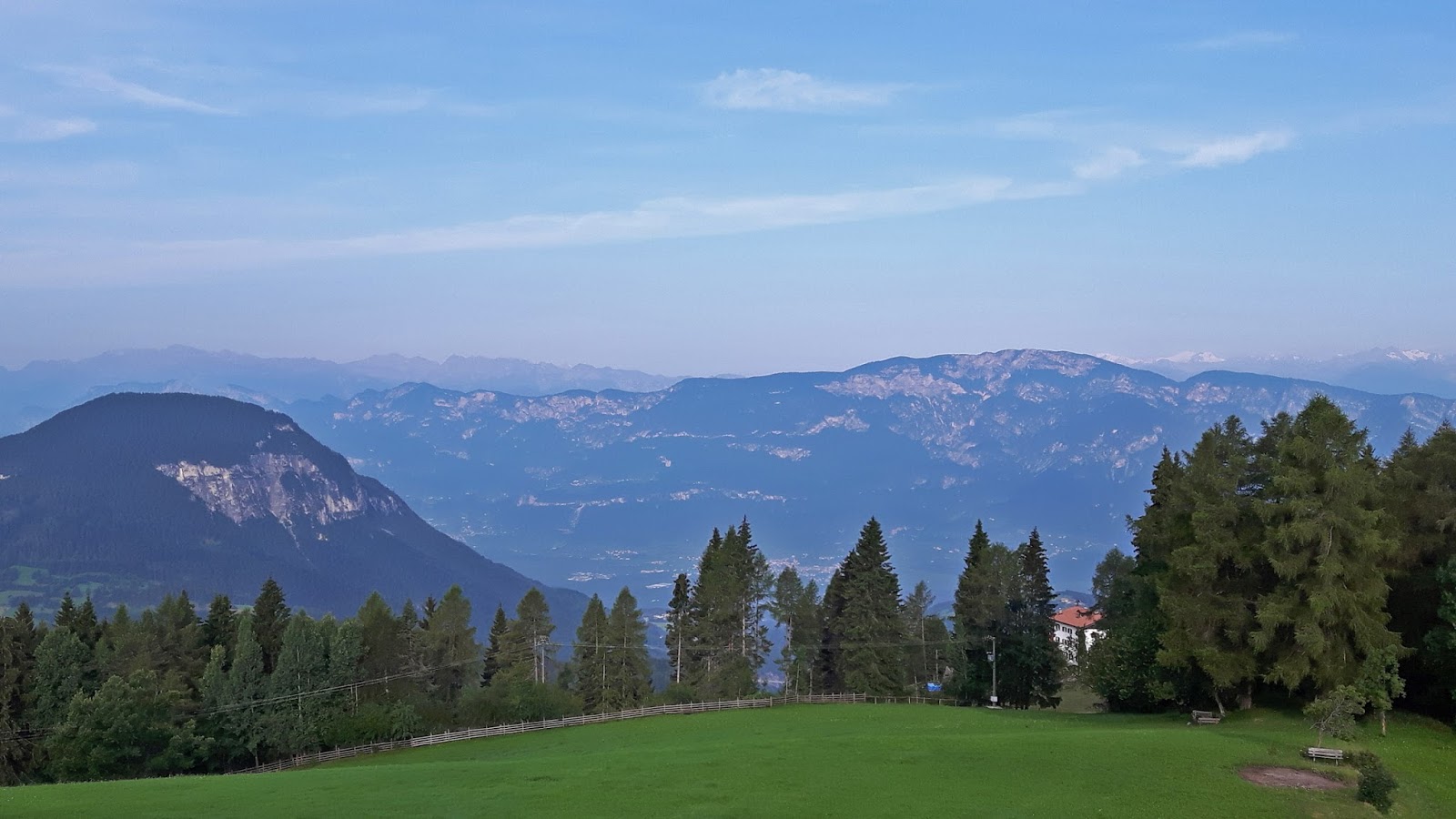
across from the hotel room out towards the mountain range the view was once
again stunning.

Before breakfast I spent some time photographing the House
Martins and Swallows that were flying around the hotel, once again the House
Martins high up.
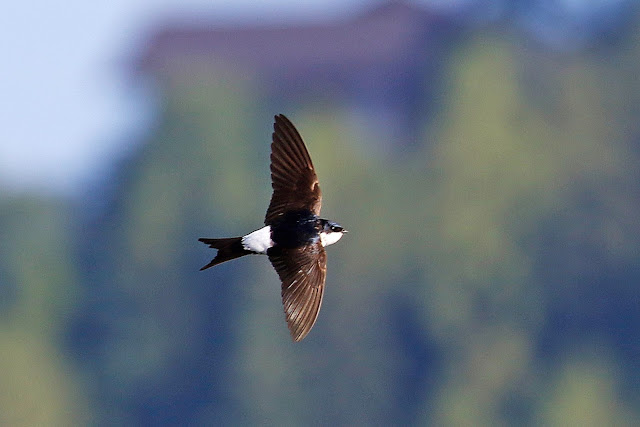
And against the backdrop of the mountains.

While the Swallows maintained their feeding strategy low over the meadows.

And against the backdrop of the mountains.

While the Swallows maintained their feeding strategy low over the meadows.

We set of for today's walk from the same point as yesterday,
but took a different path that took us past the cow sheds. One
Highland Cow had a little teddy bear with her.

Along the path a Black Redstart flitted from post to post,
it's red tail shimmering as it sat on the fence. It was carrying food and was feeding juvenile birds just fledged that were also in the area.

Initially the path edged along the side of a pine forest, and at a clearing a young Song Thrush waited patiently on the fence.

Initially the path edged along the side of a pine forest, and at a clearing a young Song Thrush waited patiently on the fence.

While the parent foraged in the grass of the meadow, presumably to feed it

On the other side to the Pine trees there were views across the open meadow towards the peak of the Weisshorn.

The moon too was visible still quite high in the sky.

The path then took us through pine and larch trees once again, and we could hear both Coal Tits and Goldcrests in the trees. One the edge of the forest we were able finally to see them in the trees. Coal Tits, Chaffinches and Goldcrests, young birds learning the important skills of catching insects in the conifers.


The path then took us through pine and larch trees once again, and we could hear both Coal Tits and Goldcrests in the trees. One the edge of the forest we were able finally to see them in the trees. Coal Tits, Chaffinches and Goldcrests, young birds learning the important skills of catching insects in the conifers.

The path then wound its way down through the forest once
again, with more orchids to see, but like yesterday they were all Common Spotted Orchids. Here the grass provided sparkles of rain drops showing as bright circles in the background

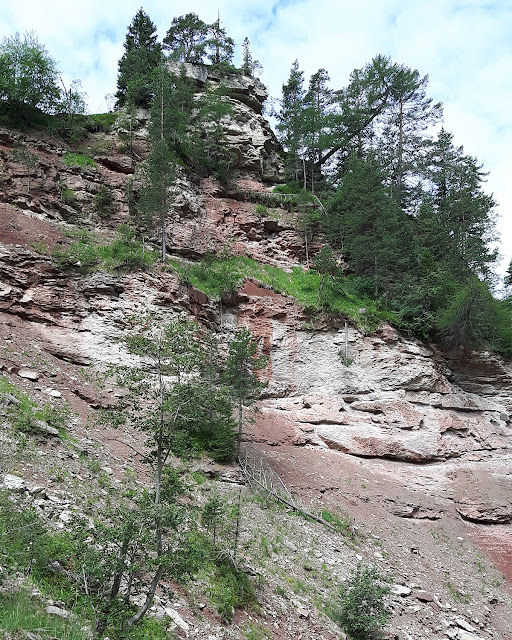
The path then started to become a little steeper and bending as we made our way into the canyon. The path then became steps which were quite steep in places and we couldn't help thinking about the fact that we would have to climb back out of here. Finally we reached the canyon floor. Looking up the sides of the canyon varied in the Reds and yellows of the rocks, the sandstones and limestone, dominating the walls of the canyon and a small stream running along the bottom. As always it is hard to fathom that this amazing geological structure has been entirely created by the power of the water over millions of years.

Initially created by volcanic eruptions over 275 million years ago, this is the regions only large canyon. The canyon is formed by three rock stratas, porphyry, which is unique here to the Alps, sandstone and the Dolomitic limestone. In between there are layers of marl and clay. As a result this is a very important location for collecting fossils, and many different fossils have been discovered here, mainly in between the strata.

The path then started to become a little steeper and bending as we made our way into the canyon. The path then became steps which were quite steep in places and we couldn't help thinking about the fact that we would have to climb back out of here. Finally we reached the canyon floor. Looking up the sides of the canyon varied in the Reds and yellows of the rocks, the sandstones and limestone, dominating the walls of the canyon and a small stream running along the bottom. As always it is hard to fathom that this amazing geological structure has been entirely created by the power of the water over millions of years.

Initially created by volcanic eruptions over 275 million years ago, this is the regions only large canyon. The canyon is formed by three rock stratas, porphyry, which is unique here to the Alps, sandstone and the Dolomitic limestone. In between there are layers of marl and clay. As a result this is a very important location for collecting fossils, and many different fossils have been discovered here, mainly in between the strata.
Having reached the bottom we turned and walked up stream, crossing the stream as it
wound its way along the bottom of the vast canyon.

We carried on passing dry waterfalls, and some where the water trickled down from upon high above us.

In places the canyon becomes quite narrow with almost vertical walls. Finally we reached a cascade with plenty of water joining the main stream. Our Guide notes said this may be dry, but after last night's rain it was flowing well.

In places the canyon becomes quite narrow with almost vertical walls. Finally we reached a cascade with plenty of water joining the main stream. Our Guide notes said this may be dry, but after last night's rain it was flowing well.

From the waterfall we scrambled over the rocks to the other side and then walked along the
side of the canyon before dropping once again onto the floor, following the
water up stream. The canyon opened up with now more angled sides of softer sandstone showing a variation in reds and yellows.
We then came to a set of balustrades that would take us back up to the top. The steps were tough, and we took our time pausing on several occasions to watch the House Martins flying around the rock faces and up to their nests.

Another reason to pause as we climbed what was a very steep set of steps were the flowers along the way, we came across our first Fragrant Orchid.

Then a butterfly resting on the pine needles required our attention. It was in fact a Speckled Wood.


We then came to a set of balustrades that would take us back up to the top. The steps were tough, and we took our time pausing on several occasions to watch the House Martins flying around the rock faces and up to their nests.

Another reason to pause as we climbed what was a very steep set of steps were the flowers along the way, we came across our first Fragrant Orchid.

Then a butterfly resting on the pine needles required our attention. It was in fact a Speckled Wood.

When we reached the view point over the Bletterbach
waterfall we took off the ruck sacks and rested to enjoy the views. The source of the water that created the canyon was now in full view.

As we sat and recharged we were joined by butterflies and several lizards warming up on the dead tree stumps and branches. This was a Common Lizard, or Viviparous Lizard

Then another emerged, slightly larger and well patterned. This I think is an Ocellated Lizard which is a species of Wall Lizard.


As we sat and recharged we were joined by butterflies and several lizards warming up on the dead tree stumps and branches. This was a Common Lizard, or Viviparous Lizard

Then another emerged, slightly larger and well patterned. This I think is an Ocellated Lizard which is a species of Wall Lizard.

It then came out further, walking along the branch.

The Common Lizard though was a lot closer to us, and was occupied catching flies that would climb the stump unsuspecting it was waiting for them.


The Common Lizard though was a lot closer to us, and was occupied catching flies that would climb the stump unsuspecting it was waiting for them.

With it being on a raised stump I was able to get down to eye level and close into photograph, a dinosaur in the Bletterbach Canyon.

From the seated view point we carried on up the path, finally reaching the top, and some more wonderful views.

From here we walked on what looked like a steady and flat gravel road, heading for the visitor centre. We had views down into the canyon, from the voices drifting up to us it seemed to be now quite busy, we had been right to get there early as we had the canyon mostly to ourselves. Looking down we could see people walking along the bed of the canyon, this view a little like the Italian flag!


From the seated view point we carried on up the path, finally reaching the top, and some more wonderful views.

From here we walked on what looked like a steady and flat gravel road, heading for the visitor centre. We had views down into the canyon, from the voices drifting up to us it seemed to be now quite busy, we had been right to get there early as we had the canyon mostly to ourselves. Looking down we could see people walking along the bed of the canyon, this view a little like the Italian flag!

As we walked along the very welcome flat path there were butterflies and orchids on the way to entertain us. A rather tatty Large Wall Brown

A Wood White.

The first new butterfly today, the Yellow Spotted Ringlet


A Wood White.

The first new butterfly today, the Yellow Spotted Ringlet

And as hoped for yesterday a perfect looking Black-veined White.

Just before the visitor centre there was a small pool where several dragonflies were circling the reeds and water. A short path led down to the water edge, and we headed down there to see if we could get better views of the dragonflies. It looked like there were several Hawkers about from the way that they were hunting, they were blue and yellow , and others almost all green. As usual they never settled and I had to resort to trying to photograph in flight, which is never easy. One dragonfly did settle, and this looked like a chaser, a Four Spotted Chaser.

As well as the dragonflies there were damselflies, this Common Blue Damselfly


Just before the visitor centre there was a small pool where several dragonflies were circling the reeds and water. A short path led down to the water edge, and we headed down there to see if we could get better views of the dragonflies. It looked like there were several Hawkers about from the way that they were hunting, they were blue and yellow , and others almost all green. As usual they never settled and I had to resort to trying to photograph in flight, which is never easy. One dragonfly did settle, and this looked like a chaser, a Four Spotted Chaser.

As well as the dragonflies there were damselflies, this Common Blue Damselfly

As we made our way from the pool several butterflies turned
up. This Small Pearl-bordered Fritillary.


And the first blue butterfly, a Marzine Blue.

We walked to the visitor centre, and were very glad we had set off early this morning as the place was packed and more cars were arriving. We turned back retraced our steps and took the path just before the pond heading towards Lahneralm.

We walked to the visitor centre, and were very glad we had set off early this morning as the place was packed and more cars were arriving. We turned back retraced our steps and took the path just before the pond heading towards Lahneralm.
At the next turn we took the chance to enter a meadow which led to a cafe, after deciding not to get a drink in what was a very busy place we returned to the meadow and stopped to eat our picnics, with a view up again to the Weisshorn.


As we ate we were joined by a small blue butterfly that was very attentive, and quite happy to sit on Helen's back and shoulder, allowing me some close up views.

It was a Chalk Hill Blue, the pale blue upper wings visible when it relaxed and opened its wings to show the chequered out fringes on the wings.


It was a Chalk Hill Blue, the pale blue upper wings visible when it relaxed and opened its wings to show the chequered out fringes on the wings.

Finally it decided that it should really take advantage of the clover flowers in the short grass.

As we lefty the meadow at Lahneralm I walked back through the grass disturbing more of these lovely blue butterflies. We resumed the walk now winding our way up through the forest. Helen found a new orchid species, this time a Frog Orchid.

From the forest trail we came out alongside some lovely meadows with some lovely lush grass that contrasted so well with the blue skies.

But looking back towards the Weisshorn the clouds were gathering once again, and looked quite threatening, another thunderstorm was on the way.

As we lefty the meadow at Lahneralm I walked back through the grass disturbing more of these lovely blue butterflies. We resumed the walk now winding our way up through the forest. Helen found a new orchid species, this time a Frog Orchid.

From the forest trail we came out alongside some lovely meadows with some lovely lush grass that contrasted so well with the blue skies.

But looking back towards the Weisshorn the clouds were gathering once again, and looked quite threatening, another thunderstorm was on the way.
The path was a tar lined road, and on either side there were
plenty of flowers and on these were several lovely Marbled Whites. As
always I can't resist photographing these lovely butterflies.

The path then reached a road, and we turned onto it heading
towards Aldein, our stop for the night. There were more Marbled
Whites about, and several whites too. By the sides of the path were plenty of flowers attracting the bees like this wild Salvia.

The guide notes described the road as "quiet" but it was quite busy, and some of the houses noted as being empty were now inhabited and looking very nice. At one stop to allow cars to pass we were fortunate to find a single Holly Blue sitting on a leaf.


The guide notes described the road as "quiet" but it was quite busy, and some of the houses noted as being empty were now inhabited and looking very nice. At one stop to allow cars to pass we were fortunate to find a single Holly Blue sitting on a leaf.

We turned off the road and headed down a grass track with
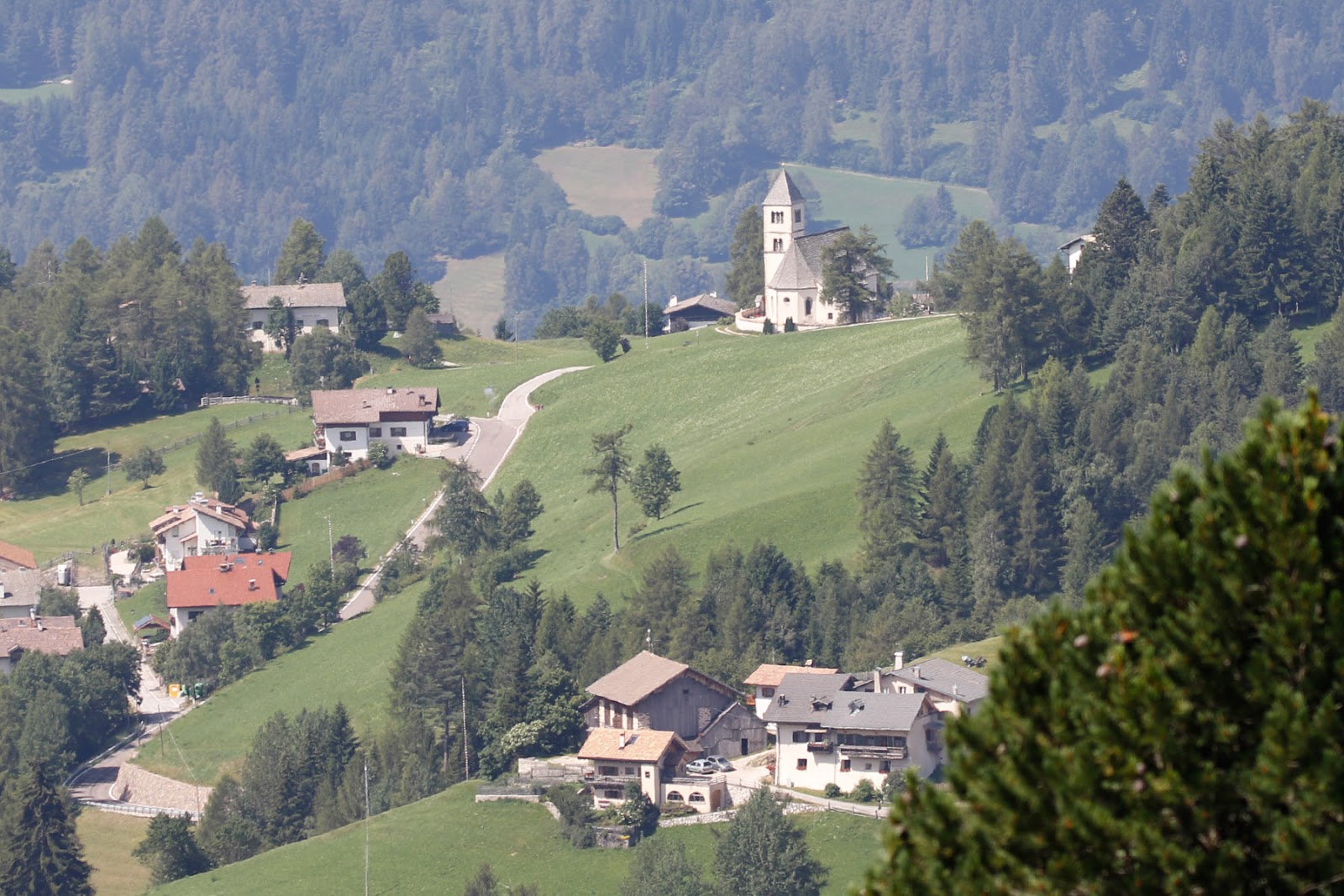
some lovely views of Aldein, the church as always in this region the focal
point for all to see.

The track was steep and in places muddy probably as a result
of the recent rain storms.
The track then became a stream and we negotiated the mud and
water by stepping on the stones. At the bottom we turned onto yet
another road and headed into Aldein. It was now hot, and despite the
dark clouds away behind us the sun continued to shine, and any shade was
welcome as we made our way to the church.
To get to the hotel we had to take a road that ran alongside
the church, uphill, and this was not that easy after the exertions of climbing
out of the canyon. However we finally made it and were able to relax
on our balcony as yet another thunderstorm clattered away around us.
Dinner was again very nice, four courses although perhaps a
little more German this time and local. Overnight we were treated to
the church clock chimining on the quarter, and in style on the hour. There
was no need to check clocks or watches. Then at 6.45 continual ringing with the call to Mass. It was still quite warm so necessary to have windows open, as a result it was a difficult night's sleep with the church being right next door to the hotel.