A weekend away in Somerset was a welcome change. The plan was to go direct to Ham Wall and then walk to the Avalon Visitor Centre where there was a cafe. However as we set off from the car park the clouds moved in and it started to rain. The radar app showed the rain was going to be around for sometime, so we decided to abort that plan and head to the Outlets for some lunch and shopping. By about 13:30 the skies were clearing and the forecast for the remainder of the afternoon and early evening was very positive, clear skies and plenty of sunshine. As a result we headed back to the RSPB car park, this time only intending to spend the time on the RSPB reserve.
We set off along the old railway line that is now a gravel track and in the warm November sunshine there were plenty or Red Admiral still around even if one or two were looking decidedly worn.
Some though were looking very smart despite the late season.
At the first viewing point there were at least four Mars Harriers over the reeds and the open water.
The track runs east to west and has several benches that look either north or south over the marshes. These benches were in the full sun and were a magnet for the Common Darter dragonflies. Here two male Common Darters.
A close up of the head and compound eyes, you can in fact see the multiple eyes that make up the compound.
The duller looking female.
Another butterfly to be seen in November, a Speckled Wood.
We walked the path to the second and last viewing point and again there were Marsh Harriers quartering over the open water and reed bed. The Harriers were almost everywhere you looked. This a male, which seemed reluctant to come too close to the path.
The females, or immature birds would pass quite close and give some lovely views.
Looking south across the reed bed the back lit reeds looked very spectacular.
Having reached the edge of the reserve we decided to walk back as the paths around the lakes were flooded and very muddy. All the way along the path where there was Ivy there were Red Admiral, it was quite bizarre to have so many butterflies about at this time of year.
Back at the first viewing point a crowd was beginning to gather, I had dismissed the possibility of a Starling show, thinking it was maybe too early, but apparently they have arrived and in huge numbers already, so we decided to stick around and see what would transpire.
On the islands in the open water a Great Egret was in amongst the duck preening.
There were plenty of Marsh Harrier to be seen over the reed bed so it was nice when there was the variety of a male Sparrowhawk that came over the view point.
It was a male Sparrowhawk despite the fact that one watched claimed it to be a Peregrine because it was white underneath.
No doubt it was here waiting for the same event we were.
The view with forty minutes to go until sunset.
Then one of the watchers picked up a Kingfisher that had flown onto one of the platforms in front of us. Unfortunately it is a little distant but the Kingfisher showed well.
It was then an exit left.
I expect the Marsh Harriers were also awaiting the starling event, and they were interacting with each other over the marsh.
The sun was heading down and the colour in the clouds and the trees was changing.
Reflections in the water
Then small groups started to appear and for once on a visit here they seemed to be preferring the area to the north of the main path.
The Great Egret then decided to fly across in front of us, the light not that brilliant now so a little grainy.
It flew to the bench where the Kingfisher had been earlier.
Once upon a time this was the bird you came to see on the Somerset Levels, not they are very widespread across the southern counties.
The numbers of Starling was increasing and the show was beginning to start.
Drifting in over the reeds, the setting sun turning the background a sultry pink.
There was also some shapes being created in the air as can be seen from this video.
They were heading for the reeds to the right of us and were quickly pouring in, being joined all the time by others from all points of the compass.
Watching with binoculars I could see at least two Sparrowhawks hunting in amongst the reeds, the Starlings coming back out as the birds of prey attacked.
With all the starlings heading into the reeds and out of sight we were beginning to think we were not going to get a show.
But groups kept on arriving.
A close up of the flocks.
Then for some unknown reason they poured out of the reeds and headed for the centre of the reed bed in front of us.
And the Marsh Harriers followed them, looking for any opportunity.
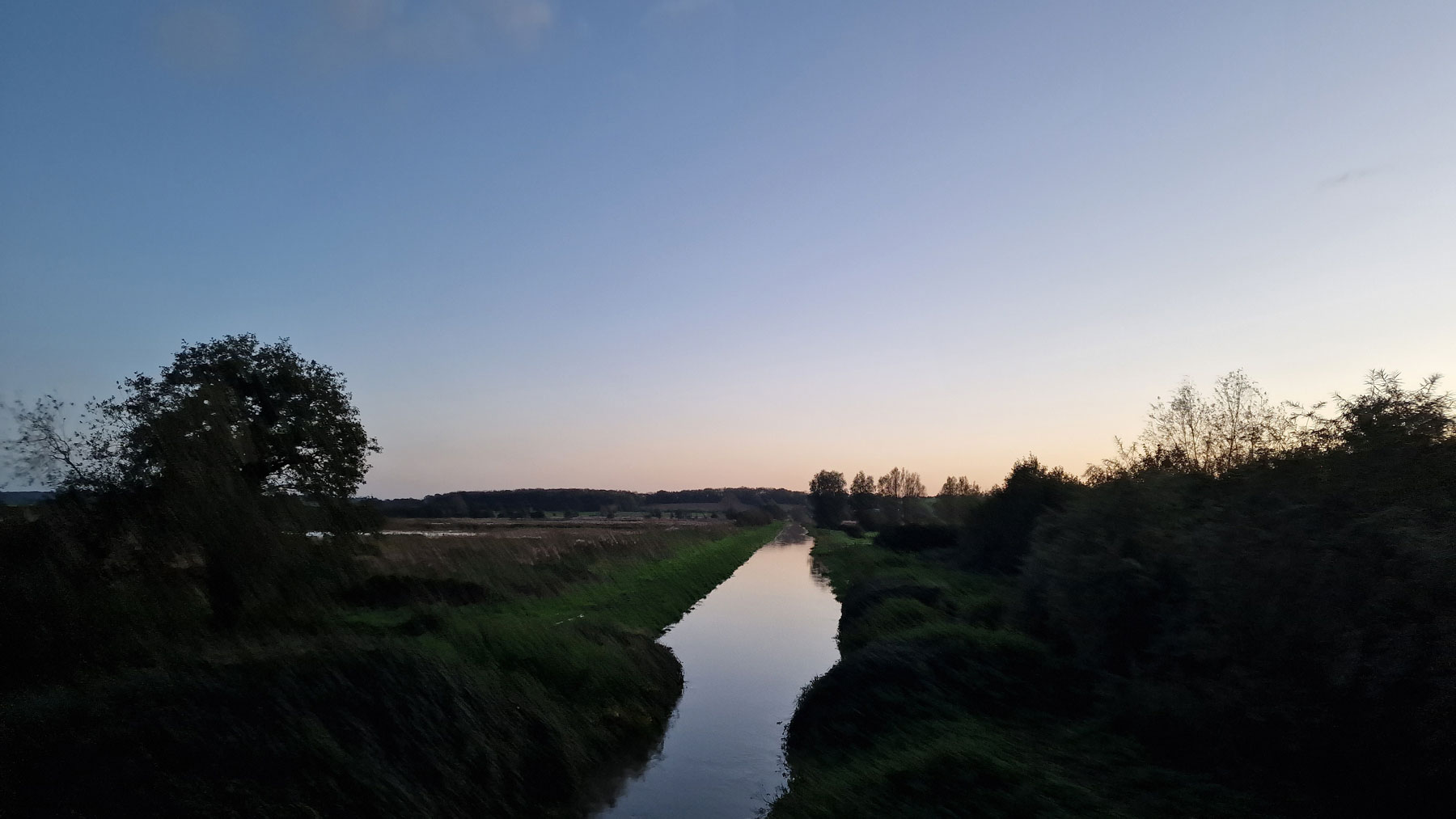
It was now quite dark but the stragglers were still coming in and joining the others in the middle of the reed bed. With the second movement earlier we knew it was now over. Heading back to the car park one moor look to the south over one of the canals
A day that started with rain and possible disappointment, produced some wonderful scenes. Great to see the Starlings once again.
After the climb of Glastonbury Tor on Friday and the views across the Somerset Levels it was down on to the Levels the next day. Parking in the RSPB Ham Wall car park we were greeted by a male Pied Wagtail, inspecting the puddles. At this time of year thoughts go to White Wagtails, but not this bird.
From the car park we walked along the main path heading west towards Shapwick Heath following the South Drain. A Great Egret surprised us as it flew low over our heads and then dropped into the reeds on the other side, there were also several distant birds on the far side of Noah's Lake.
The great expanse of water that is Noah's Lake didn't have the quantity of duck that were present back in January. The same species were present but in much reduced numbers. In January there was the continual whistles of Wigeon, but today there was hardly any calls at all other than the squeak of a Moorhen, or the call of a Little Grebe to its mate.
On a pool close to the path there were several Pochard drakes, scanning the water there was no sign of any females.
We walked all the way to the road that crosses the heath and then turned to the left and headed towards the Canada Farm area. Walking down the track towards the hide there was a Great Spotted Woodpecker and lots of Redwings in the birch trees. In the hide it was very quiet, hardly any duck on the water. At the back of the lake a Marsh Harrier twisted and banked over the trees.
The area is also a large expanse of reeds which contrast with the darkness of the trees and steely blue grey of the water.
The clouds were beginning to break up and the sun was coming through and while there was little on the water to interest us, the clouds and sun above the water once again lended itself beautifully to the black and white photography.
Leaving the hide we walked back along the track to the road. Siskins were feeding in the alder alongside the track and caught this Blue Tit using the many twigs and branches to get a drink from a very dirty muddy pool
Further along we disturbed many Fieldfare from the trees, while some were feeding in the adjacent field.
We walked back to the bridge that takes the road across the South Drain, with the sun now out the scene looked quite dramatic once again looking towards the Calcott Lows area of the Avalon Marshes
After a coffee in the visitor centre we made our way back towards Ham Wall, the clouds and sun above Noah's Lake produced a quite dramatic landscape, once again in black and white to increase the impact.
The reeds as well glowing in the sunshine against the dark background of the distant trees.
A Little Egret for a change on the open water in front of the elevated hide, with Wigeon and Gadwall in the foreground.
We carried the walk along the South Drain and made our way to the first viewing platform on the Ham Wall reserve. Once again the number of duck on the open water was much reduced compared to our visit in January. On the pool on the other side from the viewing platform there was a pair of Great Crested Grebes building a nest together. I watched and waited in the hope that they would enter into a display, but they were more concerned with nest building. Where the reeds had been cut there was a good number of Snipe.
From the viewing platform a female Marsh Harrier drifted across the reeds before dropping down out of view.
A male then appeared and slowly made its way from the back of the reeds and then above us quite high.
The female then reappeared over the reeds and used the wind to travel quite quickly across the top of the reeds.
A pair of Stonechat were in the bramble bushes just in front of the platform.
Having decided to leave I just caught sight of the grebes now displaying, unfortunately too far away and just as they were finishing.
We headed back to Litton, where there was still some time to walk around the Litton Reservoirs, these are two reservoirs owned and operated by Bristol Water that can be found close to The Litton where we were staying.
The individual lakes are called Lower Litton and
Upper Litton. The former is 8 acres in size with a shallow area and plenty of
weed, the latter 16 acres and is much deeper than its sister lake and very
different in character. Long and narrow with steep sides, and is fed by the River Chew which flows in at the top end. They were built around 1850 by the Bristol Waterworks to
bring water from the Mendip Hills to Bristol.
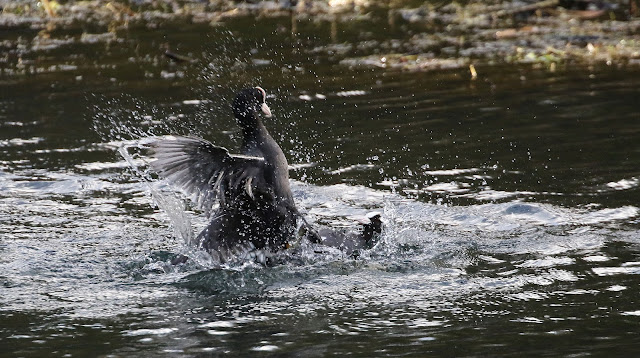
We walked from the car park and then followed the footpath that goes around the Upper Litton north bank. The water was quiet but as we walked close to the bank we disturbed Mallard and Coot and this seemed to spark a territory dispute in the Coot. All of a sudden there was splashing and below us a pair of Coot were engaged in a very fierce fight.
The fighting is over territory and not necessarily the female, if another bird enters into another's territory the first threat is swimming towards each other with the wings arched above the back, making both birds look bigger than they actually are. Sometimes this succeeds in diffusing the situation and both birds back off. However if it doesn't the next action involves one bird flying at the other like a black rocket, their neck stretched out and their feet
pattering on the water.
When that doesn't deter the intruder and fierce battle is the final recourse and this was what we were now witnmessing
Water going everywhere and wings beating as a black mass twisted and turned on the surface of the water.
Each
combatant leans right back, resting on the water with its wings, and attacks
with its green legs and feet. It may try to grasp its opponent’s breast with
one foot, and strike with the other. It will also try to get on top of its
enemy and push it under water.
Feet were flying and both individuals were aiming pecks at the head of its opponent.
Finally one gave way and swam off, with the winner and its mate chasing after it to ensure it got the message. Some fights involve three birds, with the mate of one of
them joining in. The fight can also be to the death and an unlucky coot is sometimes found dead, either savaged or
drowned, at the lake’s edge.
Leaving the Upper Litton we walked down to the lower Litton reservoir, where it was much calmer, up to eight Little Grebe were seen at one time.
Walking around the bottom of the lower reservoir we disturbed several Teal from the run off stream.
The view from the bottom of the lower Litton, looking up to the dam of the Upper Litton.
We then decided to make our way back to the dam and back along the Upper Litton path. This was extremely narrow and very muddy in places. This made it very difficult walking and sometimes in places quite a challenge not to slip down the bank. Finally we reached the main dam and was able to re-trace the path back around the top of the reservoir. The Coot were all quiet as we passed.