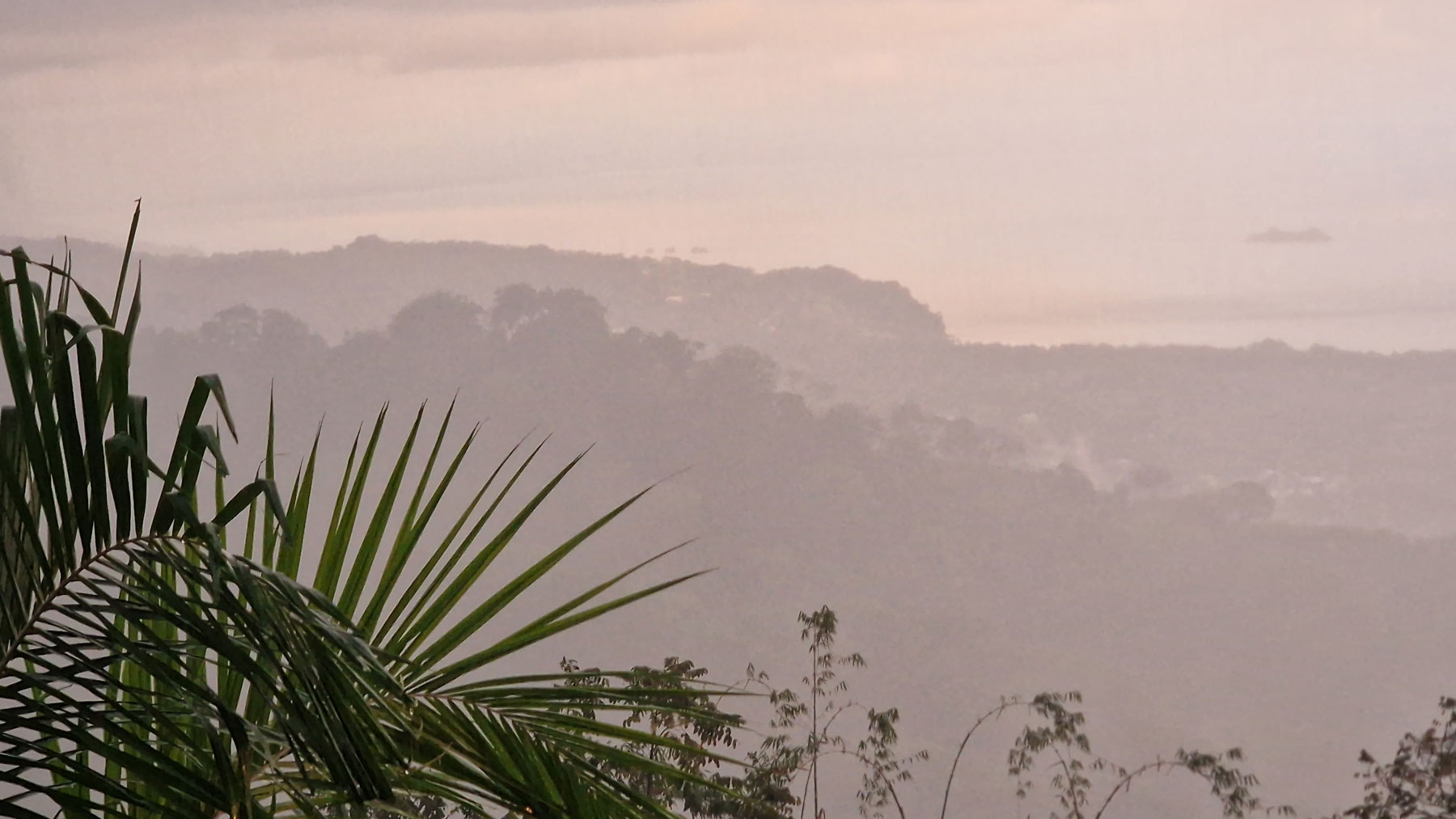
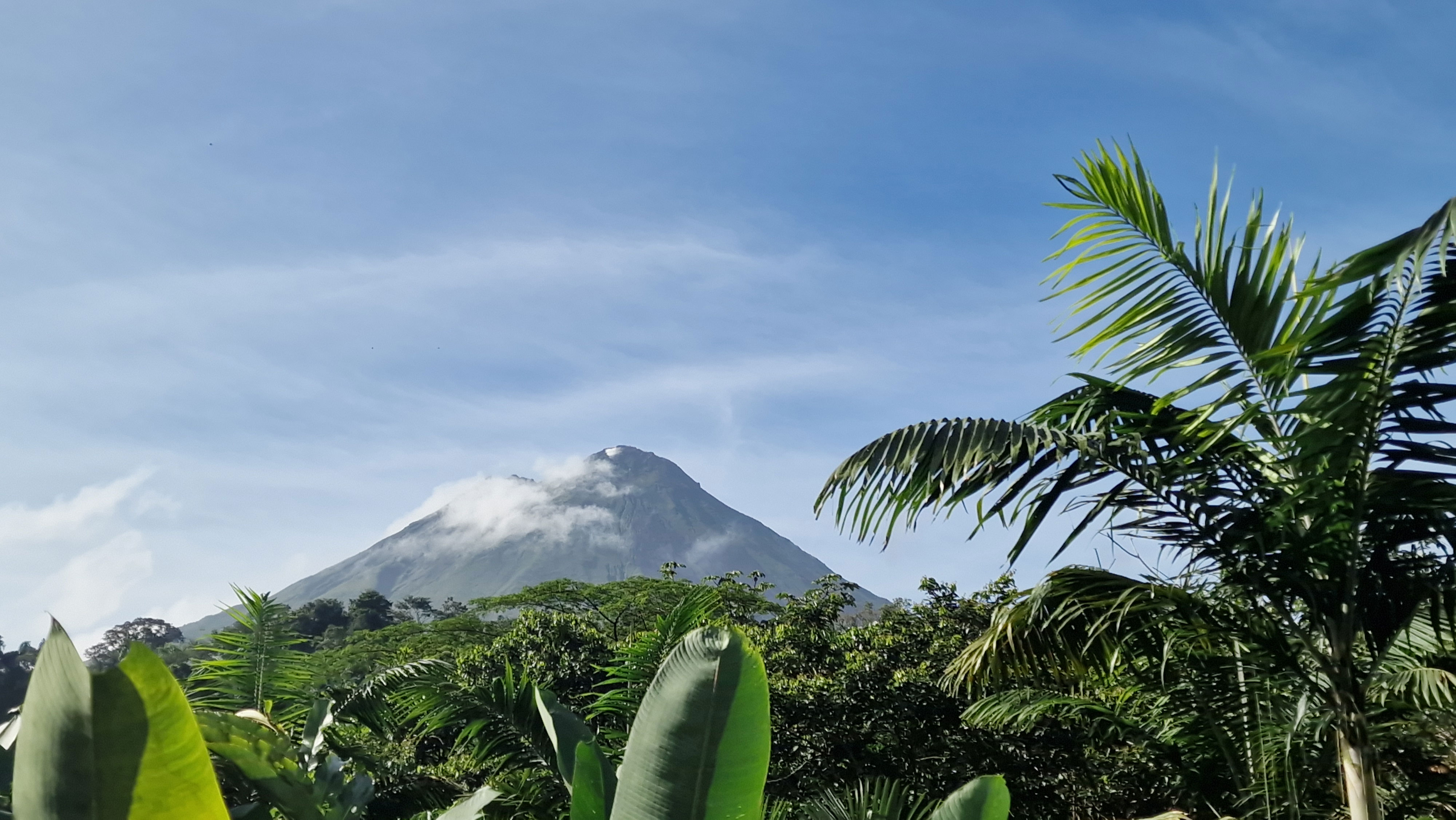
There was overnight rain for our first night here in La Fortuna, but this had stopped in time for breakfast and as we sat outside having breakfast the clouds began to move away from the volcano. There are many people who come to this area and never see the volcano.
A close up of the cone and crater, and despite what an American said on a nearby table that is most definitely not snow at the top!
We spent the morning walking around La Fortuna's central area where there were souvenir shops and plenty of restaurants and coffee shops.
In the centre was a small park, and like all the rooms in the hotels there was always a view of the volcano.
There were Social Flycatchers and Blue-grey Tanager in the trees around the park and as we waited for our pick up back to the hotel, a Bat Falcon was chasing Northern Rough-winged Swallows.
We spent the afternoon on our private patio and read both on the chairs and in the plunge pool. The Volcano view would constantly change from being completely obscured to this phenomenon, the clouds have wrapped around the volcano, almost like covering it with cotton wool.
In the late afternoon the clouds came back and with it more rain.
The following day I had organised a trip out with a guide on a private tour. I had hoped we would be going to the Arenal Bird Observatory and this proved to be the case. We left at 5.30am and drove around the volcano. We disturbed a Common Pauraque, a type of Nightjar and one of the commonest nightjars in Costa Rica.
Once in the Observatory we headed to another balcony that overlooked gardens of verbena and trees and with a platform with pieces of watermelon speared on to it. Looking to our north there were views across Lake Arenal that looked spectacular as the sun rose.
As ever the volcano was in front of us, but this morning was shrouded in cloud.
As the light became brighter the tanagers started to appear to feed on the water melon. This an Emerald Tanager.
A Yellow-throated Toucan.
I normally don't like photographing the birds on the feeders, but this was a wonderful way to appreciate the colourful tanagers, That said this is a rather dull looking Palm Tanager.
Male Silver-throated Tanager.
Golden-hooded Tanager in a more natural setting.
A small troop of Spider Monkeys moved through the trees, this youngster giving the best views as it lingered in an opening.
No feeders here at Arenal the hummingbirds zipping around the flowers in the gardens. This is a Rufous-tailed Hummingbird.
Back to the watermelon and a male Green Honeycreeper.
Amazon or Red-lored Parrots in the distant trees.
We left the balcony and walked around the gardens, tucked under the canopy of a small tree this Scaly-breasted Hummingbird was singing.
As appears to be the way with small birds, this hummingbird was able to deliver quite a loud song.
Going unnoticed was a Broad-winged Hawk sitting on a post in the middle of the garden.
A Rufous-tailed Hummingbird sat on the top of a verbena bush.
We moved to a set of trees where there were quite a few tanagers, Blue-grey, Palm and Silver-throated were seen but not photographed. This Crested Guan was a little easier.
Yellow-throated Toucans were calling in the trees.
The toucans then came into the trees to feast on the berries.
As you walked around the gardens there were birds everywhere. Ahead of us an Amazon Parrot in a dead tree stump.
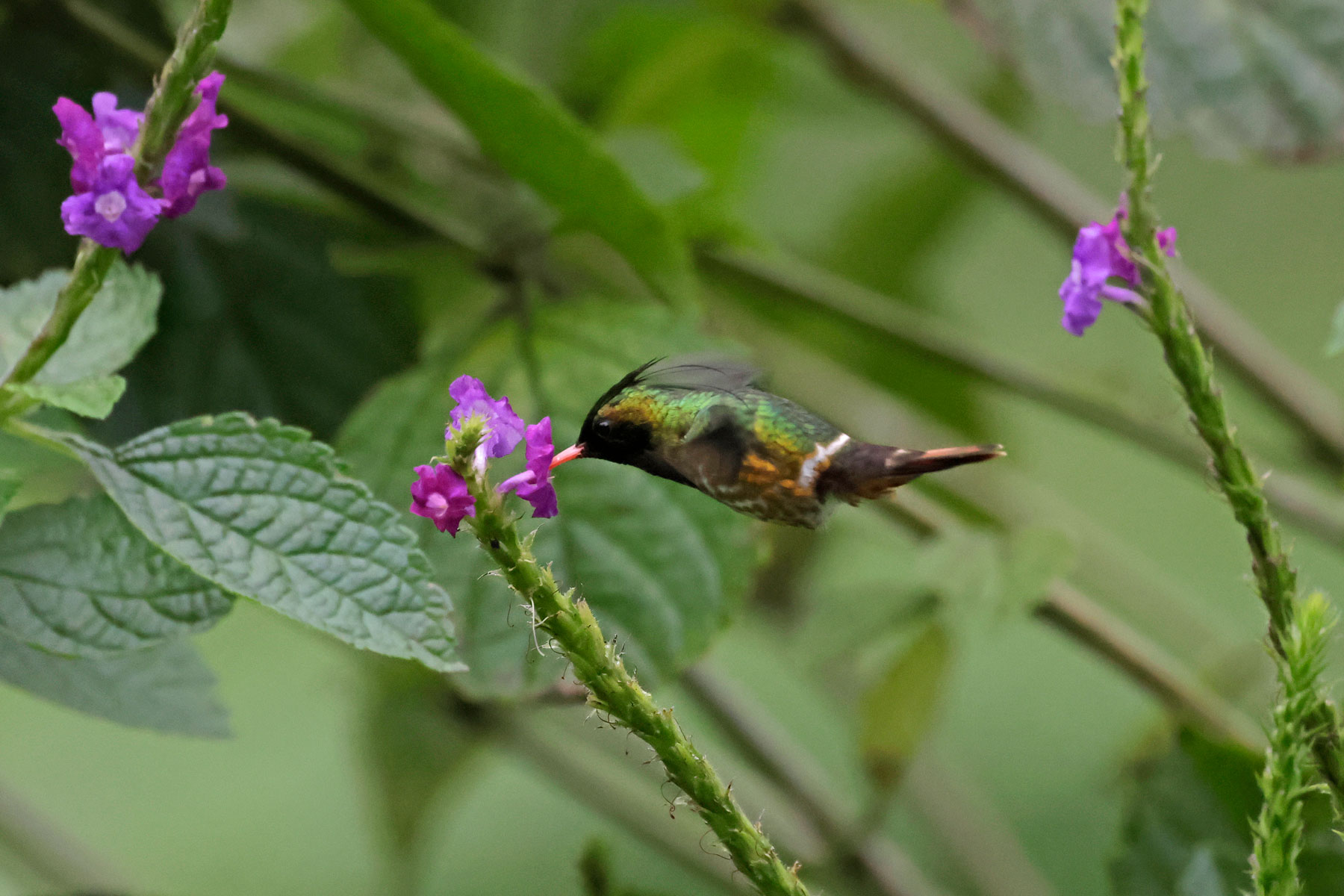
Violet-headed Hummingbirds were feeding on the verbena, but in between them I found a Black-crested Coquette.
Our guide then set up his scope looking down into the dead leaves at the base of a bush. he told us it wasn't a bird but we might be interested in what was there. As I looked through the scope it took awhile to work out what it was, but suddenly I realised, a snake.
We were then told it was a Jumping Pit Viper, a highly venomous snake. The species is endemic to Costa Rica. They can usually be found in fallen leaves, between tree roots and in the
dens of other animals. It has a broad body and head reminiscent of some North
American rattlesnakes. The maximum length is around two feet but with a substantial girth.
Contrary to what the name implies, jumping pit vipers cannot
jettison themselves at invaders, but instead attack as any viper would: with a
quick strike most commonly at ankle or calf height.
Back to the birds and another nice Rufous-tailed Hummingbird.
We set off on one of the trails through the forest feeling quite wary of the undergrowth and dead leaves. As we passed by a tall tree I heard a lot of scrabbling in the bushes and looking up something was climbing the tree, as it cleared the scrub, we could see a light coloured furry body, going higher it had what looked like dungarees on, it was the Lesser or Collared Anteater.
Known in Costa Rica as the Northern Tamandua, the Lesser Anteater is a tree-dwelling creature that nimbly
navigates branches using its prehensile tail. Their bodies are covered with
gold or tan and black fur similar to a panda and they can weigh up to 18
pounds. Enormous front claws help the lesser anteater scale trees; they have an
extra long claw on the third toe used for digging and defence. They use their
prehensile tails for balance in the treetops and as an anchor when they go into
a defensive position. The lesser anteater is primarily nocturnal and spends
around 40% of its time in trees. Ungainly on the ground, it is not capable of
the gallop of its larger relative, the giant anteater.


A specially adapted mouth and tongue enable lesser anteaters
to consume up to 10,000 ants in a single day. Their long, sticky tongues have
tiny barbs designed to grasp termites and ants from nests and underground
homes. While ants, termites and larva make up the bulk of their diet, anteaters
have been known to feast on fruit and eggs as well. Guided by a powerful sense
of smell, anteaters can detect termite mounds and ant nests with ease. Avoiding
insects with painful stings or bites, the lesser anteater deftly snatches up
unsuspecting prey with its tongue, which can measure up to 16 inches! Their
mouths are tooth-free, so the animals rely on powerful stomach enzymes to
digest food.
As it climbed the tree it stopped to investigate the bark. Leaf cutter ants move down the trees carrying the leaves back to the nest and it could be that it was feeding on these.
Here is a bit of video showing what it did next.
We left the anteater and made our way to a clearing in the forest where several trees had fallen. Searching around the rotting wood was a Wood Thrush another winter visitor from North America.
Above us, our guide pointed out a male Black-crested Coquette.
A good opportunity to see the feathery crests on the head and around the cheeks.
As we made our way back to the car park we got a much better view of a Scaly-breasted Hummingbird.
As we made our way back out of the reserve the guide stopped for us and pointed out a very smart Broad-billed Motmot on the overhead wires.
This is a medium-sized forest dweller that sits motionless
on horizontal branches, or in this case wire, in the mid-story. The head and
breast is rufous-orange with black mask and breast spot. The back and belly is
green with a long tail. It is most similar to the larger Rufous Motmot; which
has a larger size and greenish chin. Often found singly or in pairs inside
forest, usually below canopy.
A little further along our guide put in some good work to flush out the lovely Rufous-tailed Jacamar.
They live in the evergreen forests, often at edges and
around adjacent clearings. They perch upright at mid-heights on vines or other
exposed perches and fly out for flying insects, especially butterflies,
dragonflies, and wasps. Note the very long, slender black bill (like a giant
hummingbird). Throat is white on male and buffy on female. Their loud shrieking
calls were how the guide knew they were there and he was able to imitate to
bring this one out. They bear a close
resemblance to kingfisher to whom they are related.
It was then back to the hotel and another afternoon on the private patio. A great day with an excellent guide. Tomorrow we are going across Lake Arenal, over the continental divide to the Pacific slope and a whole new biome at Monteverde. The trip list after today stands now at 107 and the lifers 31