Tuesday, 20 May 2014

3rd May - Minsmere, Suffolk

We decided on an early start to beat the masses that were going to descend on Minsmere over the course of the day and indeed the holiday weekend.  It was a bright sunny morning but with a cool northerly wind, but it had eased a little bit from the blast we had encountered the evening before.

When we arrived in the car park there were several cars parked already, and a few people left over from the dawn chorus walk that had taken place.  We made our way towards the Bittern Hide, a favourite place where you get a lovely view across the reed bed, while also being able to watch open water.

There were people already in the hide, and they turned out to be friendly and informative, and we would continue to bump into them throughout the day.  Looking out from the hide all that was present was a drake Gadwall, in the open water looking stunning in the early morning sunlight.


On the other side of the reeds a Mute swan was also lazily moving back and forwards, probably standing guard over a mate on a nest.  Once again the shadows and the the reflections in the stillness of the water framed a lovely scene.


It wasn't long before a Marsh Harrier was up and flying low over the tops of the reeds.  This one is a male, the grey in the wings identifying it.


The drake Gadwall was joined by another, and they swam together for awhile before they slowly drifted apart.


A group of four Red Deer wondered down the path, and they were quickly joined by Jackdaws that were looking for either food or nest material from the deer or close to them.  This one seems to be carrying mud.


The deer themselves were making most of the shelter the reed provided from the cool wind to enjoy the warmth of the sun.


As we sat there we would be disturbed every so often by a burst of song from a Cetti's Warbler.  While being very loud in song it is not always that easy to see them.  But this individual was being very obliging and came out onto a dead branch.


It is the best views I have had of one, and it soon became clear that there were two, and probably a nest as they would keep returning to the same spot, and continue to bellow out the call.


The Marsh Harriers continued to drift by, although at a distance that made it hard for the best pictures


This is a female, slightly larger than the male she also has a yellow ochre head.  The male was about as well, and came close and hovered as if to hunt.


While watching the harriers I noticed something coming fast straight at us, and lifting the binoculars I could see it was a Sparrowhawk, a large female.  She flew straight at the hide low over the reeds then just in time up and over the hide.


As you continue to scan the reeds something will suddenly pop up.  This time it was the briefest of views of a Bittern as it came out of the reed bed, and almost as quickly dropped back down.


So it was back to the Marsh Harriers and they continued to perform in front of us, gliding slowly over the top of the reeds, then twisting back, hovering and looking down into the bed, and thenn on and again to continue scanning.


Cloud was beginning to roll in, and we decided to go and get some coffee and breakfast, you are though reluctant to leave a good seat because you never know what you will miss,m but there is also the draw of the other places.

We stopped quickly to check for Adders in a site we had been told of but we couldn't find any.  One had been seen earlier, but they are very sensitive to any disturbance, and apparently the one seen was shedding skin, and this makes them even more nervous.  So it was to the cafe, that Chris Packham describes as "wonderful" and a bacon and sausage sandwich.

The Sand Martin's are back at the the colony behind what is now the dipping pool but for me will always be the original car park.  The birds were busy clearing out the nest holes, and you could watch them flying in, and kicking sand out.


We walked along the north wall, and then around the scrape.  At the first hide the gulls were dominant with their calls ringing out while they fought and displayed with each other.  This Black-headed Gull was perched close to the hide.


Scanning through the gulls I found one then two with black legs and a very battleship grey mantle.  My immediate thought was Kittiwake, but surely not here on the scrape, but they were, and there were at least 12.


They stood there ground quite fiercely with the other similar sized guklls such as Common and Black-headed


But why were they here.  The mystery was further confounded when as we left the hide and walked along the beach we could see them flying out to sea with a beak full of mud and vegetation.  They could also be seen returning with empty beaks.  Where were they going with it?  Why were they here?

Another gull that caught my eye was a partially black full hooded gull, it was black not brown with significant black in the primaries.  The full black hood would be a Mediterranean Gull, but not with black primaries, maybe it could be a hybrid of the two?


Leaving the gulls and the scrape we walked on to the sluice, where this time of year the swallows can be found, and they didn't let us down.


We walked back into the reserve and along by the reed beds.  Reed Warblers were singing almost everywhere, and one was very close to the path, and with patience we were avble to watch it, although the reeds would partially hide it as the breeze blew them about.


Leaving the scrape we turned back towards the Bittern Hide and beyond there to the Island Mere.  On the way there were several Muntjac Deer feeding either side of the path.


At the Island Mere Hide it was quiet, but over the mere there were several Swifts, the first of the year for me.  I managed to photograph one.


There were two pairs of Great Crested Grebes out on the water, and a Little Grebe close in by the reeds.


Bearded Tits could be heard pinging around the reed beds, and they could be seen briefly as they flew past.  We could hear Bitterns booming but they never showed.  Leaving the hide Cetti's Warblers sang from the reeds, and one even showed, dancing on a log in front of us.

On the grass land close to the path were a few rabbits feeding, always a cute subject I couldn't resist.


Back at the Sand Martin bank I waited and caught one just as it was emerging from the nest hole.


We walked around the the north hide where there was little activity.  As we came out of the hide both a Blackcap and a Garden Warbler was singing.  The Garden Warbler was very difficult to spot, but it is there if you look closely.


We walked along the beach again, heading to the levels where there had been a Garganey reported.  On the short grass between the gorse a Small Copper butterfly was sitting out of the cool breeze.


A little further on a Whitethroat was singing from the top of the gorse.


The swallows were still active at the sluice, but would rest on the branches close by.  Once again I was able to get quite close.


At the levels there was no sign of the Garganey, just a few Redshank and an Avocet.  I did though manage to find a male Wheatear on the dried mud.  This is a poor shot but serves as a record.


We decided to walk back to the reserve, the sun was warm if you managed to get out of the wind by sheltering amongst the gorse, something this little rabbit was doing.


As we reached the sluice and entered the reserve I noticed two large birds flying over the reed bed.  Picking them up with binoculars I could see that they were Bitterns.  They continued to fly quite high around the reeds in front of the Bittern Hide.  I do not recall seeing Bitterns in flight for as long as these two flew about.  Finally they dropped down in a location that was probably in full view of the hide.


We popped into the South Hide, I wanted the chance to photograph some of the terns, and was fortunate to find three species sitting on one of the islands.


Here we had three Little Terns, two Sandwich and four Common Terns.  The little and common terns were chased off by a Black-headed Gull, but it did not seem to want to take on the Sandwich Terns.


The whole scrape did not have that many waders present.  What there was though was in summer plumage.  This Black-tailed Godwit.


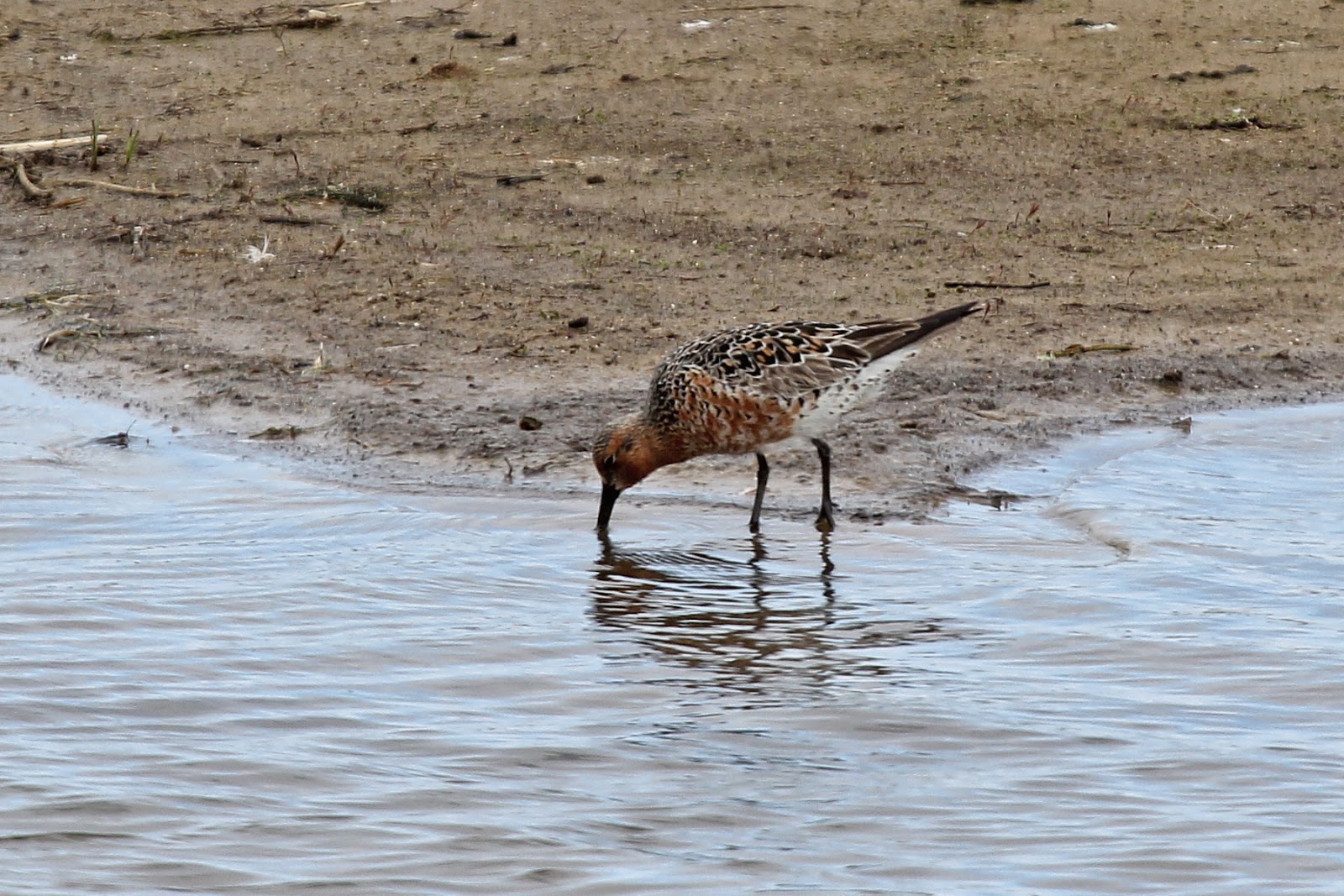
And this Knot, showing why in certain countries it is known as the Red Knot, we typically know there as grey birds.

The dominant wader was of course the Avocet, the bird that made this reserve famous.  Some can be seen on their nests while other pairs are still courting.


We left the scrape and once more walked around the reeds knowing we were heading back to the Bittern Hide.  When we got there there were a couple of spaces free so we settled down again for another watch over the vast reed bed.

First up was a male Marsh Harrier, but this time passing close to the hide, out over the open water.


We were then treated to a bit of theatre and comedy involving a Water Rail, and fortunately the Marsh Harrier was not around.  In the morning a Water Rail would every so often run from one reed bed to the other across an open piece of water.  I never managed to capture it as it would suddenly appear and race across.  This afternoon as we sat there it started again.  the rail would appear from one side.


And after a while would come straight back.


Then it came back again.


Only to shortly appear again from the same place


How did it do that?  Had it managed to get back without us seeing?  Although soon became clear when two little bundles of black feathers appeared and raced across


They were then followed by three more


The clue was there in the second photograph above, the adult rail is carrying what looks like food, so we have to assume it was feeding the young or the other adult, then when the time was right the adults have led the young to a safer place that has a good food source.  Wonderful to watch, and there were cheers in the hide when the youngsters appeared.

The drama of the rails over, somebody picked up what was thought to be Cuckoo, but there was some doubt, maybe it was a falcon.  It was very distant, and wasn't perched like a Cuckoo.


Just as I got the telescope out to have a closer look it flew, and was unmistakeably a Cuckoo.

We continued to watch the reeds, and as if on call a Bittern flew up from the reeds, and then down again, this time the picture is a little clearer.


By now the Marsh Harriers were a little more active.  Both male and female could be seen regularly hunting the reeds, checking for ducklings, voles and maybe baby Water Rails.  The male coming closest to the hide.


Away to our right as we looked out over the reeds they seemed to have a nest.  following the male one time you could see it was carrying prey, and it headed towards the area of the nest.  As it got close the female flew out to join him, and they wet through with a food pass.  The pictures aren't the best but they show the ritual that helps maintain the bond between the two.


Unfortunately it looks like a young duck or rail.


The afternoon was turning into early evening, and we were joined by a group of Red Deer that emerged from the reeds and waded through the water to the main path.


By now were debating when to leave, this is always a difficult decision because you will always wonder if you have missed something, but you have to go sometime.  This time though we were given a sign.  From the reeds came another Bittern, but this time much closer and it also did not just drop into the reeds immediately, it flew right in front of the hide.


On that we decided it was time to depart and we headed back to the car and the cottage.  Another great day at a wonderful reserve which will soon be seen by many in ways we would never dream of I am sure.

Thursday, 15 May 2014

2nd May - Lakenheath, Suffolk

This May Day Bank Holiday we were returning to Suffolk, a cottage almost on the beach at Thorpeness was our base,  We have spend several May days here, and enjoyed good weather in what is a beautiful part of the country.  The plan was an early start and an early arrival at a superb RSPB reserve at Lakenheath.  Back in the late eighties, when I was heavily into twitching and year listing, and based in Essex, this location was farmland and poplar copses famous for its Golden Orioles.  Today after the RSPB has taken over the land and returned it to a fen landscape the Poplar trees still remain, but unfortunately the Orioles are now extremely rare.  The work though put in by the RSPB to return this reserve to its natural landscape of reed beds and open water is nothing short of amazing.  Reeds planted by had now have developed into one of the largest reed beds in the UK, and with it the birds and animals that live in that environment.

Leaving the car park early we walked down the path towards New Fen with Reed and Sedge Warblers singing from the reed beds on either side of the path, and away in the distance a Cuckoo was calling.  We stopped at the watch point on New Fen and looked out across the reed beds.


Apart from this lone Mute Swan that probably had a mate on a nest nearby, there was very little to see.  In comparison the songs of the warblers rang out, and ewvery so often the low sonic boom of a bittern, deep within the reed beds.

We walked on and came across the new Mere hide built and installed this winter.  the weather was not good, the dark clouds were rolling over us, and it looked like the possibility of a rain shower so we decided to check the new hide out.

 The beauty of arriving early meant we had the hide to ourselves, and as we entered a Cormorant was fishing in the mere, the light and reflections capturing it wonderfully


We watched it fish, and catch several fish, swallowing them quickly before it decided to fly away.  Ibn its place a lone Canada Goose took up its position in the lovely light and reflection.  Again it probably had a mate on a nest nearby and was taking the chance for some relaxation before the chores of parenthood kicked in.


In general it was quiet, the weather was quite cool, not conducive to a spring montage of activity.  A pair or Reed Bunting displayed, fed and sang from within and at the top of the Reeds.  The male being the most active.


As we watched the Reed Buntings a Water Rail scuttled across between the reed beds eluding the camera, something that was going to be a familiar story over the next few days.  The Reed Bunting activity was curtailed by a Marsh Harrier that came into view above the reeds.


But then disappeared from us, drifting across the reed bed and out of sight.  The light was constantly changing as the sun came out and then in, and dark clouds brought short sharp showers.  This change in light highlighting the reflections on the reed beds.


When the showers looked like they were going to give way to sunshine we left the hide and made our way to the look out across the large reed bed.  The sun unfortunately never really came out, but as we approached the watch point we were able to find a Reed Warbler that did show long enough for some photo opportunities


In addition there was a very loud Cetti's Warbler, and this Whitethrat that perched high on a bush to deliver it's song.


We hung around scanning the reeds in the hope that there might be a Hobby come over, or indeed one of the Cranes that were known to be in the area, but it didn't happen, and we had to be content with watching the adult coots feeding there young on the edge of the reeds


We made our way back to the car park, with very little else happening.  Marsh Harries flew over, Cuckoos called and Reed warblers sang, but it was quite cold, and not conducive to spring birding.

Our next destination was to be Thetford, and a walk around the River Ouse footpaths in the hope of seeing the otters there.  Our first port of call was a coffee shop, but after that we were not able to find any otters, so we headed to the cottage in Thorpeness.

After settling in we decided to explore.  The village pub was closed until 18.00, and in the distance we could see Aldeburgh, so we decided to walk there and see what the townm had to offer.  At first it was a shingle beach walk, but this turned into a grassy surface, and with the wind on our back we made good time.


Comming into Aldeburgh, the fishing boats and gulls increased

The fishing boats looking very picturesque on the beach.


The town itself was very "Suffolk" and we found a pub that served a lovely pint od Adnams "Ghost Ship".


The journey bvack was a different story, into a cold north easterly wind,but this only pushed us to do it in quick time.  A lovely pasta meal, and an early night and we were rready for another early start and the gems of Minsmere the next day

Monday, 12 May 2014

12th April - Mirissa to Colombo, Sri Lanka

This morning we set off for our final whale watch, the final chance to find the Blue Whale.  Like the previous days it was a warm sticky start, but unlike previous days there was an air of the end of term, due to the trip coming to an end, and our Sri Lankan guides all looking forward to the new year celebrations.  At the port thing were no different, guests arrived and waited expectantly, checking the latest sightings board, and hoping for success today.  The one thing that was different, the light, there was more cloud and therefore the fishing boats around the harbour were not as bright as on previous visits.

We set off on time and headed out into an ocean swell that was also a lot stronger than the last trip.  The Whiskered Terns flew alongside as set off, and these were replaced by the White-winged Blacks and Greater crested Terns.  The sun finally put in an appearance, and changed the look of the shore as we headed on.


Once again we took position on the top of the boat, practised now in the art of balancing, but always ready with the hand to grab a rail as the boat lurched into the waves.  It was very quiet, we could see other boats going off in all angles in the search, but there was nothing.  After about an hour od sailing and seeing not even a dolphin, the look outs got a little more excited.  Away in the distance there were some fishing boats and we were heading for them.  One of the look outs asked me to guess what whale there was.  I reeled off the ones I hoped for, and the conversation went something like this 

"Blue Whale?
"No!
Sperm Whale?
"No!
"Bryde's?
"No!
Then running out of suggestions I just said "Killer?" He smiled and said "yes", and it was at that point I knew we were not going to see Blue Whale on this trip.

Killer Whales or to give them their right name Orca, occur only a handful of times in the season, they are very rare in these waters, a bit like the Sperm Whales on the first day.  But when there are Orca the Blues disappear.  I was told stories by the lookouts of them seeing Orca attack the Blues, so you can understand why.

As we approached you could see the tall dorsal fin break the water., and as we got closer it was possible to see that there appeared to be three present, two adults and what looked to be a young calf.  The calf stayed close to what must have been it's mother, while the other, with a much taller dorsal fin could have been a young male.


Boats had arrived from nowhere, and there were also a group of small fishermen with lines dashing around the whales probably in the hope there were tuna too.  We followed the Orca from a distance but some of the boats went close as you can see from these pictures


The mother and calf seemed unconcerned through by the boats, but the other whale dived and swam off.  The family pair would move through the water at a shallow depth, breaking through the waves to breathe


The dorsal fin has distinctive marks, and it was this that makes me believe there were definitely three individuals.  At one point the adult swam across in front of the boat, and you could see the white markings on the side of the whale under the water.


Then it broke the water close to the boat.


By now their patience with the smaller fishing boats who were getting very close wore thin, and they started to take longer dives to get away from them.  As a result we decided to leave them, and went in pursuit of a large pod of Spinner Dolphins.


They swim very close together in groups that make up a super pod of, in this case at least 400 plus dolphins.  This behaviour attracts the attention of the sea birds, and at last I was able to get good views of a Bridled Tern as it joined the Greater Cresteds to look for any opportunity of food being served up by the dolphins.


The dolphins were everywhere, and each little group would have a different behaviour, some just breaking the water all together, but others leaping and spinning in the air.


Wonderfully entertaining to watch they were on every side of the boat.


It is said that the reason we have such an infinity with dolphins is because their mouths always look like they are smiling, and that they are always happy.  As you watched this pod iot definitely looked like they were enjoying themselves and were having a great time.


Finally we left the dolphins, and it was back to shore, and then back to the hotel.  We would be leaving at lunch-time for the journey to Colombo where we were staying for one night before out flight back to the UK the next day.

On the way we stopped at a Turtle Hatchery.  This is supposed to be a conservation effort, but it is hard to understand why it is necessary to keep young hatchlings in concrete pools, it really was a sad experience.  Yes some of the turtles were injured, but others looked fit, and could hear the sea and were rubbing their skin on the concrete edges in an effort to get out.


Another stop was Galle and the Dutch Fort.  It was hot and we all really wanted to just move on.  We walked the walls for awhile, and looked out across the bay.  It was very colonial, and with a lot of European influence as is to be expected.  We had a drink in one of the hotels that was straight out of the British Empire, and it had some interesting photographs from the turn of the twentieth century.


It was here we said goodbye to Sampath, and then we set off to our hotel to wait for the trip to end.

A wonderful ten days in a lovely country.  My expectation was of a country like India, but it wasn't, there is definitely a difference and we enjoyed it.  The wild life was spectacular, and it was a shame the images were lost, but we both have the memories, and they cannot be taken away.  Would we come back again?  yes we would, and hopefully to see that Blue Whale.  In total we saw 112 birds with over 40 new lifers for me.  There were 6 species of whale, and some incredible animals including the beautiful Leopard, and magnificent Elephants.