The forecast for the day was awful, but as I set off from home to meet Ian it was still dry, this was soon to change as I passed under the M27 it became very wet, and as I parked at Titchfield Haven, the wind was blowing from the south West with quite a bit of rain. Ian had been there awhile, and had found a tern on a sand bank that had become exposed with the falling tide. We moved closer to find that there were in fact two Sandwich Terns present. At opening time of the reserve we made our way to the visitor centre to pick up the passes, with the weather set to be bad almost all day we were going to take refuge in the hides around the reserve, and so we set off to the Meon Shore Hide, at this time not aware that the events of the day was to take an interesting twist before it was over. Close in on the mud in front of the hide a Snipe was feeding.
Every so often it would pause to have a quick preen.
Black-tailed Godwits were spread out all over the scrape, and I counted 101, which by coincidence was the number reported on the sightings board. A Lapwing came close to the edge of the mud, again one of those birds that you just seem to accept, but has a beauty that may not be appreciated.
At this stage it wasn't raining, but the sky was threatening, and during the dry spell there was a concerted movement of House Martins and Sand Martins low over the water and out over the top of the hide towards the sea. It was a mixture of adult birds, and juveniles.
A Kingfisher then put in a very brief appearance, flying in, perching on a post, and then away all in the same time. We picked up a Ruff on the far side of the scrape, and it came ever closer joining up with a Little Stint on the east side of the scrape. Both at this stage were distant, but the Ruff came closer, moving via the islands to finally feed in front of us.
A juvenile bird, it continued to feed in front of us until it was spooked by a Sparrowhawk that flew low very close to the hide.
The rain was coming in short showers now, and in between the showers Swallows replaced the House Martins flying low across the open water.
It was then that we picked up a Stint on the far west side, and watched as it slowly made its way closer to us. We had seen two Little Stint that had been reported, and as there was only one showing at the far side of the scrape we assumed this to be the other. It moved past Black-tailed Godwits and two Common Snipe as it worked the mud with a clockwork efficiency.
The majority of the Black-tailed Godwits were first year birds with the grey winter plumage, but every so often one with fading summer plumage would come close.
It was now all eyes on the stint that was coming closer and closer giving us the opportunity of some good close views. We concentrated on the pictures, and didn't really take in the appearance of the bird, a lesson there for us all. I even took the time to video the feeding action.
We were pleased with the opportunity to get close pictures
Later that evening I received a mail to tell me that the Little Stint we thought we had, was in fact a Semipalmated Sandpiper. It had been seen later in the day and photographed and identified. Needless to say I was a little shocked, and then embarrassed by the fact we hadn't really looked properly at the bird, just spent the time photographing and assuming it was one of the Little Stints. Now when I look at the pictures I can see the difference between the two birds. Firstly there is no white mantle "V".
The upper parts appear greyer and darker, and there is a clearer cap being made by the supercillium, while a dark line extends from a much more blunter bill, back though the eye to produce a dark patch around the ear.
Checking the books, other points to look out for are the shorter primary projection, in the Semipalmated the projection is much shorter, making the Little Stint appear much more longer winged. The Little Stint has a split supercilium, where the upper supercilium forks up the side of the crown, where in the Semipalmated there is no split. As they say hind sight is 20/20 vision, and looking now with the aid of all the literature it is a lot easier, but at the time we were pleased with some good views of Little Stint! The bird continued its clockwork feeding and at one stage flew off to return to the far west bank where we had originally picked it up and it started its way back all over again. We turned our attention to the other areas, a Grey Heron being something we couldn't confuse, could we?
And even during the rain, which by now was settled in, and quite heavy, the swallows continued to fly over the water and head out to the south.
As always presenting the challenge to photograph.
A lull in the rain allowed us the chance to move to the Pumfrett Hide, but halfway there it started again, and we arrived in the hide a little damp. There were plenty of Teal all over the mere, and on both sides Black-tailed Godwits, that in the main were quite settled, but had one little episode where they were spooked and flew around the reserve before settling back on the south scrape.
One was feeding close in, and every so often would have a funny five minutes, flapping wings and dashing about.
In amongst the Godwits were two Avocet that managed to stay far enough away to avoid the camera lens. We scanned through the many eclipse Teal in the hope of finding a Garganey but without any luck. Sitting in amongst the Teal was an adult Lesser Black-backed Gull.
Despite the persistent rain we moved on to the next hide, Spurgin, where we found a distant Green Sandpiper that then disappeared, and again plenty of Teal. The hirundines continued to pass through, and with them a Swift, that flew around the reed beds in front of us for about five minutes before moving away along with the hirundines.
The Green Sandpiper then re-appeared flying across and past us in the hide to the water on the left hand side.
Here it stayed for a short while
Before flying again past us to settle on the mud to our right.
It then managed to disappear once again. We sat and watched Snipe, and continued to check the Teal, but nothing else appeared so we braved the rain once again, this time walking around to the east side of the reserve. Along the board walk a flock of Long-tailed Tits called in the willows. Checking the Suffern Hide didn't take long it was devoid of any birds apart from a single Little Egret sheltering from the rain in the reeds. We walked to the Meadow Hide, but here the birds were distant, and there was no sign of the hoped for Yellow Wagtails, despite the fact that the cattle were feeding close to the hide. Entertainment here was provided by a Marsh Harrier, that at first teased by staying distant, but then gave some good views as it followed the river.
The rain had returned to coming in pulses now, but out over the Solent there were signs that maybe the worse was over. We decided that we had had enough, and headed back to the cars. The tide was coming up once again, and the harbour was filling up. On the far side we were surprised to find a single Brent Goose.
We headed home satisfied that despite the rain we had quite a good day, needless to say it became better later, but we can't claim to have found the bird, but we did see it, and probably helped to finalise the identification. A lesson learnt here that you should always be on the look for something different, and not just accept what you think you see.
After what was a glorious August the weather changed on Friday, with much cooler conditions and a lot of rain. The rain continued overnight and into the small hours of the morning. As I headed towards Lymington there was still dampness on the roads, and with the clear skies, plenty of mist. As I pulled into the car park at the marshes the sun was trying to burn off the the mist that was hanging over the marshes.
The teasels close to the fence were covered in cobwebs, that in turn were covered with dew, and shining in the early morning light.
As the sun climbed higher the mist began to recede and the distant trees emerged.
I had met up with Ian, and we headed down the side of Fishtail Lagoon, heading for the sea wall. We stopped to scan over the pools at th back of the lagoon and immediately found two distant Little Stints. This reserve is an excellent place, but it is essential to use a Telescope as many of the birds are quite distant from the viewing points, this also makes it a challenge for photography. As we stood looking at the pools, there was a sharp shrill whistle, and we turned to see in disbelief, two Kingfishers in the elder tree quite close to us. It took a little while to realise that there was the opportunity for a photograph, and as the cameras were raised the Kingfishers were off again with another sharp whistle. We made our way to the sea wall, where the tide as already coming in despite high tide being around 13.00. Looking across Fishtail, a Cormorant sat on the island drying its wings.
Another whistle, and I turned again to see a Kingfisher on a post in the water, as I raised the camera it was off, but I did manage to capture a record as it flew away from us once again.
As the Kingfisher few away into the bushes, all that was left on the water was a Little Grebe, only a silhouette in the early morning gloom.
We walked on to get a better view of the pools where the Little Stints were. We counted at least eight Little Stint as they fed amongst the larger and bolder Dunlin.
As well as the Little Stints there were several Dunlin, a single Greenshank, two Curlew Sandpipers, and a Common Sandpiper. There were also Teal, Mallard, Gadwall, and a shoveler all in eclipse plumage. Every so often the waders would be spooked and would fly around the marsh, only to return to the same spots. As the sun came out it would highlight them.
We walked up to Keyhaven Lagoon where there were two Curlew Sandpipers and about twenty Black-tailed Godwits, but again very distant, so rather than hang around we returned back towards Fishtail. We stopped again to watch the stints, and as we did so five Knot appeared, at first settling at the back of the lagoon, but they soon were off, this time coming to rest on the small sand island.
They were clearly restless, and were off again flying over our heads and out on to the salt marsh.
Next stop was the Jetty lagoon, where we did manage to find the two Wood Sandpipers but these were at the back and would move behind both the little grass islands, and the Canada Geese making it impossible to get a credible photograph. There were several Black-tailed Godwits and a single Curlew Sandpiper that showed well.
As we stood watching the waders large skeins of Canad Geese were strung out across the sea heading for the lagoon. We watched them as they came in low skidding across the water.
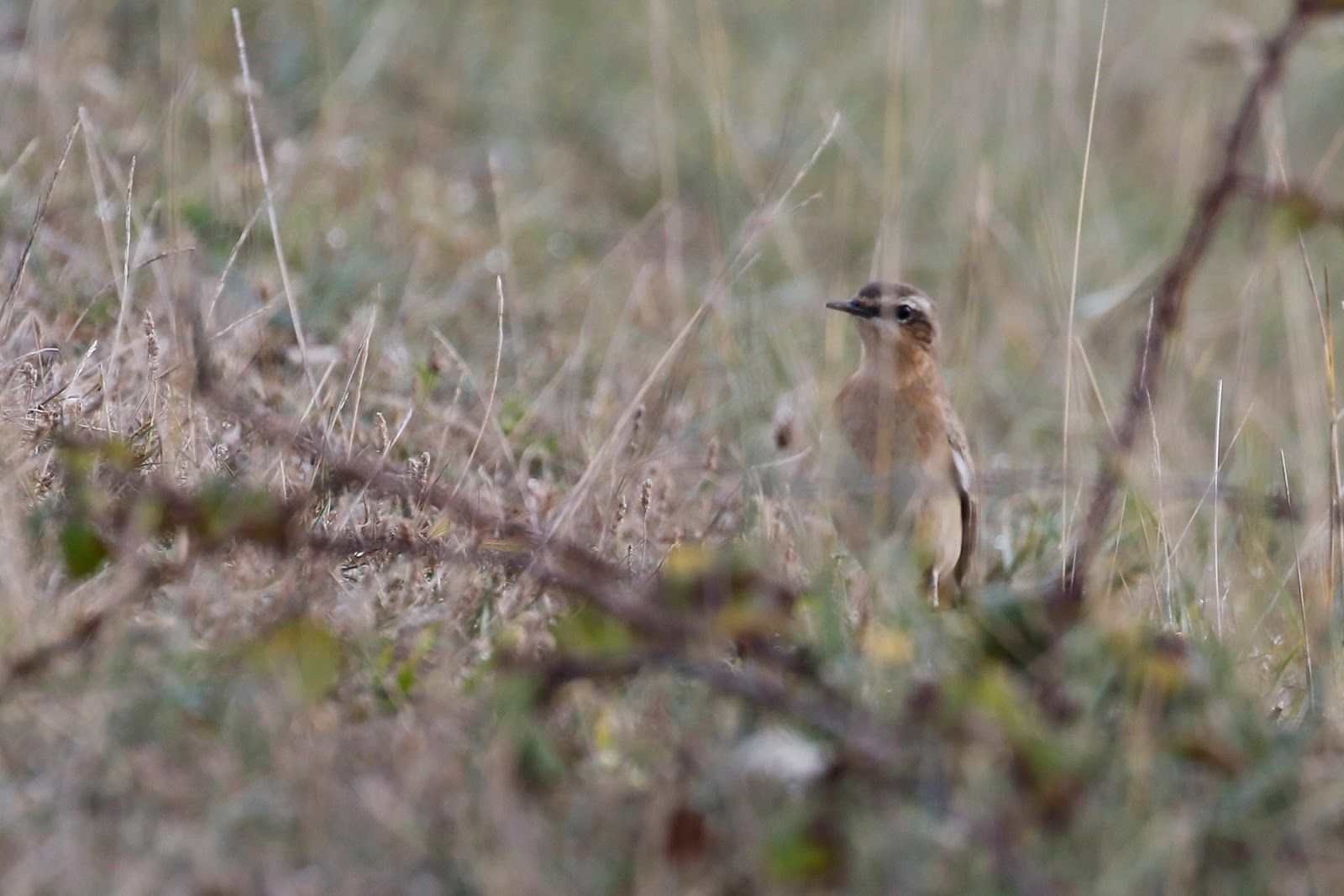
Pretty soon the water was covered with them, and the air filled with the calls of the geese. We moved on again, around the sea wall, and past the jetty. A little further on we disturbed a Wheatear in the grass on the edge of the sea wall.
As we edged forward to get a closer look we flushed it and it flew down onto the beach.
We carried on around the path, past Butts Lagoon where there were several Ringed Plover feeding in the familiar style where they move gentling, and then stop to bend down slowly to peck at anything they have found. Contrast this with the energetic clockwork action of the stints and the Dunlin.
We had hoped for a Spotted Redshank on Oxey Marsh, but could only find Redshank, and this single Greenshank.
From here we made the long trek towards Normandy Marsh, it is this part of the walk that can be a little boring, as you turn back on yourself crossing the outflow. A Kingfisher put in another rapid appearance speeding off with a whistle just like roadrunner. At Normandy most of the waders were very distant. We counted at least six Greenshank, and seven Knot amongst the usual fare of Dunlin and Redshank. Two of the Knot then came close to the sea wall.
The sun of the early morning and the still calm conditions had now disappeared and we were under darkening overcast skies, and a very strong westerly wind. The forecast was for rain in the afternoon, but it was still only 11.00 but rather than hang around we decided to head back. Rather than walk around the sea wall we crossed the marsh to reach the jetty, where at first we found a single Eider, which from nowhere became three, only to turn into a raft of fifteen Eider.
We made our way back to the Jetty Lagoon to see if the Wood Sandpipers would be a little more confiding and come a little closer. The lagoon was still covered with Canada Geese, and the numbers of Black-tailed Godwits had increased, but more importantly one of the Wood Sandpipers was closer to us on the sea wall, not a lot but closer to allow the chance to get a photograph.
Of the three commoner sandpipers we see in the UK, the Wood Sanpiper is much longer legged than the green and common. The wind was now quite strong, and it meant it was necessary to rest the camera on the telescope to keep it still. We walked back to Fishtail, then back again to walk down the footpath to check the fields, which were pretty much dry, and empty, other than a large flock of Goldfinches on the teasel and Thistle heads and a single Wheatear.
After dropping off the scopes we walked down the cycle path in the hope of some small birds, but the fresh wind meant that very little showed. On the lake by the reclaimed land were Tufted Duck, two Great-crested Grebes and several Sand Martin. On the bank a large roost of gulls including Great and Lesser Black-backed Gulls. We were also searching for Whimbrel, but with no luck. As we headed back Golden Plover called and then two flew over our heads and out to the back of Fishtail.
We scanned the lake, and Ian asked for a Common Sandpiper, and I duly found one.
After stopping for lunch we headed back out to the lagoons, walking along Fishtail where a solitary Greenshank was standing amongst the Dunlin and Little Stints once more.
From Fishtail we walked around to Keyhaven, and as we reached the corner, in the deeper water was a Spotted Redshank. As it fed the head was almost always under the water, and it moved closer to the reeds.
With the tide now at its highest the lagoon at Keyhaven was full of feeding and roosting waders. Close in were several Black-tailed Godwits.
And at last some Curlew Sandpipers that were close.
It is slightly larger than the Dunlin with a longer neck, and legs.
The bill is also longer, finer tipped, a with a more evenly decurved bill.
These were I think juvenile birds with an unmarked belly and a prominent supercilium.
Here you can see the comparison of the much greyer Curlew Sandpiper with a paler belly than the Dunlin behind it.
At the back of the lagoon was a large roost of well over 100 Grey Plover, some of which were still in summer plumage.
We headed back to Fishtail to see if the Spotted Redshank was showing better. It was still there and with a Greenshank. The Greenshank flew off leaving the Spotted Redshank still feeding vigorously, but finally it slowed up and allowed us to get some views of the head.
And that was it for me, domestic duties called and I headed off home leaving Ian to go off in search of more goodies. Not a bad day with some quality waders, eighteen wader species not a bad day total. We missed Bar-tailed Godwit, Whimbrel and maybe Green Sandpiper.