Unbeknown to me our journey took us through the city of Bharatpur, I wasn't really conscious of this until Vinod mentioned that this was the site of a famous bird reserve where bird-watchers come to see and record birds. I then pointed out to him that we were bird watchers too, and he then asked if we would like to visit. I had heard of the reserve and had no hesitation in saying yes.. The entrance to the reserve was just off the main road, and we pulled in, and I set off to pay the entrance fee and negotiate a guide.
We
only had a couple of hours but they were an unexpected bonus. The name of the
reserve is Keoladeo National Park, formerly Bharatpur Bird Sanctuary, it is a man-made and man-managed wetland. The reserve protects Bharatpur from frequent
floods, provides grazing grounds for village cattle, and earlier in its creation was primarily
used as a waterfowl hunting ground by the Maharaja.
Home to 366 bird species, with over 230 species of birds known to be resident, the sanctuary is one of the richest bird areas in the world and is known for nesting of resident birds and visiting migratory birds including water birds. The rare Siberian cranes used to winter in this park but this central population is now extinct. According to founder of the World Wildlife Fund, the late Peter Scott, Keoladeo National Park is one of the world’s best bird areas.
It was midday, not the best time of day, and it was hot. We secured a guide, and a rickshaw, in which to ride. The guide cycled alongside us as Helen and I sat in the Rickshaw while this poor Indian guy pedaled us down the main path through the reserve. This was probably the most bizarre way I have been birding, but it supports the local economy, but I did feel rather foolish sitting in the rickshaw when I would have preferred to have been walking.
Almost immediately we stopped, and the guide pointed up into a tree by the side of path. Tucked away in a hole of the trunk of the tree was a small owl, a Collared Scops Owl. It sat there like all owls do during the day time with eyes tightly shut. Never mind it was a new bird for me.

A little further on the path became covered by trees and on either side was marsh and open water. We came across a White-throated Kingfisher, that sat under the leaves in the dark which made photography difficult at first, but then, the kingfisher turned to look at us, and showed the white throat.

On the opposite side in some marsh land a Green Sandpiper fed.

There were quite a few people about, but they were not birders, and the giuides were trying desperately to find birds that would interest them. I was just pleased to be birding regardless of what was about. Temples and forts are interesting but given the choice I know what I would be doing.
One of the guides then called out having found a Oriental Honey Buzzard on the ground.

A bird that doesn't really look like a raptor with its pigeon like head and red eye. It must have found a bee or wasp nest as it was feeding on the ground., but as the noise level rose amongst the other watchers it flew off.
A Greater Coucal flew across the path and settled under a bush, again in awful light. Another new bird for me. It is sometimes called a Crow Pheasant, but is in fact a member of the cuckoo family, but unlike the other members is not parasitic. The head is black, upper mantle and underside are black
glossed with purple. The back and wings are chestnut brown, with eyes that are
ruby red.

It was back into the rickshaw, and we were pedaled on. Red-wattled Lapwings were everywhere, but it was nice to see them in proper surroundings as they can also be seen by the side of the road, around town centres and were also on the lawns alongside the road leading from Delhi airport.

Again under the cover of the trees we came across another new bird, the Indian Pond Heron.

Not visible when at rest, it has brilliant white wings when in flight. You can see it was hot as the birds were panting with bills open.

Out in the open a White-chested Waterhen, a relative of the Common Moorhen, of which there were many about.

Once upon a time I would have been excited to have seen a Great Egret, but with their numbers increasing now along the south coast in the United Kingdom, it is not such a thrill, however they are still a very elegant heron.

It was not only birds present a small group of Spotted Deer could be seen, this young male with velvet covered antlers.

As seems the way everywhere in India, Rose-ringed Parakeets could be heard above us and in the trees. A pair settled on the edge of a palm tree, and made a nice composition.

Our guide then pointed out another bird in the palm tree, another owl, this time a Spotted Owlet, another new bird.

If you look you can see that there are actually two birds there, a pair. Again they never opened their eyes at all, fast asleep? Maybe, but probably just ignoring us.
Another guide then found yet another raptor on the ground, a Great Spotted Eagle, probably an immature bird. It was on the ground with wing out stretched, for what reason wasn't clear, maybe antting? Head and wing coverts are very dark brown and contrast with
the generally medium brown plumage

A large raptor flying over at he same time was another eagle. I caused confusion as it had a pale belly and under wing coverts, and I thought it was a fish eagle which are rare here.
Then our guide provided once a again, and yet another owl, this time an Oriental Scops Owl. No facial view but you can see the dagger patterns in the plumage. This is the grey phase, apparently quite rare in the park as they usually get the twany brown phase.

The trees then gave way to more open areas of water and grass, on one of the islands was a group of Lesser Whistling Ducks. They appear ever alert with their heads and neck extended. Yet another lifer

A little bit further back there was another duck, and another lifer. The Spot-billed Duck, named after the marking on the tip of the bill.

Above the duck in the same tree was a raptor, this though was a familiar bird, but not normally seen perched in a tree, the Marsh Harrier.

Then we came across one of the birds I was hoping to see when i realised we were able to spend sometime here, the Sarus Crane.

The Sarus Crane is a large non-migratory crane found in parts of the Indian
Subcontinent, Southeast Asia and Australia. The tallest of the flying birds,
standing at a height of up to 1.8 m, they
are conspicuous and iconic species of open wetlands.

As was to be expected with birds that pair for life there were two birds present. In India they are considered symbols of marital fidelity,
believed to mate for life and pine the loss of their mates even to the point of
starving to death.

The main breeding season is during the rainy season, when
the pair builds an enormous nest "island", a circular platform of
reeds and grasses nearly two metres in diameter and high enough to stay above
the shallow water surrounding it

Sarus crane numbers have declined greatly in
the last century and it has been suggested that the current population is a
tenth or less (perhaps 2.5%) of the numbers that existed in the 1850s. The
stronghold of the species is in India, where it is traditionally revered and
lives in agricultural lands in close proximity to humans.
The adult Crane has grey wings and body; a bare red head and part of the
upper neck; a greyish crown; and a long greenish-grey pointed bill. The bare red skin of the adult's head and
neck is brighter during the breeding season. This skin is rough and covered by papillae,
and a narrow area around and behind the head is covered by black bristly feathers.
The sexes do not differ in plumage although males are on average larger than
females.


There were plenty of butterflies about but not one would settle and allow me to photograph them. I had seen several different yellow butterflies with black fringes to the wings that were probably some type of Clouded Yellow. There were also plenty of whites and a few small blues. On a patch of marigolds I could see Indian Coppers but this were so flighty. The only butterfly that did stop was this Common Rose.
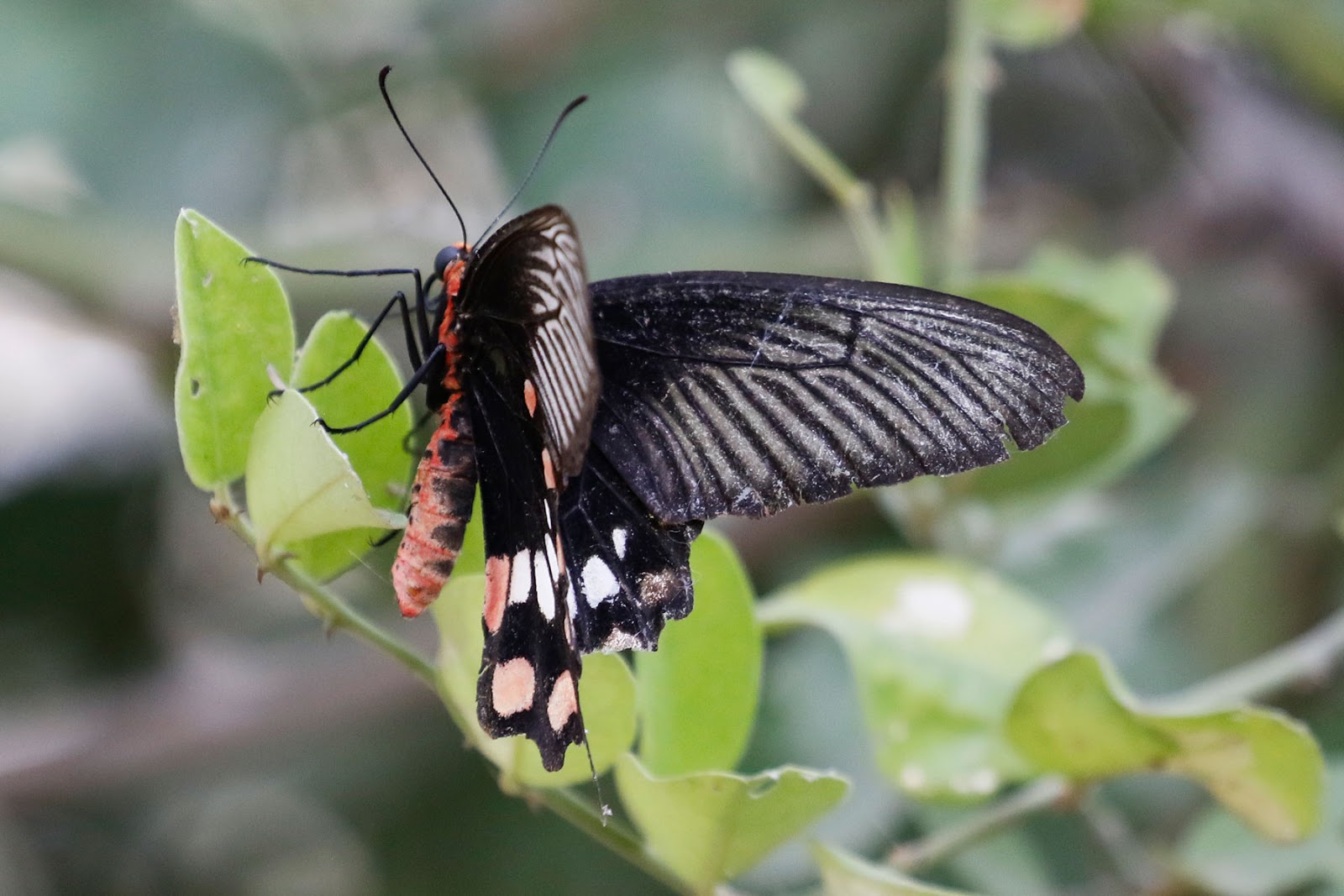
Its quite a large and heavy butterfly, a member of the swallowtail family, a very common butterfly distributed across most of southern Asia.

This area was quite fruitful, and was also in the shade. Scanning the marsh there were a pair of the largest Indian antelope, the Nigahli, or Blue Bull from the colour of the male. This pair were sitting out the heat of the day under a tree on a raised mound in the middle of the marsh.

In the long grass, a Purple Heron stalked through the blades, the very thin neck providing excellent camouflage, and showing how much more slighter this large heron is to the more familiar Grey Heron.

On the other side, another new bird, a Bronze-winged Jacana walking through the marsh.

Passerines had been hard to find, not unusual given the time of day, our guide had got me onto several but I was not able to photograph them, the best being a Scaly-breasted Munia, which I had seen before, and an Indian Silverbill, another new bird.
The one passerine that was in your face was the Oriental Magpie Robin, a bird somewhere between a robin and Blackbird in size, and with mostly black upper-parts and white under-parts, with white in the wing. As it settles it cocks the tail up.

Back out on the water, a Great Cormorant sitting on one of the island mounds.

Closer to us now was another Spot-billed Duck, allowing a much closer look.

The yellow tip on the end of the bill that gives the duck its name very clear here.

The Marsh Harrier then passed overhead, a more familiar sighting, it caused a little panic amongst the ducks.

The Lesser Whistling Ducks breaking out their whistles and stretching their necks.

The low tree boughs are the ideal place for the herons and cormorants to rest, and also fish from. On one large trunk sat an Indian Darter.

Close up you can see why they are also known as a Snake Bird.

Everywhere you looked there was something to see. On the opposite end of the bank to the Great Cormorant was an Indian Softshell Turtle. This is a vulnerable species whose numbers are reducing. The carapace can grow to just under a metre in length. They feed on fish, small reptiles and amphibians, and in places aquatic plants.

We had seen Little Cormorant in the water, but managed to come across one perched, and panting in the heat. I suppose it doesn't help to be black.

I mentioned earlier that we heard the Sarus Cranes calling from across the marsh when a Great Spotted Eagle flew over. This was the bird responsible, and you can see the resemblance to a Fish Eagle, well that is my defence.

I could have stayed all afternoon, and knew that a little further on there were more water birds, probably storks and Ibis, but I also knew we had a driver waiting who had been wonderful in allowing us this opportunity. We climbed back into the rickshaw and started the slow journey back. A two hour visit turned up eleven new birds, which made me wonder what a full day could achieve.
Once back at the car park, and having settled with our guide and rickshaw driver we were back on the road. As the light fell we encountered even more amazing sites, the best of which was two persons on a motorbike, with the pinion rider holding on to a live cow, it doesn't matter that the cow was technically a calf it was a cow on a motorbike, and here is the photograph to prove it.

As we approached Jaipur, the traffic became heavier, with many buses heading out of the city with people sitting on the roof. Inside the buses are packed, and it would seem the best place to be was beside the window where you can just gaze and lose yourself in the chaos.

Apparently the traffic in central Jaipur was exceptionally busy, and we reached the hotel just after sun down. A really good day with a mixture of culture and wildlife. Tomorrow we are in Jaipur, not sure what that will bring, but what I do know is that it will be interesting and very different.


