What a difference a day makes, this morning gone are the low grey clouds and persistent rain, and in their place was blue sky plenty of sunshine and a stiff breeze. I was able to get out late in the morning and I wanted to take the opportunity to pick up a few more easy year ticks, and to return to look for a bird I caught up with in January. One of those birds that you can't get enough of when they show so well.
My first stop was the Titchfield Canal path, on a cold clear dry sunny day the walk is popular and the car park was al;most full as I turned in. We walked the path back in late December and it was very muddy just after the Posbrook Floods, and I had no intention of walking beyond there. I was here for the split tree and its inhabitants, a very easy year tick. As I walked down the path I passed a man spinning the high murky water for trout.
I reached the point on the path, and turned to view the tree, and right on cue there was one Barn Owl visible. I couldn't see the other despite changing the angle. The one in view lifted its head every so often, but that was the limit of movement.
Rather than turn back on achieving my objective I walk on, the path being quite sturdy here with no threat of mud. I could see plenty of wildfowl and gulls on the floods, with Canada Geese and Black-tailed Godwits feeding on the grass. In the trees by the path were Long-tailed Tits, Blue and Great Tits and several Goldcrests. The lichen appeared to be of interest to Goldcrests, and they would move along the branch pushing their needle sharp bill into the folds of the lichen.
I turned back, and as I did so all the birds on the floods went up in a maelstrom of wing beats and calls. The honks of the geese, the whistles of the Wigeon, and the rush of the wing beats as they all sought safety from what had spooked them.
Back at the split tree the single owl looked out across the field. I didn't stop though, and made my way to the car, job done, time to move on.
My next destination was Mercer Row, Romsey, I had been here in January for the Hawfinches when the weather was very similar, I wanted another chance to photograph this beautiful finch. Mercer Row is a regular site for these birds during the winter mainly due to the proliferate number of cherry trees growing there on the small recreation ground. There are clumps of trees and puddles created in the mud to which all the birds come to drink. The Hawfinches are here for the fallen cherry stones, not something you see out on the ground, but tucked away within the leaf litter. Interestingly when I cleaned my boots that evening I found two wedged into the grip on the soles of my boot.
I found my way to the edge of one of the copses where there were two large puddles in the sunshine. Around me I could hear Starlings calling, Redwings in the trees above and every so often the plain piping of a Bullfinch.
The first bird to come to the water was a Collared Dove, another of those birds that gets overlooked.
Then a Hawfinch appeared at the back of the path, too far away to photograph, but good confirmation that they were about and that they still used the water. Movement in the branches turned out to be more Hawfinch, and I was able to watch one through the branches in the darkness of the trees.
I get restless, and can't stay still too long, and walked around the trees to find a male on the grass only for it to fly off. I could now clearly here them calling a strong "tic tic"call, similar to the alarm call of a Robin, but more distinct, with perhaps more emphasis on a "pix" sound..
I returned to the puddles and waited, it didn't take long for one to come down for a drink.
A male with the black eyeliner and bib.
Then a female, lacking the defined black markings around the eye and throat.
Then two males together
And then another two males, so far at least four birds, maybe five.
Then everything went quiet for a while, and I decided to wander around the park. Moving away from the puddles I could hear calls from within the branches and located one bird. in amongst the branches.
As I walked back a flock of six birds flew over my head and headed to the south, so now the count was up to eleven maybe twelve.
I walked back to the puddles, and I could hear the tick calls from within the trees so I was satisfied the birds I had seen earlier were still about. Inbetween the calls were snippets of song, although it was very difficult to find the owners. After waiting a little more another male appeared at the puddle.
The conditions were still not brilliant, and the birds would not come to the larger puddle that was in full sun.
There was another quiet spell, and I went for a walk again. I could see the Hawfinches in the trees but at no time was there a clear view. Coming back to the puddles I found a different view and watched the House Sparrows that were bathing.
I walked back to my original position and waited again. The "tic" calls became louder and I found the source, one male out in the open, but in a dark part off the bushes.
Then a female came down to the puddle, instead of drinking she plunged straight in watched by a pair of House Sparrows.
Who decided to join her.
I went off for a walk again, and the calls and song were really quite evident now, the song being a series of "Zih" or Zrrrr" which are strung out. The song is very quiet but as they were the only birds around making a sound it was easy to hear. However they have a habit of dissolving into the tree branches and can be very difficult to see as they sit very still. This one was suddenly highlighted by the sun as it came out.
Then I managed to find a male singing from the top of a tree in the open.
And another a little lower down in competition.
I returned once again to the puddles and waited. Once again there were plenty of calls and snippets of song, and as these became more intense I noticed that there was a bird close to me in the open, lit up by the sunshine.
There was still the problem of the branches but here the majority of the bird was visible.
At last I had the pictures I wanted in full sunshine.
The winter sunshine shows off a really beautiful bird.
It then went through some wing flapping and stretching.
Before turning to show of the club shaped extensions to the inner primaries.
By now I had taken my fill of photographs and decided to move on, next stop was to be Alresford and the Pinglestone water cress beds. It was on my way home, and provided the chance of another year tick and maybe one or two more. I parked at the triangle and walked back to the water cress beds.
Scanning the beds to the north I quickly picked up two very light pipits walking on the concrete walls. While very distant with the scope I could see that they were Water Pipits. There was very little streaking on the underparts, with a pale grey upper, and distinct white wing bars. Much too far away though for anything more than a grey blob record shot.
Scanning the beds some more I came across three Grey Wagtails, unfortunately no closer than the pipits.
There was no sign of the other bird I was after, a Green Sandpiper, so I walked to the viewing place to look out over Alresford pond. The last time I was here was last March, and the water level then was quite low, today it was full with no sign of any mud at all.
Cormorants were on the trees at the back of the lake, and dotted around the water were Shelduck, Gadwal, Shoveler Tufted Duck and a pair of Pochard. In a little pool alongside the viewing area there were at least six Tufted Ducks diving. The water looks black and this provides the ideal background for photographing Tufted Ducks once more.
A Mute Swan was also there and again perfect for a white bird with a lovely reflection.
There have been on and off reports of a Hen Harrier coming into roost and a Barn Owl hunting the reed bed. I had at least an hour and a half to wait for this, and with squally snow showers around the area I decided to cut my losses and head for home. Just to make it easier I convinced myself that it was far too windy for a Barn Owl to hunt anyway.
A great day to catch up with the Hawfinch once again, I think I have now satisfied that need.
Yet another dismal Saturday forecast, with heavy rain forecast from mid morning, however about an hour before dawn there was quite a heavy frost, and as i left home heading west the temperature was minus three degrees. The temperature fluctuated along the journey, but as I crossed the bridge over the Test at Harbridge, the fields were tinged with that dusting of frost as the light began to increase. I pulled up behind Ian's van and as I got out the sky to the west was dark, and overcast, but in the east there was a small window of clear sky on the horizon that seemed to polarise and refract the sunlight, providing a quite spectacular colourful sun rise.
As the sun rose the clear sky diminished and this provided an incredible red sky, no doubt red sky in the morning is a shepherds warning.
As we stood transfixed by the light and spectacular colours the birds started to move across the sky.
A couple of pairs of Goosander flew north, and then a few groups of gulls coming off the roost on Ibsley Water at Blashford.
We were here to look for the reported Bewick's Swan that had been with the large herds of Mute Swan. The fields alongside the road were empty, and we could make out swans in the distance, so we decided to walk around the lanes to hopefully find the Bewick's.
As we walked the light once again changed taking on a very strange glow, turning
everything a pinkish yellow colour, if there is such a thing. The streams picking the colours from the sky and contrasting with the frost tinged grass all around
It felt quite unnatural, but at the same time uplifting, dawn is my favourite time of day, and with each sunrise I get to enjoy the appeal never disappears.
I stopped to photograph the reeds against the flowing water, the strange light taking on the colour of the reed stems
As we walked past the church there were many Jackdaws just waiting up and sitting on the tower calling to each other, probably discussing the best fields to visit this morning for breakfast.
Depending which ever way you looked there would be a different colour in the sky. We were walking north as these Canada Geese flew in from the flooded meadows alongside the river. The sky now a light pink, as the sun began to peek above the horizon.
There were geese in all of the fields, Canada, Greylag and Egyptian and in the distance a few Mute Swans, but no sign of the hoped for Bewick's Swan.
Away to the east there were now huge flocks of gulls coming off the roost at Ibsley and heading north to the fields beyond Fordingbridge, the sky now a rich yellow as the cloud began to win the battle with the rising sun
Mute Swans, adults and immature birds, continued to fly into the field on our left as we headed north along the lane, unfortunately still no sign of the Bewick's Swan.
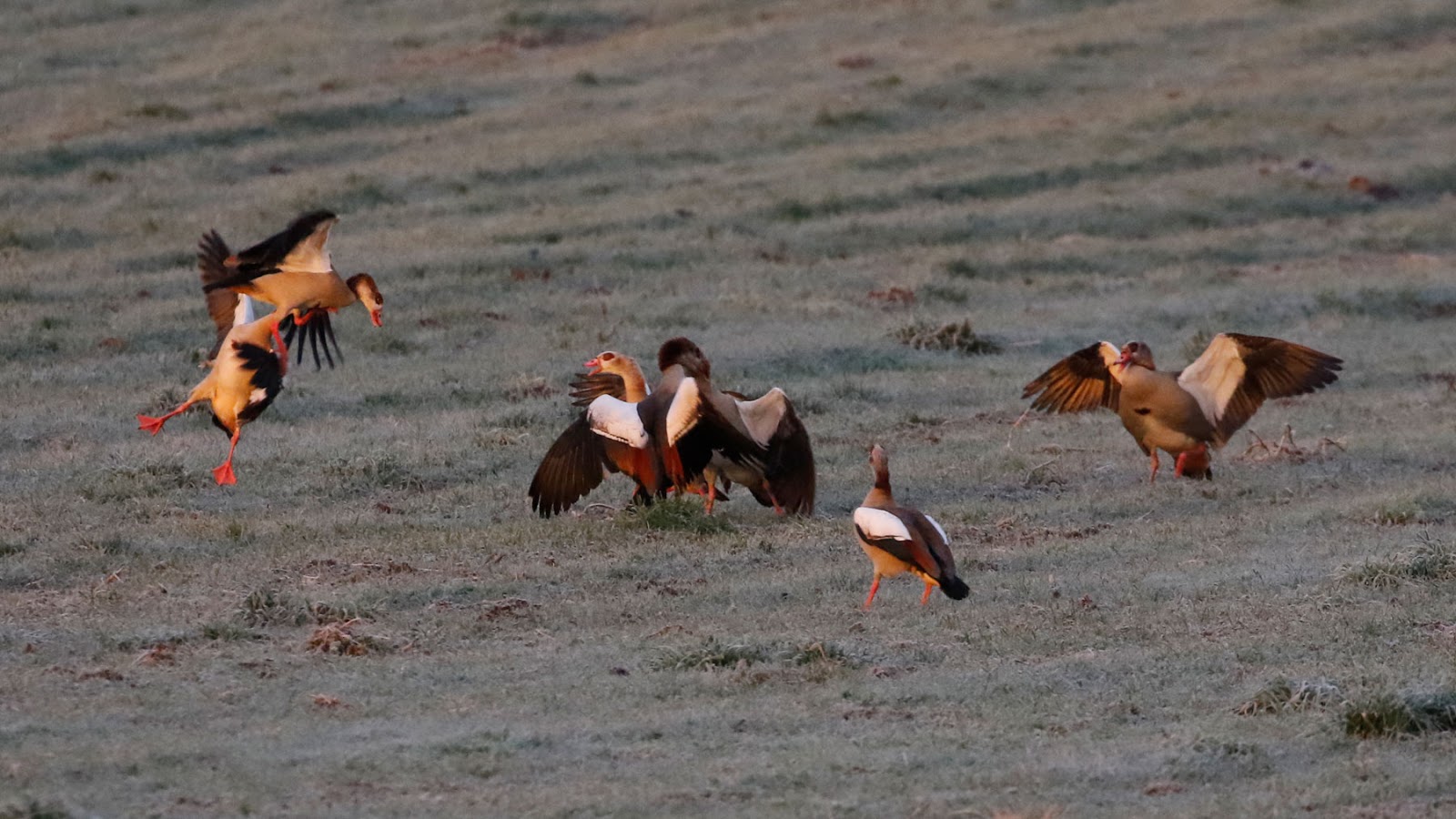
The area is always a good spot to see Egyptian Geese, and this morning there were plenty about. They are elated to the Shelduck, more than a goose, and have arrived here courtesy of the Victorians having them as ornamental birds, where fully winged breeding colonies were established on lakes in Norfolk, and of course this led to feral populations being established.
I have seen them in Africa, often alongside water holes with game such as zebra and antelopes. When you do see them it is usually in pairs, and scanning across the field today they were mostly in pairs, but every so often their calls would increase, and fights would break out.
Quite a fierce fight broke out with wing beatings and birds flying up into the air.
These are mainly territorial battles, with pairs getting too close to others. They would stand very close to each other and try to bite the back of the opponents neck.
The one on the left appears to be goading the others but staying a safe distance
Then peace would come for a short while as the pairs settled down. I counted 31 birds in the field, as they usually are in pairs I would assume there was another somewhere. We also watched them fly up to the trees and perch there on the branches.
To get to February without seeing a Fieldfare was for me quite unusual, and as I remarked on this Ian pointed out a flock perched in one of the trees in the field. Warming up in what was left of the morning sunshine, they sat at the top of the tree.
The search for the elusive swan was proving fruitless, but if we hadn't have come looking for it we would have missed an incredible start to the day. There was still sunshine about, and it was throwing lovely long shadows over the fields and at the same time providing a golden glow on everything.
The geese were starting to graze on the frosty grass
The stream of Mute Swans flying into the main field had now become a trickle, this pair heading low across the field, the whine of their wing beats increasing as they flew towards us.
We turned back and investigated another lane with easier views across the field, but try as we might we could not find a Bewick's Swan. The sun had now gone for the morning, and the sky took on the monochromatic look that seems to be the normal fare for every Saturday since the start of the year. We decided to walk back to the cars, and then head off to Blashford Lakes, we may be needing the shelter of the hides today.
It was still early, and the hides were not yet open. We stopped at the visitor centre and watched the birds on the feeder. A male Brambling put in a brief appearance but then disappeared as quickly as it arrived. We walked on, stopping at the Woodland Hide, and peered over the fence at the feeders once again. Again there were quick views of a Brambling. On the fence two Robins were squaring up to each other. The tactic is to push the breast out, and throw the head back to show as much red while trying to get height above the opponent, maybe also a few notes of song.
We walked on to Ivy lake, stopping at the south hide to try and get a view of the water. Through the trees I found the Great White Egret stalking on the edge of the reeds on the far bank.
So it was back to the Woodland Hide where the door was still locked, so we continued to watch over the fence. A Long-tailed Tit provided entertainment this time, hanging from the branches in a tree close by.
Then posing nicely.
A male Brambling appeared above the fence close to the hide, we were a little way from it.
Finally we got into the hide, and opened one of the two windows that open and sat to watch the birds coming to the feeders.
A male Siskin sat in the scrub, emitting a kind of quiet sub-song as it waited for the chance to get on the feeder.
The Nuthatch normally flies straight on to the feeder,and then away, however this one made an advance that was a little more measured, creeping through the branches before getting on to the feeders.
Then the Brambling arrived, at first they were seen at the back of the scrub, sitting in a tree with Chaffinch. Then one came in closer and after using the feeder sat on the branches for us.
In their winter plumage the males have a mottled black head, which in the summer turns all black.
It always amazes me why there is any doubt between identifying a Brambling over a Chaffinch, they are so distinctly different, and there is no mistaking a Brambling when you see one, even the female stands out.
We waited to see if there would be any Redpolls about, but nothing showed, and we decided to move on. As we left the hide there were the first few spots of rain and a Great Spotted Woodpecker drummed from a tree above us before flying off.
We stopped off in the Ivy Lake North hide, possibly the worst bird hide ever built. The only windows that open are on the side of the hide, and those to the front are covered in a one way film. Because they don't open the windows also get covered in condensation and rain drops, and are impossible to see out of. There is a sign in the hide saying it cost £10,000 to build which if it did was a complete waste of money!
There was nothing of interest that we could see so we headed back to the car park, and onward to pick up the scopes and then off to the Tern Hide. We were the first in the hide,and settled down as the rain became a little heavier. The water was relatively empty, with a few Tufted Duck dotted about, and in front of us a group of Goldeneye. The drakes were showing off to the ducks, going through their sky pointing display by throwing back their heads, and lifting their bodies out of the water.
One of the Tufted Ducks swam past the hide, and demanded to be photographed.
The visit here was for two reasons, one there were hides and these would be very useful as the rain became more persistent. the other reason was the possibility of Black-necked Grebe, and maybe some unusual gulls later in the day. The grebe though was our first target, and we scanned the far side of the lake in search of it. From the tern hide there was no sign of it, and with a break in the rain we decided to walk around to the Goosander Hide.
There were a few Goosander on the bank of the spit in front of the hide, and close in a few Tufted Duck, one of which became a little alarmed.
In scanning the far side again in search of the grebe I picked up a large gull that was washing vigourously. What caught my eye was the fact that its mantle was a much darker grey than that of a Herring Gull, but nowhere near the darkness of a Lesser Black-backed.
We watched the gull as it bathed, the tips of the primaries were much darker, almost black from our view, and there was definite red spot showing on the bill. Finally it flew to an exposed sand bank and we could see the yellow legs of a gull that I was now convinced was a Yellow-legged Gull. It was though much to far away to photograph.
Continued scanning did not produce the wished for grebe, but closer to the hide a pair of Little Grebe chased off an interloper, and then proceeded to fish around the submerged tree branches.
The rain would come and go, and in another break we decided to walk around to the Lapwing Hide. Once again we scanned the far side of the lake without any luck, trying desperately to turn Little Grebes into our quarry. On one break from this fruitless scanning I looked in front of the hide, and a grebe appeared. Absolutely typical, we had been looking as far away as we could and the bird we were trying to find had been right under our noses all the time. We could have almost poked it with the telescope!
The fluffed up rear end recalls a Little Grebe, but everything else is so different, the peaked crown, and almost upturned bill provide a characteristic shape. The white cheeks are not as pristine as in the Slavonian grebe, and the dark smudges extend below the red eye. On this bird there are signs of orange on the breast. At first I thought this may be the plumage starting to change to the breeding plumage, but that would be a black breast, so maybe tis is just a stain from somewhere.
It made its way along the edge of the shore, then turned around and went back to the right and out of sight.
We sat in the hide as the rain became heavier, and the visibility decreased and spent the time watching the few ducks there were and putting the world to right. Goosander flew into the bay, but never came close enough for any good photographs. The Black-necked Grebe appeared once again, following the edge of the water, and a pair of Pochard appeared as if from nowhere.
Out on the water a few gulls were collecting, mostly Common and Black-headed Gulls, as we watched them come in it became very obvious as the rain closed in along with the mist that trying to pick anything out in this weather was going to be virtually impossible. The trees on the far side of the water were disappearing quickly, and after what had been such a colourful start to the day was now a very sad washed out grey day.
We decided that was it, and walked back to the car in the rain. Before going home though we drove around to Harbridge once more to search the swans for the Bewick's. It was nm't there but in the field now were hundreds of Fieldfare, making the most of the wet ground.
Hopefully the Saturday weather can only get better, as the rain is becoming very depressing. The day though had not been a complete wash out, and I would not have missed the time before and after the sunrise for anything.