Wednesday, 11 April 2018

1st April - Whale Watch Two, Mirissa, Sri Lanka

Despite the jet lag it was another good night's sleep, I awoke before the scheduled alarm time around 4.00 am, the next time I opened my eyes the bed side clock said 5.28 am and we were supposed to be picked up at 5.45!  After a manic 15 minutes we appeared down stairs in the lobby and proceeded to dismantle the picnic breakfasts, before realising that they were not ours.  Despite all this we were the first to arrive once again at the office, and once again our names were top of the list.  We headed down to the harbour where we once again wrote our names on the Coastguard list, but did not declare our ages (there is an obsession on the Sub-continent with age!).

Once the boat was  prepared we boarded and this time headed to the top deck.  We were joined by a group of Australian tourists, and there was an instant better feel about the day.  As Helen describes it, if the karma was good, as it was this time, then the occupants deserved to see something special.  In talking with the crew, who were amazing through out, it was clear that they did not enjoy yesterday's trip for the same reasons, too many boats chasing one whale, and the behaviour of the clientele on the boat.

So once again as we waited for the other passengers to arrive I spent the time taking in the sights and colours around us as the little harbour began to wake up for the day, and the night fishermen returned from the efforts in the bay.

  
Some beautiful reflections again.


The light was different from the previous day, a little more diffused by the light wispy clouds and the hazy conditions, this seemed to accentuate the colours.


More of the larger fishing boats could be seen moored up, their owners returning in time to celebrate the New year holidays next week.


While some are more pastel, others are bold and in your face colours.


Closer, the small boats cast their reflections in the still water, whether they are rust or just wear and tear they still look amazing


The Whiskered Terns still circled around dropping down and dipping into the water, but always managing to evade the perfect shot.  What did catch my eye though was a Striated Heron that flew across low over the water, catching the sunlight as it did so.


At 6.50 am we finally set off out of the calm waters of the harbour and into the heavy swell of Weligama bat.  The sea was distinctly rougher than yesterday's trip, and this became more apparent as we past the eastern tip of the bay, with the rising sun gaining height into the morning sky.


Yesterday we headed due south, but today the heading was more south east, into the rising sun.  Another difference from the previous trip was the increased number of fishing boats on the water.  Yesterday had been a holiday, and probably accounted for the lack of fishing, but today they appeared to be everywhere, some returning home.
 

But others clearly intent on staying out.


 As well as the number of fishing boats there also seemed to be large flocks of birds.  I am not sure here as to what comes first, do the fishermen follow the birds, or do the birds find the fish and the fishermen follow?  The birds though had found a large shoal of fish, probably being chased by tuna, and they were picking of the small fish as they were herded to the surface in an effort to escape the tuna.


It is difficult to get clear identification from the boat, so it was left to the photographs once viewed to identify the birds.  There are Bridled Terns, White-winged Black Terns, Gull-billed, and a few Whiskered and Common Terns.

 
The clouds and low sun sent shadows across the sea, turning the water a golden colour as we headed steadily south east.


The fishing boats moving about constantly following the birds.


It was no surprise then with all the boast about when we came across our first pod of dolphins.  These were Spinner Dolphins, and as we approached I saw one spin out of the water but that was the only time on the trip.  


When we had come across them previously in 2014 they were constantly spinning, but this pod seemed very intent on fishing, and they would surface and they all together disappear for a short time before turning up again herding the boiling water of fish.


We followed the dolphins as they chased the fish, and the fishermen in their small boats with outboards maneuvered between us and the dolphins in the attempt to catch the tuna that were also herding the bait fish below.  They tow a plastic lure on a line, and we saw several seem to catch something, but never saw them land anything.


The Spinner Dolphin is a relatively small dolphin found exclusively in tropical waters. 

The dorsal area is dark grey, the sides light grey, and the underside pale grey or white. Also, a dark band runs from the eye to the flipper, bordered above by a thin, light line.  They feed on fish and squid, but in turn are also prey for sharks, Killer and false Killer Wales, and Short-finned Pilot Whales


The pods can be quite huge, this group though was not that big.  Back in 2014 we did see a pod of over 100 individuals, one of the few photographs that managed to survive from that trip


We followed the dolphins for a short time, but then decided to leave them with the fishermen, and headed on our way.

   
We could see the shore still, unlike yesterday when we went straight out.  We had though travelled a considerable distance to the east as we could clearly see behind us the Dondra Head lighthouse at the southerly tip of Sri Lanka.

There is constant communication, between the boats and the shore, amazingly there is a mobile signal reach that far out to sea.  This allows information to be shared, and it was clear that they knew there were whales about it was just that they were a long way off.

Finally we could see a spout in the distance and we moved in towards another Blue Whale.  While there were a lot of boats about, there was nothing like the numbers seen on the previous day.  The most distinctive part of a Blue Whale is the blow, a vertical tower of spray that can reach up to nine to twelve metres in height.


Already we knew that we were getting better views than yesterday, the height of the upper deck helping considerably.
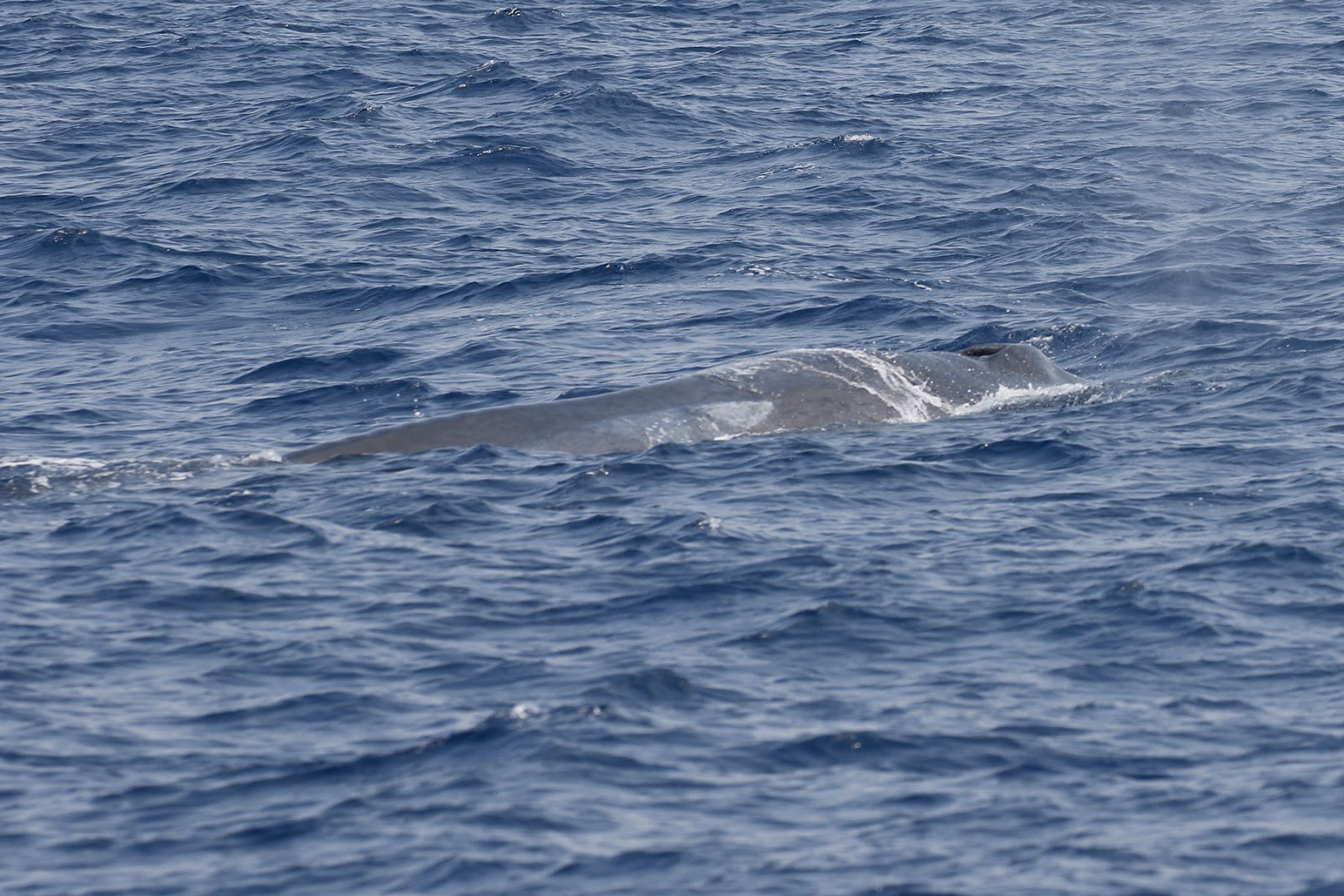
 

Like all rorqual whales (the largest group of baleen whales including Fin, Sei, Humpback and Minke Whale), the Blue Whale is slender and streamlined. Although we were never able to see it, the head is broad and U-shaped when viewed from above and relatively flat when viewed from the side. Along the centre there is a single prominent ridge, which ends in an impressive “splash guard” around the blowholes, which you can see here.


Clearer here as to the shape of the "splash guard", and you can just make out the lighter colour of the head through the water.


The dorsal fin is relatively small, variably shaped, and placed about three-quarters of the way back from the snout tip.  This is probably the one photograph that does justice to the incredible size of this animal, the spout being about six metres high, the largest animal ever known.


Blue Whales grow to between 23 to 27 metres in length, and weigh in at around 150 tons.  the females are generally larger than the males, by comparison a bull elephant weighs around 4.5 tons.  In fact the tongue of a Blue Whale weighs about as much as an elephant!

We followed one whale only to realise that there were in fact two whales present, and this split the attentions of the boats, making it possible to enjoy the experience without concern for the animal.  While it would dive, it was never a deep dive, and we were never able to see the impressive tail flukes that are the classic whale shape.  Here the back is arching as it prepares to go under.
 

These dives would last up to 12 to 15 minutes, and then you would just wait to see where it would appear, by waiting for the blow.


Blue whales get their name from their grey to blue coloration on the dorsal side.  The head is uniformly blue, but the back and sides are mottled. There is light to extensive mottling on the sides, back, and belly, generally in the form of dark spots on a lighter surface, but can be the reverse.  Here you can see the mottling on the skin around the dorsal fin which is more about lighter spots on a dark background.


Here you can see the lighter grey colour down the side of body just in front of the dorsal fin.


On one of the dives I was also able to see another Remora fish attached to the side of the whale, just behind the blow hole.


One of the whales came up close alongside the boat, if they do that it is fine, what is not allowed is the boat steaming up close to the whale.  It swam along quite contently next to us.  After each blow it would submerge and you could make out the blue hue in the water, and as it became clearer you knew the whale was surfacing.


With that final dive it was clearly time to head back.  It was just 11.30, and we faced a long cruise back to Mirissa.  the estimate was arriving around 14.00, we had travelled a long way, and the current on the return leg was against us.  This required a change of plan for some of the passengers, but for us it wasn't too bad.  

About half way through the return trip we passed the Dondra head Lighthouse.  This is situated on the most southerly point of the island of Sri Lanka, and is also the countries tallest lighthouse.  The lighthouse was designed by a British man James Nicholas Douglass, and was built with granite shipped from quarries in Scotland and Cornwall.  Building was completed in 1890.  On our last trip we stopped to visist the lighthouse on our journey to Yala.


Finally we turned the point into Weligama Bay, and into the harbour at Mirissa.  As the boat moved to its mooring place a Whiskered Tern stood on one of the moored boats, which made for an easier target that when they were flying around the harbour.


We reached the hotel by about 15.00, and just about had some time around the pool before the sun started to drop in the sky.  This would be our last night of our first stay at the hotel, we would return later in the week for one more whale watch.  The view from the balcony was even spectacular in the nigh time.


Today's whale watch had made up for the anti climax of the first Blue Whale sighting.  Today we had much better views, and could appreciate the size of the animal.  They do not have the same character of the Humpback Whales, where you are never quite sure what they are going to do, but there was a majesty and presence in the animal.  Size is always difficult to assess when there are no markers to gauge from, but believe me they are huge, and I was more than satisfied with today's sighting, and we can now say that we have seen Blue Whale.

Tomorrow we get the chance of a lie in, then travel around the coast to Yala National Park.  The attention turns to the possibility of seeing leopard, encounters with Elephants, and soe really spectacular birds.

Tuesday, 10 April 2018

31st March - Whale Watch One, Mirissa, Sri Lanka

The alarm went off at 5.00am local time, I have no idea what time my body thought it was, the four and a half hour time difference turned completely on its head by the early start, but adrenaline and the excitement of what lay in wait for us pushed us out of bed and downstairs to meet our driver for the rest of the week.  As we left the room there was a note under the door.  

Today was a public holiday in Sri Lanka, they have one each full moon, and all have different names to celebrate events in Buddhism, the holidays are called Poya, and today's was specifically named Bak Full Moon Poya,and celebrates Buddhas second visit to Sri Lanka to make peace between two warring chiefs who were also uncle and nephew.  In addition, to recognise the day the hotel would not be serving alcohol, we were going to have a problem later.

It was 5.30am and dark when we left, but the calls of the crows around the resort could be heard loud and clear.  The roads were quiet, but there were still plenty of tuk tuks about, and as always these would slow things down.  The roads in Sri Lanka are nothing like the noisy madness of India, but they still manage to scare and amuse at the same time.  Missing are the continuous car horns and animals seen in India, but remaining are the close shaves as vehicles pass each other, and the unpredictability of what the vehicle in front is going to do.

We made our way around the coast road, and then turned off, heading down a road I could remember well.  As we turned the corner I wondered who we would be sailing with, but as we pulled into the office of the Mirissa Water Sports company I realised it was the same company we had sailed with back in 2014.  


This was great news as I can remember them being very commited informed and also aware of the safety of the animals, something that could not be said for some of the other companies.  As we checked in I recognised several faces, although they never remembered us.

We were first to arrive, first on the list and eventually first on the boat.  It was then that we made a mistake electing to sit at the front of the boat, on the deck floor.  At the time it felt right, but it was eventually in full sun, and rather low down for good views. 

The harbour first thing in the morning is a very calm and serene place, the water is very still, and as the light increased full of colourful reflections from the many fishing boats that were scattered around the edge and in the middle of the water.


Whiskered and Lesser Crested Terns flew around us, the former dipping constantly over the water, while the latter flew above us scanning the water below.


I picked up a large bird flying towards us from outside the harbour.  As it came closer I could see that it was a Brahminy Kite.  It is a common bird of prey found through out Asia and Australia.  It is a distinctive looking bird with the rufous red upper parts and white head.


Like all Kites they mostly feed on carrion found along the coastal regions, dead fish, crabs and other dead animals, although they will take live prey such as fish and small animals, and will also take prey from other birds.  In this case the Kite was carrying a fish, and headed over our heads towards the trees at the back of the harbour.


As the light improved I tried my luck at photographing the Whiskered Terns flying around the boats. Some were in breeding plumage while others were still showing first year non breeding plumage, as was the case with this individual, the black cap showing a lot of white, and the body lacking the greyish appearance of the adult.


As the sun rose the light improved significantly, and attention turned to the fishing boats and the reflections cast in the water.  This fishing boat is the traditional design used on the south western coast of Sri Lanka, and is known as the oruwa.  It is specifically a Pacific outrigger, but the difference of the Singhalese boats is that they would use a rectangular sail.  In this case though, the sail has been replaced by an outboard motor.


All the boast are very colourful though, decorated with advertising and bold colours.


Other more typical boat shapes through colour into the water.


I finally managed to catch a shot of an adult Whiskered Tern, here you can see the dark body, and the white below the cap that gives it its rather dubious whisker!


On the far side of the harbour the larger deep water fishing boats were docked.  These boats go out for a month a time to catch Tuna, Marlin and Swordfish.  They are starting to gather back in harbour now as the New Year approaches and they all return for the holiday.  What was disturbing though was the amount of plastic bottles and bags floating in the water around them, this will find its way out into the open sea at some time.


We were not the first boat out, and I watched the reflections of the boat from the company Raja of the Whales as it left the harbour.


As we finally  headed out we passed a lovely sky blue fishing boat and its accompanying reflections.


Coming out of the harbour you soon come to realise the swell on the water, and we headed south past the eastern point of Weligama Bay.


On our last trip we had found dolphins and Sperm Whale quickly on the first day, but the subsequent trips out that time it was a lot harder, and we travelled for sometime before seeing anything.  This morning was very much like that.

We passed a large flock of terns feeding above what looked like hunting Tuna, the terns too distance for definite identification but I could make out more Whiskered and the odd Bridled and Gull-billed Terns.


There were whale watching boats in front of us,and if you strained your eyes to see if they changed direction or stopped to look at anything, but they kept going, and the small looking freighters on the horizon soon became enormous ships in front of us!


Then the phone on the boat rings and we change direction, in front of us the distant whale boat also changes its behaviour and starts to circle.  After what seemed like an age we can just make out a blow on the water, a high column of spray is a good sign.  The rest of the passengers start to accumulate at the front of the boat, many of them Chinese tourists with just smart phones at the ready.  There is a lot of pushing and shoving, and finally a distant view of a whale just breaking the surface of the water.


With it being a holiday the boat was full, but so were a lot of other boats, and they were now bearing down on this one whale.  There are guidelines about how close you can get to the whales, it is set at 200 metres but these were just that, guidelines and no one seemed to care.  Our boat though did keep the distance, but this did not seem to help the whale.  It would stay briefly on the surface, blow, and then as the marauding boats bore down on it, dive, fortunately not showing the fluke that would indicate a deep dive, but arching the back and showing the small distinctive dorsal fin.


In addition to the marauding boats, our fellow passengers were not making it an enjoyable experience on board.  In an effort to get a sighting they would push and shove past you, despite the fact you had been standing there all the trip.  Smart phones would be pushed into your face in an effort to get the impossible shot of a very distant whale, and when the whale did surface it would be greeted with shouts and whoops like you have never heard

I can't show you the melee on board but here is an indication of how close the boats were.


We bobbed about with the boats waiting between dives for a good view.  Our position on the deck was not conducive to good shots, but to be fair the whale was hardly on the surface for anytime.  In this shot though you can see a Remora fish stuck to the back of the whale.  The position is just between the blow hole and the dorsal fin.  These fish attach themselves through a modified dorsal fin that acts as a sucker on to the whale.  It moves around the body eating ectoparasites and flakes of skin while benefiting from the fresh flow of water across its gills.


Finally one last dive was enough for our boat to turn around and head back, there were just far to many boats to make the viewing an enjoyable experience.  Here is the base of the fluke, but we never saw the full classic whale shaped fluke.


We could now say we had seen Blue Whale, but it wasn't the emotional sighting that I had hoped for, too many other boats pursuing the whale in an effort to please smart phone carrying tourists was not what I had expected.  I could only hope the experience would improve tomorrow.

We had come a long way out, the constant cruising south taking us about fifteen nautical miles off shore.  The journey back was a long one, with very little to see other than this petrel that flew past.  At the time I wasn't sure what it was, but researching at home I now consider it a Jouain's Petrel, the pointed tail, and all dark plumage picking this out for me, but if anyone out there has a different view then I would be happy to hear about it.


We finally got back to the harbour just after 13.00, we had been out for just over six hours, and met by our driver, who took us back to the hotel.

We spent the afternoon by the pool, and in the sea, then as the sun started to drop in the sky we went for a walk along the beach.  Heading on to the beach we were confronted with passing terns off shore, and yet another gathering of House Crows.


They seem to be everywhere, and are very social calling to each other all the time.  They also seem to know when there is an opportunity, starting to gather around the pool when the light falls and people leave the tables.  I was not sure what this gathering on the beach was for.

We headed east with the setting sun on our backs.  The oruwa were sitting high on the beach, there colours reflecting on the wet sand.


The boast already for the evening trips out into the bay.


The colours being very vivid on the fishing boats.


As we reached the end of the "parked" boats there was little else to see,  just beach and distant cliffs.


So we turned and walked into the sun, the view changing considerably.


As did the fishing boats


In 2014 it was all about the fishermen on sticks in the sea, there was no sign of them here, just surfers in the water enjoying the considerable waves.

The sun was dropping behind the fishing boats, changing them into dark silhouettes.


At the surf's edge footprints fill with water that looked like liquid gold in the setting sunlight.


The crows had now turned their attention to the fishing boats picking over the nets for anything that would resemble a meal.

 
With posted look outs to call in others should they be successful.


Finally the sun began to sink below the distant clouds, what remained cast a golden line across the surf.


Tomorrow was going to be another early start, but hopefully a little less stressful out on the water.  Fo now we had to find some way of getting a drink tonight to celebrate actually, finally see the largest ever animal to live on the planet Earth, the Blue Whale.

Monday, 9 April 2018

30th March - 7th April - Sri Lanka - The Itinerary

Four years ago Helen and I visited Sri Lanka on a guided organised tour to see both Blue Whales and Leopards, the details are here.  That trip is remembered for two main reasons, firstly we did not manage to see Blue Whale, and secondly the SD card in my camera was corrupted when I returned home and I lost the majority of the photographs from the trip.  We did manage to see Leopard though, and had some wonderful views of a pair of adolescent cubs.  That trip also delivered some amazing encounters with Sperm Whale, some wonderful new birds, and vivid colourful landscapes, but all remained was the memory.

This had dogged me ever since, and in the depth of winter after returning from the highs of seeing tiger in India we decided that we should return, but this time making our own arrangements.  We originally tried for the February half term holiday, but the direct flights on Sri Lankan Airlines were not available, so we opted once again to visit over the Easter holiday, as we had done before.  This time though Easter was a little earlier, with us departing six days earlier than in 2014.  Last time we missed out on Blue Whale by one day, I was hoping that the six days would play to our advantage.

So on Thursday the 29th March we entered the late afternoon traffic heading away for the Easter holidays, and arrived at Heathrow terminal 3 in plenty of time.  We were flying direct to Colombo on Sri Lankan Airlines, arriving at 12.45 local time the next day..

Our arrangements were made through Travelbag, with them using a local agency Diethelm in Sri Lanka.  We were to be picked up by a driver at the airport, and taken the the Weligama Bay Marriott Resort, where we would stay for three nights.  Here we would undertake two whale watches on the 31st March, and the 1st April, then on the 2nd we would drive to Yala National Park, staying in the Cinnamon Wild Hotel, which we had used before in 2014.  An ideal location minutes from the park entrance.  We would be here for another three nights before returning to To Weligama Bay for another two nights and a final whale watch.  Our return flight to Heathrow was a day flight on the 7th April.  It was a very packed schedule but one we were both looking forward to.

The flight was on time, and getting through immigration was very painless, as I had applied for electronic visas in the same was our trip to India I was fearing a similar experience of long queues but they did not exist, and we moved through immigration with a smile.  Our bags turned up quickly too, and everything was falling into place very well.

Last time when we arrived we had to wait for well over an hour for a couple to turn up, this time as we were on our own we were hoping to set off quickly.  But as we walked the line of name boards searching for ours, the hope evaporated, there was no one there.

Fortunately a local representative was present, and after a while he began to sort things out.  Eventually after about an hour, a driver was found for us to take us to Weligama Bay.  This is around a two and a half hour journey, but it took over three hours, and when we returned to the airport at the end of the holiday, I realised that the driver got completely lost!

When we finally did arrive at the hotel we realised that when we had been here before it was in construction, and that at the time we had commented on what an eye sore it would be on the bay, and to be fair it was.  However it was a wonderful resort, and as we walked in we realised we had struck lucky

We had also been told that there would be instructions regarding the rest of our itinerary when we arrived at the hotel, but there was nothing, so it required more phone calls to finally get a start time for our first whale watch in the morning.

The sun was now just going down, as we walked into our room, and from our balcony we had wonderful views around the bay.


Palm trees lined the edge of the beach all the way around the way, while surfers could be seen waiting for the perfect wave in the ocean.


As the sun sank the bay was lit with a golden light, it was a lovely scene to soak away the stress of the journey and the problems we had encountered in getting to the hotel


House and Large Billed Crows were everywhere, and their calls drowned out the squeaks of the Rose-ringed Parakeets that were using the Coconut palms to roost in.  As the sun finally set the sky turned a vivid orange, silhouetting the crows on the fronds of the palms.


As I said in my last blog post, I hope that the trip turns up something huge, tomorrow we would find out!