Our first full day on the island and I though I should start with some background on Mull.
The Isle of Mull or just Mull is the second-largest island of the Inner Hebrides (after Skye) and lies off the west coast of Scotland in the council area of Argyll and Bute. Mull is the fourth-largest island in Scotland - and also in Great Britain as a whole.
Mull has a coastline of 480 km (300 mi), and its climate is moderated by the Gulf Stream. The island has a mountainous core; the highest peak on the island is Ben More, which reaches 966 m (3,169 ft). Various peninsulas, which are predominantly moorland, radiate from the centre, creating many sheltered sea lochs.
Mull has been inhabited since around 6000 BC. Bronze Age inhabitants built menhirs, brochs and a stone circle. In the 14th century Mull became part of the Lordship of the Isles. After the collapse of the Lordship in 1493 the island was taken over by the clan MacLean, and in 1681 by the clan Campbell.
During the Highland Clearances the population fell from 10,000 to less than 4000, today it is around 3000 permanent inhabitants, swelled at times by tourists such as us. The Highland Clearances were the forced eviction of inhabitants of the Highlands and western islands of Scotland, beginning in the mid-to-late 18th century and continuing intermittently into the mid-19th century. The removals cleared the land of people primarily to allow for the introduction of sheep pastoralism. The Highland Clearances resulted in the destruction of the traditional clan society and began a pattern of rural depopulation and emigration from Scotland.
The weather was glorious, the sun having been up since about 4:30 am, and before breakfast I took a walk along the road, scanning the beach and water. Oystercatchers were everywhere and a Cuckoo called distantly. On returning a White-tailed Eagle was pointed out to me, by the cottage owner, sitting in the pine tree on the edge of the peninsula.
This was probably the bird we saw flying across the Sound yesterday afternoon. I got the scope out and was able to get better views and this video, the first and last time I would be able to do this with the new gadget I had due to loosing a vital part later in the day.
Today we were meeting up with a guide to take us around the island to find the places to watch the key species. We joined the guide, Peter Hall, at the Craignure Ferry Terminal and then headed north back towards our cottage. The first stop was just outside Craignure where you could just make out a White-tailed Eagle nest, but the only sign of the presence of the adult birds was a Hooded Crow appearing to mob something behind the trees.
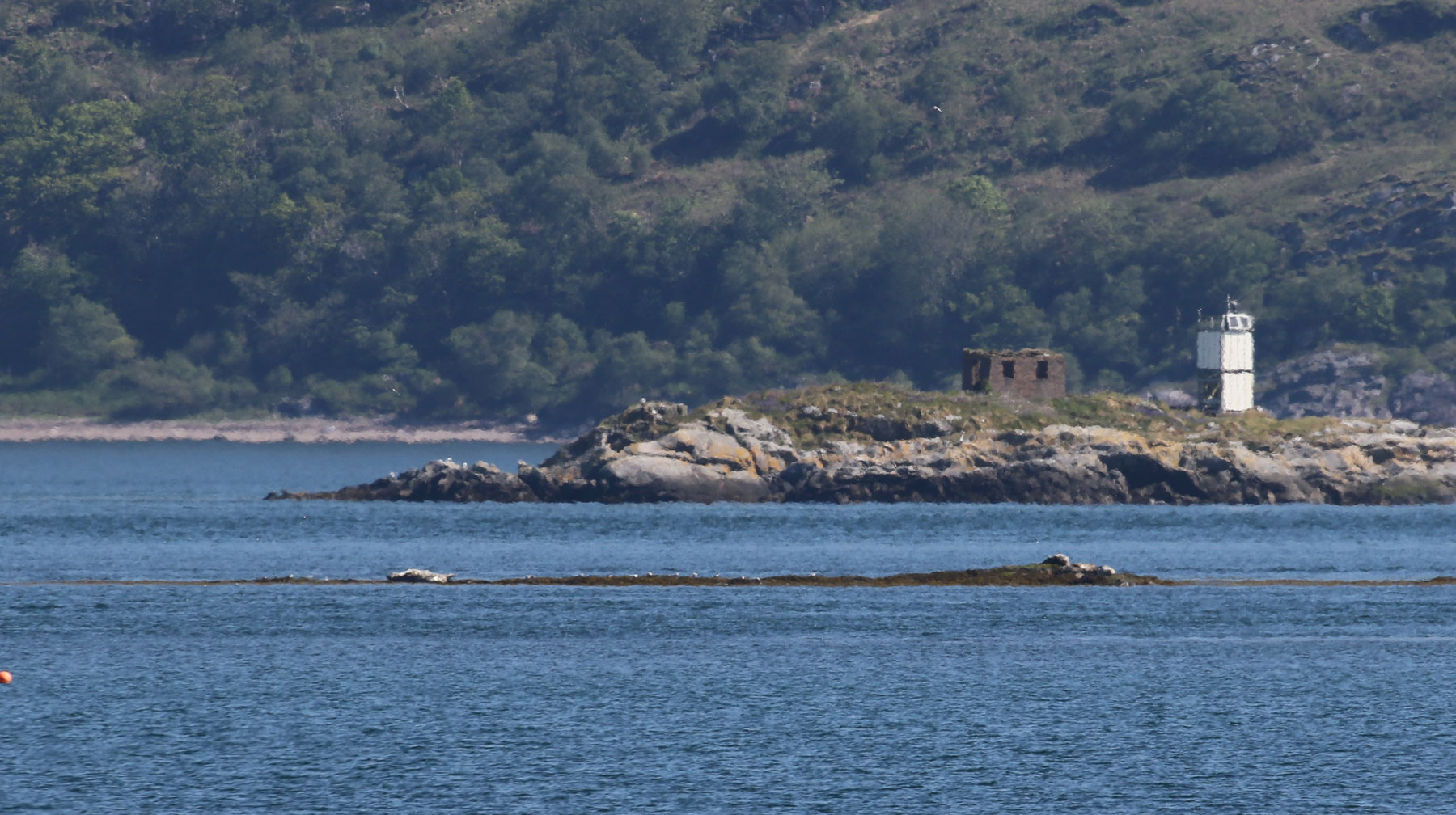
Hauled out on the rocks in the middle of the Sound were several Common Seals.
Next stop was Fishnish, just past our cottage, to hopefully see the bird we had watched before breakfast. The eagle wasn't there, but there was some activity on the beach. A pair of Common Gulls
Common Sandpipers could also be heard among the rocks while behind us a Willow Warbler sang and every so often there was the call of a Cuckoo. The Cuckoo would appear to be distant, then became a lot closer and after some searching it was found on one of the power lines.
The next stop was to be Loch Na Keal, we headed north to Salen and then turned inland and around to a small car park on the north shore. The target bird once again was a White-tailed Eagle. This is a reportedly regular spot where the adults sit in the tree and can be viewed quite easily both in the tree and flying back and forth. Needless to say on arrival we were told that both had just flown off. We waited but they didn't return, with time pressing we moved on again. This time to the south side of the loch almost opposite where we had been
Here there was a Golden Eagle nest in the mountain behind the loch and it would also be possible to watch for the White-tailed Eagles too. We stayed, watching, had lunch and were entertained by Meadow Pipits and Skylarks.
With both eagles a no show we moved on following the shore of the loch. Wheatears appeared to be everywhere, flying across the road and disappearing into the rocks.
The water of the loch was a deep blue and the tide falling which was revealling the sea weed and rocks on the beach and as we drove the search was on for possible Otter.
Another stop to view the island of Inch Kenneth produced a very distant Black Guillemot and and Great Northern Diver of which here is a poor record shot.
Inch Kenneth is one of the most historically important
islands in Scotland. Along with Iona, this island has a significant number of
important burials of the kings of Scotland. The island (Innis Choinnich) was
named after St Kenneth, who founded a monastery on the island.
Inch Kenneth was the home of the song writer and
philanthropist, Sir Harold Bolton. Bolton wrote the lyrics to the ‘Skye Boat
Song’. The island became infamous during the Second World War due to its
connection with the Mitford family, who bought the island in 1938.
Our next stop was to learn the story of "Tragedy Rock". At the foot of the 1,000 foot cliffs of Gribun stands Clach na
Leannan, the "Stone of the Courting Couple" or "Tragedy Rock" as we were informed. The stone is just 50 yards inland
from a road where it passes the first farm coming from Salen direction, with a
wind blown elder tree at the gable. With
the overhanging cliffs along this stretch of the road there are many occurrences
of rock avalanches after heavy rain or a passing sheep dislodging a stone.
In about the year 1700, in autumn, a young man named John, a
local shepherd was betrothed to Rona, daughter of a local blacksmith. The
couple had been fortunate in obtaining a small but cosy cot- house that stood
on a piece of flat land at the foot of the cliffs of Gribun. Their new home was
situated opposite where the wedding was taking place.
The wedding celebrations went on until dawn in the barn of
an old farmhouse. A storm had been threatening all day and broke in the night,
a great wind came roaring in from the sea accompanied by torrents of rain. As
time went on the newly-weds slipped out and hurried over to their little home.
With the noise of the storm, pipes and celebrations, no-one heard the dreadful
sound in the night when a great outcrop split, and a huge section rolled down,
coming to rest on and completely flattened the cot-house with the young couple
inside.
To be honest I was more interested in watching the Wheatears.
The road then winds up hill and through a pass that drops down toward Loch Scridiain. Heavy deforestation had taken place on either side of the road with just the tree stumps left to ensure there is no soil erosion. We stopped to search for Golden Eagle once again, but only found a Red Deer. A little further along a pair of Whinchat were perched in the remains of the trees by the side of the road.
We followed the north shore of the loch, searching once again for Otter on the beach and amongst the rocks without any luck. A stop at the end of the loch produced a pair of Red-breasted Merganser and Mallard but no sign once again of the hoped for Otter.
After a cup of tea we set off from the loch into Glen More.
The Glen is surrounded by peaks, the most notable being Be More the highest on Mull. The area is covered in grassland and on our previous visit to the island we had the pleasure of watching Short-eared Owls hunting. Today, the weather was still warm and the chance of repeating that were very low. We came to a parking area where there were already a few cars. This we were told was another site for a Golden Eagle nest. The location of the nest was pointed out but as with all our other stops today very little was happening.
Then from over the ridge appeared one bird quickly followed by another. Wings spread wide, squared with the primaries projected, pale patches in the wings and a long tail. No doubt immediately, our first Golden Eagle.
What followed then were some wonderful views of this iconic raptor soaring around the ridges of the cliff side and out over our heads. I have to say these were the best views I have had of a Golden Eagle in my life and they made up for the quietness of the day up to now.
The sandy, golden brown feathers on the neck give the eagle its golden name.
Settling on the cliff face for a while
Then soaring out overhead, never having to flap wings, just gliding and using the lift from the ridge and cliff face.
Pulling the wings into the body allows the eagle to stoop at some considerable speed.
The golden eagle is a massive bird of prey, with longer
wings and a longer tail than the rarer white-tailed eagle. White-tailed Eagles
though are slightly larger overall. Adults are mainly dark brown, with a golden
head and neck, while the young birds have white patches in their wings and a
white base to the tail.
We were told that there are now more Golden Eagles in the Argyll district than Kestrels, whether this is true I can't say. On Mull alone there up to 30 nesting birds.
It is a massive bird of prey that mainly hunts rabbits and
mountain hares, but will also catch foxes and large birds like grouse. It can
be seen soaring high in the sky in upland areas and remote glens in the north
and west of Scotland. Golden eagles have large home territories, nesting on
rocky cliff faces and in trees where it builds a giant nest or 'eyrie'. These
nests are often used by successive generations to rear their own young. Golden
eagles pair for life.
Coming briefly into the crag in the rocks that is the nest.
A truly wonderful sight.
We watched the Golden Eagles perform for just over 30 minutes before one drifted away and the other moved into the nest. It was time to move on, Peter was wanting to show us a White-tailed Eagle and we headed down to Loch Don where were able to see a nest in a tree. The views were very distant and even through the scope was a little unclear, no matter it was a White-tailed Eagle and we now knew another nest location.
So that was it, we headed back to the car at Craignure and then onto the cottage. After a bit of confusion over the location of my waking boots along with a trip back to Craignure we headed down to the beach to explore. The tide was coming in and it wasn't easy waling across the beach. We went so far and then decided to head back. In doing so we disturbed a Curlew and Whimbrel plus of course the ever present Oystercatcher.
Plus a good view of one of the local Common Sandpipers.
Walking back along the beach we had a view of our cottage.
Not a bad start day, the views of Golden Eagle surpassing my wildest dreams. The weather looks to be holding so expectations were beginning to run high for the rest of the week
Only a year late we were standing by the car at the Ferry Terminal in Oban waiting for the crossing to the Isle of Mull. The trip was originally booked way back in May 2019. The restrictions due to Covid last year meant that we were unable to go, so the booking was moved to this year. Since the turn of the year we have lived with crossed fingers, probably up until the second week of May when I think I felt confident enough to consult the maps and guide books once again. We left on Thursday evening and spent the night in Warrington just off the M6. On Friday we continued on to Oban where we spent last night. Standing by the car in the misty drizzle it was still difficult to believe we would be making the trip.
We boarded the Ferry just before 7:00 am, left the car and after a quick breakfast I was up on deck to watch as we pulled out of Oban harbour, the sea still and almost mirror like and while the clouds hung low over the surrounding hills and mountain the sunlight would break through albeit very watery.
The ferry maneuvered its way around the islands dotted outside of Oban, passing the lighthouse on Eilean Musdile.
The first birds seen were Guillemots on the water, then skittling away across the surface as huge ferry came too close for comfort.
Small groups would fly past, here mostly Guillemots but with a single Razorbill amongst them.
Looking behind as we headed onward towards Mull three Harbour Porpoise were seen in the wake of the Ferry
As we moved into the Sound of Mull we passed Duart Castle. The castle has dominated the view to the Sound of Mull and Loch Linhne for over 700 years. The castle being the ancestral home of the Clan Maclean.
With the ferry starting to slow as it approached Craignure I noticed two birds flying north on our port side. At first I thought they were Great Northern Divers from their size, but on checking what are basically record shots I could see that they were in fact Black-throated Divers, a very good start to the week.
We were not able to get into our cottage until 16:00 so we had to use up the time. Driving off the ferry we turned right, heading north towards Tobermory. The road at Craignure is of two carriageways, something of a rarity of Mull where the majority of roads are single carriageway with passing places. We soon though came across the single carriage way as we drove through the village of Salen, and this last almost all the way to Tobermory.
After parking we walked to the harbour where it is difficult to resist the iconic view of the buildings that line the harbour road, unfortunately the high tide prevented any reflections but I am sure there will be other opportunities.
Helen and I last visited Mull back in May 2008, then we stayed in the Steading's Flat at Glengorm Castle just a few miles north of Tobermory. With time on our hands we decided to visit and walk some of the paths we used to use back then. The road from Tobermory winds through forestry and open moorland. The highlight along the way was a Cuckoo on the power lines.
We pulled into the coffee house car park and the memories came back, unfortunately these memories for me did not extend to where to walk and we headed from the castle down the wrong path and having to detour back to the route we would have taken.
Soon though the views were also coming back as they stretched out across the sea with the Ardnamurchan peninsula, the furthest point west of the mainland of Britain and the islands of Eigg and Rum.
The first notable wildlife was an Irish Hare, which is a subspecies of Mountain Hare and the only species of hare found on Ireland, hence the name. They are also found here on Mull where they were introduced over 100 years ago.
Mull hares are slightly smaller, have shorter ears and white fur on the back of the legs, under the tail and on the ear edges, even in the summer. There is some debate about whether the mountain hares on Mull are related to the Irish hares because they also are found on beaches eating seaweed. However, the mull hares turn white in the winter, which is very rare among Irish Hares.
The area we were walking in was one of slacks and peat and moss where water was coming up through the ground as it made its way from the peaks to the sea. In places there were large clumps of Cotton Grass and in places the Marsh Orchids could be seen to bbe starting to flower.
The most dominant flower around us though, was the Bluebell with large patches spreading across the slopes of the hills.
As well as the Bluebells there were also plenty of flowers you would associate with the floor of a wood before the canopy closes over. Primrose, Lesser Celandine and Wood Anemone could be found all over the place.
More towards the sea and on the rocks of the cliffs overlooking the sea pink Thrift was in flower providing a lovely contrast against the dark grey of the sea.
Despite the overcast conditions there was a visible radiation presence and this brought out a few butterflies. This a Small Heath.
And a Green-veined White.
More views across to the Ardnamurchan peninsula.
In a round a bout way we managed, by crossing a stream, to find our way to the path we should have been on at the start of the walk. This lead us back towards Glengorm Castle. Highland Cattle were feeding in the field with also Black-faced Sheep and their lambs. With the sun coming out this Highland bull stood out against the dark grey colour of the surrounding sky.
After lunch in the coffee shop we headed south, stopping along the way for a pair of Buzzards harassing a Hen Harrier. We decided to head to the Fishnish peninsula on east coast of the island, an area that looks out over the sound of Mull.
As we stood scanning the shore line and the Sound we were surprised by a very large bird that flew over and headed west toward the mainland. As it went it was mobbed by a Hooded Crow and from the size difference it could only have been a White-tailed Eagle.
Still with time to kill we decided to walk a forest loop. At the start a Willow Warbler, one of many present on the island, was singing from the top of a Spruce Tree.
It was a nice enough walk, but with high trees on either side of the path not possible to see anything special. The one item of interest being this Common Heath moth.
By the time we had returned to the car park it was time to travel the one mile to our cottage for the week. Just off the main road it had views out across the Sound with distant conifers that appeared perfect for an eagle watch point and sea wrack covered rocks calling out for an Otter to visit. Time would tell what the week here on the beautiful island would bring