Friday, 13 December 2013

6th December - Titchwell, North Norfolk

We had booked to visit the North Norfolk coast in January to see the geese, but close to the time, snow was forecast and we postponed the trip, until late February and the geese were gone, and the chance missed.  So we decided to try again, and booked ourselves into the Rose & Crown at Snettisham for this weekend.  There was no full moon, and the tides were high.....too high!

On Thursday the forecast was for a storm surge that would send very high tides along the east coast and the north Norfolk coast.  I was aware that Snettisham would be closed until Saturday morning, but no one really expected to see what actually happened.  We set off early on Friday, and arrived at Titchwell around 9.30 to be greeted with the news that the tide had washed away all the dunes on the beach, and that the sea had just failed to breech the walls surrounding the freshwater pools.  The reserve was only open as far as the Island Hide, and clearing up work would maybe allow the reserve to fully open later.  Snettisham had fared much worse though, the sea wall had been breeched, and the Roost Hide was completely gone, nobody could find it, and another hide had been turned upside down.  Snettisham was to be closed for the foreseeable future.

We decided to walk around the autumn trail first, it was clear and cold with still a brisk northerly wind blowing.  There was very little about and no calling birds.  For my first time ever at Titchwell I could see the sea from the reserve, in the past the dunes hid the breaking waves of the sea, but now there they were in full glory, the white breakers clear against the dark grey blue of the water.  As we looked at the sea, a Marsh Harrier came into view, probably scavenging for anything that had drowned in the flooding, it must have been considerable


We walked back to the main west bank path, and walked to the Island Hide.  On the top of the bank, which must have been about two metres high there was weed, and the odd bucket and plastic bottle, deposited there as the tide receded, the whole marsh to the west must have been one big lake.

In the hide we settled down to watch the wildfowl returning to the freshwater pool.  We could see Teal and Shoveler and in the distance was a large flock of Wigeon.  Brent were also dropping in and there was also a steady movement of Greylag Geese.  As they flew low over the water the weak December sun appeared to make them glow as they flew over.


The hide faced east, and the sun was shining in through the viewing holes, and providing a little warmth now that we were away from the fresh breeze.  The seed heads of the reeds were back lit by the sun, and looked like golden feathers standing upright.


The ducks and geese were coming and going and would fly low towards us, providing the ideal opportunity to capture them in flight.  First were the Brent Geese.


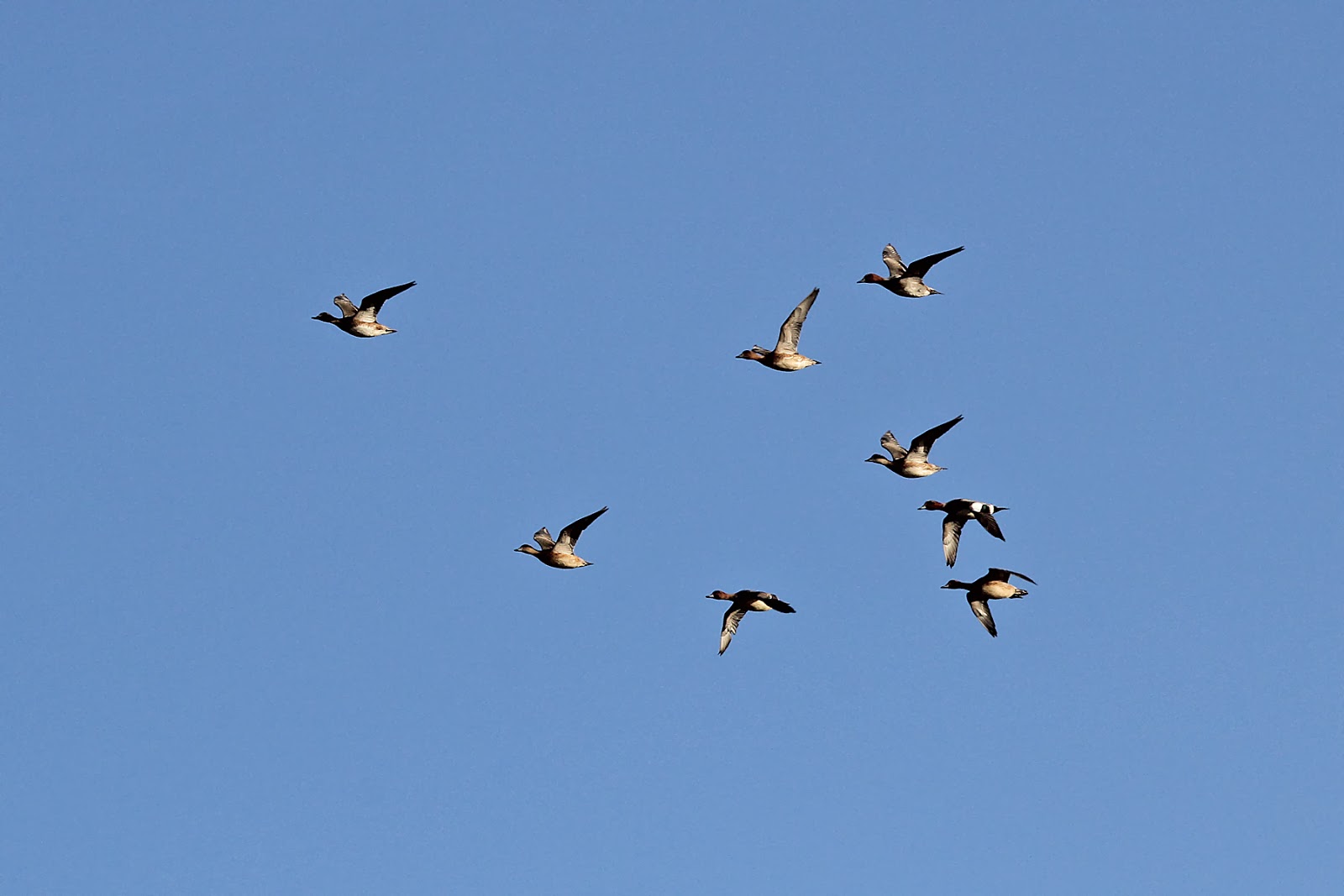
Then a flock of Wigeon came over but just a little higher.  When you see them on the water they do not appear to have a tail, but in flight it is very pronounced as a point.

The Island hide always seems to be distant from the birds, but every so often a pair of Teal would swim by.  This pair came past us and into the shimmering and sparkling water created by the low sun.


We noticed that people were walking beyond the hide along the west bank, and heading along the path to the new hides.  The clean up work had progressed well, so we decided to head on and try our luck in the new hides.  As we walked along the bank this male Shoveler was preening and it provided a view of its spatula shaped bill as it scratched its chin.


The new hide on the freshwater pool is probably the "creme de la creme" of hides, space lovely windows and seats and none of the feeling of a confined space.  The one problem though is it faces south, and at this time of year on a sunny day it is difficult to see anything but dark shapes.  Consequently you are looking to the side, or just in front of you hoping that there is something to see.  

Fortunately there was a group of Teal feeding by the edge of the water, their heads and speculum changing colour as they moved and the sunshine caught the feathers at different angles.


They were quickly joined buy a small group of Wigeon.  From a distance the Wigeon looks like a grey body framed with black and white, and a brown head.  But up close that impression changes.  The grey is made up with a series of wavy black lines on a white background.  These are vermiculations after the Latin name for a worm, mainly because they resemble the wavy pattern of a worm's trail.  The brown head is a deep red chestnut, with a stripe yellow ochre that could have been put there with a paintbrush.  The breast is incredible, what colour is it - pink?  Not really, but then its not orange either.

This drake swam around with it's ducks in tow.


Then finally found a shallow patch and stood there to enjoy the midday sunshine.


There are two birds I tell myself I must resist in photographing, one I failed with already today, and as of yet I had not seen a Little Egret.  But another male Shoveler swam past the hide quite close, and I couldn't resist any more.


After coffee we popped into saltwater hide, there wasn't much about, and as the path the beach was now open we decided to head there.  On the mud as we walked along the path was a Bar-tailed Godwit.  It makes a change to see these as opposed to their cousins the Black-tailed which are more common down where we are.  The bill is not so up turned and there is no black tail, but it is when they fly and there is no white wing patch that you realise how different they are.


The light was also making the mud appear very cold.

We walked down a very muddy path to the beach.  There had been a boardwalk through the dunes, but this was now totally destroyed, and in fact there was now no real need for one as there were no dunes.  All that was left was patches of Marram grass that was still rooted into the sand, and the sea had not been able to move.  This is looking west, the wooden stakes you can see in the foreground are the remains of a sea watching platform.  Away in the distance you can see a person standing by a dune, this gives an indication of how much sand has been removed.


We walked along the beach, stopping to check flocks of Goldfinch and Linnet for anything a little rarer.  we couldn't find anything, and by now it was very cold so we decided to head back to the hides and another coffee.

Back on the saltwater marsh, the godwit had been joined by a Grey Plover.


And a little further on there was a Spotted Redshank feeding very energetically in the water still remaining in one of the channels.  Again the light gives both the mud and the water a blueish haze, emphasising the cold.


Back in the hide the light hadn't improved very much, and you were still looking at the dark shapes, but they also added a little atmosphere to some of the scenes.  This Bar-tailed Godwit silhouetted as it preened by the edge of one of the islands.


While these sleeping Teal have a silvery look to them caused by the grey clouds and weak winter sun.


There was a sandy bar in front of us, and there was a group of Pintail at sleep.  A few though were a little more active, but always distant which was very frustrating as this is a lovely duck with the males white flash in the chocolate brown head distinctive.


In amongst the Pintail was a small group of Avocet.  These three were a little more adventurous, and moved away from the sand to feed in the shallow water.


A drake Teal swam close past the hide window, again an opportunity not to miss.


The grey of the Teal's flanks turns out to be just like the Wigeon's, wavy black vermiculations.

We decided to make our way back to the car, the sun was now beginning to drop, and we wanted to see if we could find a spot to watch the geese heading off to their overnight roost.  As we came out of the hide and turned onto the west bank again the Spotted Redshank was feeding in exactly the same spot as we had seen and photographed it in February.


Walking along the path towards the visitor centre I noticed a small thrush sized bird flying low at speed, it looked different and when I managed to get on it I could see it was a Merlin.  It sped though upsetting a few Teal, and then out over the reed bed.

On the other side of the path two Marsh Harrier drifted above the reeds, their wings held in a "V", and as they did they would rock from side to side as the watched the ground and reeds below them.


We were advised to drive to Cholsey Barns, a short distance from Titchwell, here we could sit and wait and the geese should head over us towards their roost in the Wash.  We found the site quite quickly, the fields around us were dotted with coveys of Red-legged and Grey Partridges, and as we sat watching the sky you could hear them calling along with pheasants.

We waited and it got gloomier, and gloomier.  The partridges became dots, but other shapes emerged too.  Larger ones lopping across the field, these were Hares, and when one suddenly turned and scampered off I scanned the sky and picked up a large falcon, it could only have been a Peregrine zipping across the field, no real threat to the Hare, but probably one to the Partridges if the they panic and fly.

The Peregrine continued away to the south.  I could see small flocks of geese in the distance, but nothing over us.  A Hare came onto the road, and lopped past the car on Helen's side and then off into the field behind us.  Finally Iheard Pink-footed Geese calling and looking up I saw six flying just below the cloud.  "Six?  Only six!" was what the barmaid said when we told her in the evening, so it would seem we were sent on a wild goose chase!  But then we did manage to see Peregrine, and Hare up close so not all was lost.

Monday, 4 November 2013

1st - 2nd November - Sidlesham, West Sussex

Every so often we like to get away to what we consider a very special place.  I have always loved the area around Selsey, Sidlesham and Pagham Harbour, and the Crab and Lobster at Sidlesham provides the perfect base in every degree, good walks, good food, and lovely accommodation.

On Friday the morning had been damp with drizzle and the occasional heavy shower, but when we arrived it had dried out and the sun was even looking to break through.  Checked in, changed and we set off for the north wall of Pagham Harbour.  As we walked along Mill Lane a male House Sparrow was taking a bath in the puddle by the road, but as I went to take a photograph it flew up into the bush.  As we walked past though it returned to its ablutions.


We took the path through Halsey's Farm, and then out and across the fields towards the sea wall.  As we approached the wall, a brown bird that I initially thought was a thrush flew from the hawthorn, and along the hedge and then up into a branch a little in front of us.  I checked it with my binoculars and noticed that it clearly was not a thrush, and the shape of the head and beak told me it was a shrike.  I quickly took some photographs, and then started to edge closer. 


There were faint barrings on the flank, and the chest and belly were white.  The back, head and neck were a greyish brown colour, while the tail and rump showed more showed more as a reddish brown.  The bill was pale and large. I was thinking it was a Red-backed Shrike, but it was late in the year for one, so I started to see if I could get some better pictures.

It flew off again, but seemed to settle and it allowed me to move in closer.
 

There were no features that made me seriously consider anything other than Red-backed, but I did consult the internet and books when I returned to the hotel.  It was a Red-backed, and as for it being late interestingly there was one reported on St Mary's in the Scilly Isles on the same day.  It flew on once again, and then would fly down into the grass and caught an insect which it banged on a branch before eating.  As we edged closer again it flew back around me and then over the hedge and out of sight.  We waited for awhile but it didn't re-appear, so we decided to walk on and leave it hoping it would be there when we came back.  I also wanted to see if there was anyone else who had seen it.

Up on the wall, there was a pair of Stonechat perched at the top of the bramble.  There are birds that I love to photograph, and you will see a few in this post.  Stonechat are definitely one of them.  This male performed beautifully.


The tide was out, and there were several waders on the mud as we made our way alonmg a very muddy path.  Oystercatcher, Redshank and Grey Plover could be seen, and the Curlew were both seen and heard calling.  The sun light was low, and filtered through the cloud.  At this time of year the light is always special here, and this evening it lit up the curlew on the mud.


A Mute Swan swam in one of the open rifes, the still water providing a lovely reflection.


We walked around to the Breech Pool, and by now the clouds were returning, but as ever the clouds seemed to enhance the marsh as the sun squeezed some light out from behind them.


Unbeknown to me Helen watched this Snipe fly in and settle on the far bank of the breech pool. When the sun did manage to get through it lit up the Snipe as it preened with its long thin bill.


We walked on to the sluice in the hope that the Kingfisher might be there, but we were out of luck.  There were though several Wigeon by the edge of the water and dabbling in the water in the channel, and they always look very smart.


Scanning across the open mud, the light was making it look golden in colour, and this pair of Wigeon were silhouetted against the mud.


We left the sluice and started to make our way back.  At the breech pool, Black-tailed Godwits were starting to fly in to bathe and feed.  In total I counted 37, but it was likely this number was higher as they continued to drop in as we walked away.


As we walked back up to the stile at the end of the wall, I picked the shrike up again, it flew from the bush the Stonechat were in, and then back to the main hedge by the footpath.  We watched it for awhile, but by now it was beginning to get a little gloomy.  Finally it flew up again and over the hedge. 

On the stream leading to the wall, a small group of Teal prepared themselves for the night time.


We walked back past the Crab and Lobster, and then around Sidlesham Quay, there had been a report of a Hen Harrier during the afternoon, and as we walked we scanned the march, but there was nothing.  We walked as far as the gate for the visitor centre, and checked the stream by the path for Kingfisher.  All was very quiet and we slowly made our way back in what was now a gathering darkness.  Looking across the marsh we could see a very welcoming sight.


The next day after a very substantial breakfast we set off in sunshine and a stiff breeze to walk to the new area around Medmerry.  There was quite a bit of activity along the footpath, with Chaffinches, Greenfinches and Goldfinches feeding and drinking on the path, and chattering away in the hedges.  Looking across the field there was a little gathering of Yellowhammers too.


The tide was rising, and the stream by the gate and footpath had more water in it, but no Kingfisher, there was though a Little Egret.  Watching it I recalled the egret I had seen at Titchwell, where the yellow of the feet extended up the ankles.  This bird had glossy black feet, like a pair of PVC leggings, and there was a definite contrast with the yellow feet and toes.


We went through the gate and headed towards the visitor centre, on both sides of the path there was a considerable amount of scrub, with plenty of teasel.  This was proving a big attraction to the Goldfinches, and large flocks would wheel away above us with tinkling calls, and then drop back into the bushes and scrub.  The sky was changing all the time, with blue sky and then dark clouds as the breeze moved the clouds through.  The goldfinches were contrasted sitting in the bushes against the dark clouds.


With tide rising it was worthwhile checking the Ferry Pool, but apart from a few Redshank and these Wigeon there was little to report.


We took the footpath that leads towards Ham, it was a concrete road, and was used by the construction workers for access to the Medmerry site.  As we walked alog I saw a Staot break from under a bush, and then race through the grass and back into cover.  Away in the distance there were also two Roe Deer, the first I have seen here for some time.

The sun on the ivy was an attraction for the insects, and above all butterflies in the form of Red Admirals.  We saw many through the day, and despite the ever increasing wind they were also on the wing.  This individual though did look rather tatty.


We left the protection of the hedges and came out onto a footpath that was in open fields.  The wind was constantly increasing, but for now it was coming across us and not a major problem.  Scanning across the fields again I found three more Roe Deer.


As it turns out we were going to see at least another nine Roe Deer on the walk so much for not having seen any for sometime here.

We then decided to take the new path to the north of the Medmerry site, this would take us to the Bracklesham arm of the works.  The area has been under constant threat from coastal erosion endangering the homes and livelihoods of people living on the peninsula.  The Environment agency has built pioneering sea defences.  The sea has been allowed to breach inland, so producing a vast area of flooded wetlands of both brackish and freshwater habitats.  The area is owned by the RSPB, and will become a major reserve in the are, but for now it is very much work in progress.  We made our way as much as we could along a new path but were forced to turn back when the path ran out, and we did not fancy walking through mud.

Wildlife was not that evident, although we did come across huge flocks of Jackdaw, Rook, and surprisingly Stock Dove, I don't think I have seen so many for quite a while.  With the wind getting even stronger we walked on back to the main road, and then took the road to Ham farm.  here the path leads to the new sea wall, and in the wind we could see large gatherings of gulls, and Canada Geese but not much else.  On Monday the 4th November the area is supposed to flood for the first time as a high tide breaches the area, that may start to make a difference.

We turned back, and set off across the fields to Church Norton, where fortunately it just started to rain as we were near the hide.  This was then the perfect spot to tale a rest and enjoy a coffee, while watching the waders return to the emerging mud as the tide receded, and up to five Great-crested Grebes in the main channel.

I managed to find the reported Spoonbill way off towards the spit.  It was too far to photograph, which was a shame as for a Spoonbill it was incredibly active, feeding in the shallow water with the heading sway movement that characterises the bird.

The rain stopped and the sun came out so we set off once again.  Looking across the mud I found a very pale, almost white Curlew feeding, at first I thought it was a Little Egret it was so pale, but I was able to make out the bill, and some markings on the wings

Birds could be seen everywhere in the channels that were created by the saltmarsh.  This Grey Heron looked wonderful in the sunlight as it fished in the falling water.


One bird I expected to see a lot of this weekend was conspicuous by its absence, I saw a few away in the distance, but this was the largest flock of Brent Geese we came across.


As we made our way along the muddy footpath every so often we would come across a Curlew in the long grass or amongst the marsh.  This one was feeding by probing under the grass,m but finally put its head up to allow me this shot.


We had walked a fair distance, but felt we need to do a bit more, so we decided to walk again to the north wall.  The wind by now was very strong, and I wasn't surprised to find that the shrike having been seen this morning had now disappeared.  We walked past a few birders standing in the field waiting for it.  There was also no sign of the stonechat as we made our way on to the wall.  There were the usual birds on the mud and the breech pool, and this Grey Plover looked quite splendid in the evening light.


The wind was very strong, and we made our way back below the wall to keep out of the wind, and then back for a drink, a bath, and our evening meal.  Another lovely weekend in this wonderful location.

Sunday, 13 October 2013

12th October - Titchfield Haven

I met up with Ian in the afternoon, after checking the patch in Four Marks this morning.  The weather was lovely now, sunshine and a light breeze, and the tide turning.  We were at Titchfield Haven, and it was a chance for me to get familiar once again with some water birds, birds that are hard to come by in Four Marks.

This is going to be more of a photographic post, as there really was no narrative to go with them, the birds came to us, and we sat gratefully in the hides and enjoyed them.

First up was a Little Egret that presented itself in front of us, on the dead branches positioned in the river to do exactly that.  They are an easy to photograph bird, but never fail to be impressive.


I always knew the feet were yellow, but never realised that the yellow merged up the leg as well.

A Grey Heron was also about, and it spent its time wading through the shallow water, drinking and rubbing its bill on the wood.  It did stop for a bit of preening, and this with the reflection reminded me of the pose of a Black Heron.


Little Grebes had been calling all the time, and they were also fighting each other, this one swam past the hide quite quickly as it escaped the attentions of a quite aggressive one.


Moving to the West Hide it immediately became apparent something was missing.  The last time I was here all I could hear was the constant calls of the breeding Black-headed Gulls, today it was quiet, but there were birds on the scrape.

A Snipe was feeding on the edge of one of the islands.


We also found a Curlew Sandpiper but it was too far away for any decent photographs.  The Black-tailed Godwits though did oblige and came close to the hide.


Beautifully marked birds which was enhanced by the October sun.  There was a small gathering of Starlings on the islands, and as always they provide some good entertainment.  This little group flying down to the shallow water on the edge of the island to bathe


A shrill whistle and we both called Kingfisher, and we watched as one flew past the hide, then back, and perfectly onto the depth marker right in front of us.  Cue camera shutter to record this absolutely gorgeous bird.


After the Kingfisher left we remarked on how a relatively common bird always manages to capture the imagination, and agreed that they were up there with a Barn Owl sighting which has the same effect.

We left the hide and walked around to the north side.  This gave us some different views of the Black-tailed Godwits.


We also managed to re-find the Curlew Sandpiper, and this time it was just within range.


There were plenty of teal and shoveler, in various stages of eclipse and full plumage.  This did not endear them to photography, and for once I turned my attention to this Moorhen as it swam across the scrape, I loved the reflections of its bright red bill in the water.  You should never overlook anything.


Wigeon were calling, and you could find the odd pair around the scrape.  I finally managed to find a male Teal that was almost in full breeding plumage, and with the sun, and the reflection it composed a lovely scene.


The afternoon had flown by, and now it was time to leave.  The need had been satisfied, and maybe I should do this more often, but even as I watched the birds here, I couldn't help thinking what maybe about back home, was that Yellow-browed about?  Still it was a really nice afternoon both from the bird perspective, and the company