After what was a glorious August the weather changed on Friday, with much cooler conditions and a lot of rain. The rain continued overnight and into the small hours of the morning. As I headed towards Lymington there was still dampness on the roads, and with the clear skies, plenty of mist. As I pulled into the car park at the marshes the sun was trying to burn off the the mist that was hanging over the marshes.
The teasels close to the fence were covered in cobwebs, that in turn were covered with dew, and shining in the early morning light.
As the sun climbed higher the mist began to recede and the distant trees emerged.
I had met up with Ian, and we headed down the side of Fishtail Lagoon, heading for the sea wall. We stopped to scan over the pools at th back of the lagoon and immediately found two distant Little Stints. This reserve is an excellent place, but it is essential to use a Telescope as many of the birds are quite distant from the viewing points, this also makes it a challenge for photography.
As we stood looking at the pools, there was a sharp shrill whistle, and we turned to see in disbelief, two Kingfishers in the elder tree quite close to us. It took a little while to realise that there was the opportunity for a photograph, and as the cameras were raised the Kingfishers were off again with another sharp whistle.
We made our way to the sea wall, where the tide as already coming in despite high tide being around 13.00. Looking across Fishtail, a Cormorant sat on the island drying its wings.
Another whistle, and I turned again to see a Kingfisher on a post in the water, as I raised the camera it was off, but I did manage to capture a record as it flew away from us once again.
As the Kingfisher few away into the bushes, all that was left on the water was a Little Grebe, only a silhouette in the early morning gloom.
We walked on to get a better view of the pools where the Little Stints were. We counted at least eight Little Stint as they fed amongst the larger and bolder Dunlin.
As well as the Little Stints there were several Dunlin, a single Greenshank, two Curlew Sandpipers, and a Common Sandpiper. There were also Teal, Mallard, Gadwall, and a shoveler all in eclipse plumage.
Every so often the waders would be spooked and would fly around the marsh, only to return to the same spots. As the sun came out it would highlight them.
We walked up to Keyhaven Lagoon where there were two Curlew Sandpipers and about twenty Black-tailed Godwits, but again very distant, so rather than hang around we returned back towards Fishtail. We stopped again to watch the stints, and as we did so five Knot appeared, at first settling at the back of the lagoon, but they soon were off, this time coming to rest on the small sand island.
They were clearly restless, and were off again flying over our heads and out on to the salt marsh.
Next stop was the Jetty lagoon, where we did manage to find the two Wood Sandpipers but these were at the back and would move behind both the little grass islands, and the Canada Geese making it impossible to get a credible photograph.
There were several Black-tailed Godwits and a single Curlew Sandpiper that showed well.
As we stood watching the waders large skeins of Canad Geese were strung out across the sea heading for the lagoon. We watched them as they came in low skidding across the water.
Pretty soon the water was covered with them, and the air filled with the calls of the geese.
We moved on again, around the sea wall, and past the jetty. A little further on we disturbed a Wheatear in the grass on the edge of the sea wall.
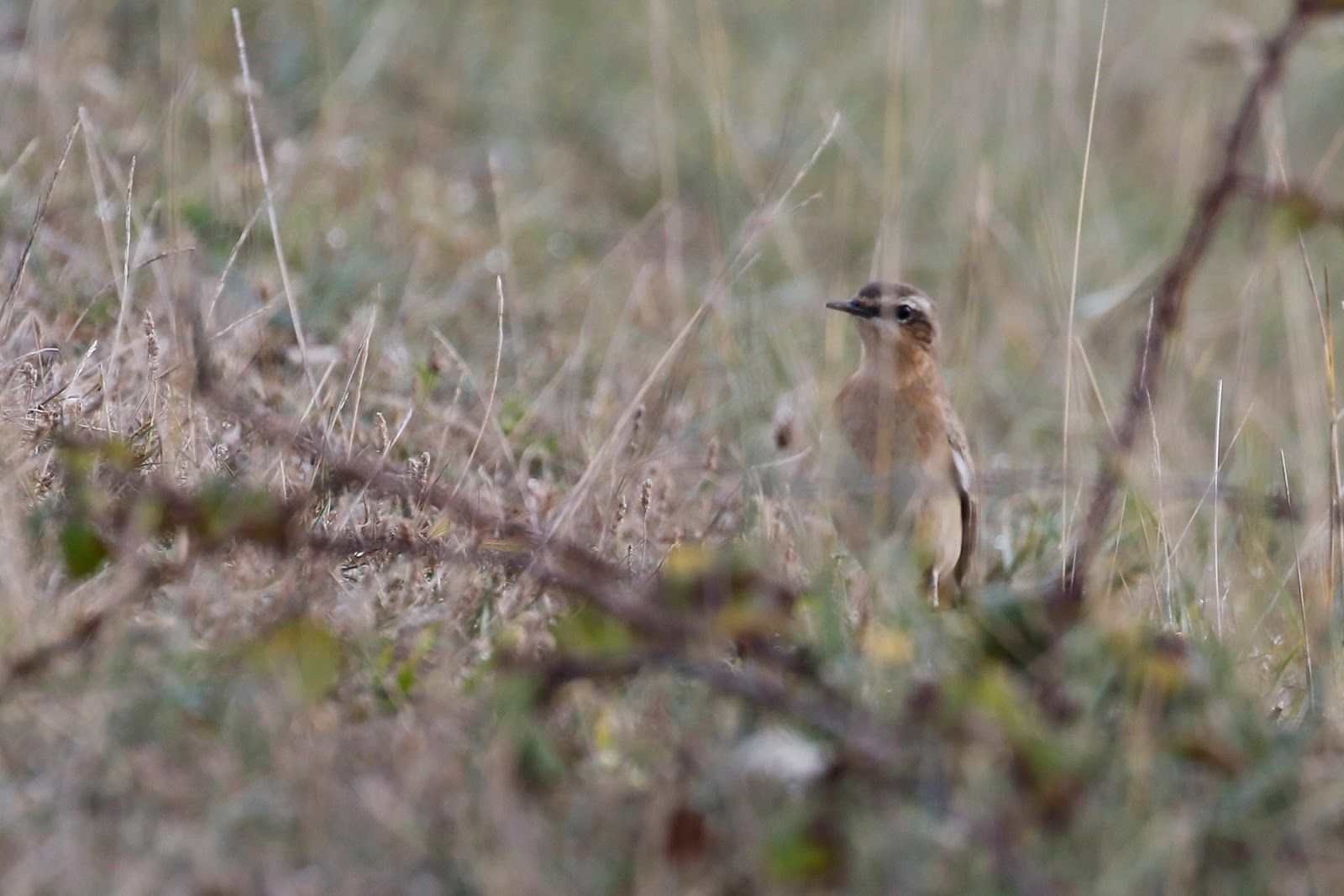
As we edged forward to get a closer look we flushed it and it flew down onto the beach.
We carried on around the path, past Butts Lagoon where there were several Ringed Plover feeding in the familiar style where they move gentling, and then stop to bend down slowly to peck at anything they have found. Contrast this with the energetic clockwork action of the stints and the Dunlin.
We had hoped for a Spotted Redshank on Oxey Marsh, but could only find Redshank, and this single Greenshank.
From here we made the long trek towards Normandy Marsh, it is this part of the walk that can be a little boring, as you turn back on yourself crossing the outflow. A Kingfisher put in another rapid appearance speeding off with a whistle just like roadrunner.
At Normandy most of the waders were very distant. We counted at least six Greenshank, and seven Knot amongst the usual fare of Dunlin and Redshank. Two of the Knot then came close to the sea wall.
The sun of the early morning and the still calm conditions had now disappeared and we were under darkening overcast skies, and a very strong westerly wind. The forecast was for rain in the afternoon, but it was still only 11.00 but rather than hang around we decided to head back. Rather than walk around the sea wall we crossed the marsh to reach the jetty, where at first we found a single Eider, which from nowhere became three, only to turn into a raft of fifteen Eider.
We made our way back to the Jetty Lagoon to see if the Wood Sandpipers would be a little more confiding and come a little closer. The lagoon was still covered with Canada Geese, and the numbers of Black-tailed Godwits had increased, but more importantly one of the Wood Sandpipers was closer to us on the sea wall, not a lot but closer to allow the chance to get a photograph.
Of the three commoner sandpipers we see in the UK, the Wood Sanpiper is much longer legged than the green and common.
The wind was now quite strong, and it meant it was necessary to rest the camera on the telescope to keep it still.
We walked back to Fishtail, then back again to walk down the footpath to check the fields, which were pretty much dry, and empty, other than a large flock of Goldfinches on the teasel and Thistle heads and a single Wheatear.
After dropping off the scopes we walked down the cycle path in the hope of some small birds, but the fresh wind meant that very little showed. On the lake by the reclaimed land were Tufted Duck, two Great-crested Grebes and several Sand Martin. On the bank a large roost of gulls including Great and Lesser Black-backed Gulls.
We were also searching for Whimbrel, but with no luck. As we headed back Golden Plover called and then two flew over our heads and out to the back of Fishtail.
We scanned the lake, and Ian asked for a Common Sandpiper, and I duly found one.
After stopping for lunch we headed back out to the lagoons, walking along Fishtail where a solitary Greenshank was standing amongst the Dunlin and Little Stints once more.
From Fishtail we walked around to Keyhaven, and as we reached the corner, in the deeper water was a Spotted Redshank. As it fed the head was almost always under the water, and it moved closer to the reeds.
With the tide now at its highest the lagoon at Keyhaven was full of feeding and roosting waders. Close in were several Black-tailed Godwits.
And at last some Curlew Sandpipers that were close.
It is slightly larger than the Dunlin with a longer neck, and legs.
The bill is also longer, finer tipped, a with a more evenly decurved bill.
These were I think juvenile birds with an unmarked belly and a prominent supercilium.
Here you can see the comparison of the much greyer Curlew Sandpiper with a paler belly than the Dunlin behind it.
At the back of the lagoon was a large roost of well over 100 Grey Plover, some of which were still in summer plumage.
We headed back to Fishtail to see if the Spotted Redshank was showing better. It was still there and with a Greenshank. The Greenshank flew off leaving the Spotted Redshank still feeding vigorously, but finally it slowed up and allowed us to get some views of the head.
And that was it for me, domestic duties called and I headed off home leaving Ian to go off in search of more goodies.
Not a bad day with some quality waders, eighteen wader species not a bad day total. We missed Bar-tailed Godwit, Whimbrel and maybe Green Sandpiper.
Sunday, 4 September 2016
Monday, 15 August 2016
5th August - Saltria to Verona, Italy, and the Holiday Wrap Up.
Well the forecast storm for today duly arrived, the tables safely stacked away on the terrace in preparation for the change in weather was not in vain.
As we had breakfast the witches on top of the pine trees at the back of the hotel were whizzing about in a ferocious wind. We packed our bags after breakfast in preparation for a long day our plan had been to spend the time once we arrived inVerona in the city as our flight was not until 22.00 that evening, but if this weather was the same in Verona it would be very difficult to know what to do.
The taxi arrived just before 10.00 and our journey began, winding around the mountain roads back to Compatsch, and then down the slopes into the mist and cloud to Kastelruth and then onto Bolzano. We passed many of the towns and villages we had walked through but they looked so different in the rain and mist.
At Bolzano we boarded our train to Verona. Unlike the journey here two weeks agao, the train was starting from Bolzano so we had time to get a seat and get the bacgs stowed easily.
It was just over two hours to Verona, the train stopping at many local stations. The weather though was not behaving, after easing around Trentino, it came back with a vengance as we approached Verona, and as we got off the train, I can't recall seeing rain like it. The heavens had literally opened.
We decided to wait it out and stopped for a drink in a cafe. But unlike the journey two weeks ago the station was packed. We decided to put our bags into the left luggage, and then attempt to get into Verona. There were signs the rain was easing and blue skies were on the way.
There was a large queue for the taxis, and we waited, finally getting one as the rain eased and we headed into the city, being dropped off at the Arena.
The rain had stopped and the sun was coming out. We had been here a few years ago so we set off down the main retail street in the direction of Piazza Erbe.
The last time we came here the rains came, but now we were lucky as we had blue skies.
We found a restaurant where we were able to get a good meal and drink, we had to pace ourselves for the long night ahead.
After the meal we wandered the streets taking in the lovely alley ways and colourful buildings so typical of Italian cities.
Open windows, feathery plants and frescos.
Buildings painted in earth colours.
And a mixture of culture and style, these windows portraying classic movie scenes.
But you are never far from a church tower.
It is the Arena that Verona is famous for. It is one of the best preserved ancient structures of its kind. The building itself was built in AD 30 on a site which was then beyond the city walls. The shows and games staged there were so famous that spectators came from many other places. Today the arena is used for open air opera and other major concerts.
the wonderful arches are fully intact.
As we had breakfast the witches on top of the pine trees at the back of the hotel were whizzing about in a ferocious wind. We packed our bags after breakfast in preparation for a long day our plan had been to spend the time once we arrived inVerona in the city as our flight was not until 22.00 that evening, but if this weather was the same in Verona it would be very difficult to know what to do.
The taxi arrived just before 10.00 and our journey began, winding around the mountain roads back to Compatsch, and then down the slopes into the mist and cloud to Kastelruth and then onto Bolzano. We passed many of the towns and villages we had walked through but they looked so different in the rain and mist.
At Bolzano we boarded our train to Verona. Unlike the journey here two weeks agao, the train was starting from Bolzano so we had time to get a seat and get the bacgs stowed easily.
It was just over two hours to Verona, the train stopping at many local stations. The weather though was not behaving, after easing around Trentino, it came back with a vengance as we approached Verona, and as we got off the train, I can't recall seeing rain like it. The heavens had literally opened.
We decided to wait it out and stopped for a drink in a cafe. But unlike the journey two weeks ago the station was packed. We decided to put our bags into the left luggage, and then attempt to get into Verona. There were signs the rain was easing and blue skies were on the way.
There was a large queue for the taxis, and we waited, finally getting one as the rain eased and we headed into the city, being dropped off at the Arena.
The rain had stopped and the sun was coming out. We had been here a few years ago so we set off down the main retail street in the direction of Piazza Erbe.
The last time we came here the rains came, but now we were lucky as we had blue skies.
We found a restaurant where we were able to get a good meal and drink, we had to pace ourselves for the long night ahead.
After the meal we wandered the streets taking in the lovely alley ways and colourful buildings so typical of Italian cities.
Open windows, feathery plants and frescos.
Buildings painted in earth colours.
And a mixture of culture and style, these windows portraying classic movie scenes.
But you are never far from a church tower.
It is the Arena that Verona is famous for. It is one of the best preserved ancient structures of its kind. The building itself was built in AD 30 on a site which was then beyond the city walls. The shows and games staged there were so famous that spectators came from many other places. Today the arena is used for open air opera and other major concerts.
the wonderful arches are fully intact.
The round façades of the building were originally composed
of white and pink limestone from Valpolicella but after a major earthquake
in 1117 that stone was used for other buildings and the arena built using local
limestone
As you walked around there were many props and scenery from the shows that were being performed.
An array of weapons.
It was time for an ice cream, and a walk back to the railway station to pick up the bags. The railway station was a lot quieter than when we left, just one dog waiting in the taxi queue.
It was then a short bus ride to the airport where we sat and waited to check in for our flight home. Plenty of time then to reflect on what had been a wonderful holiday.
In order of visiting the hotels and our thoughts;
Gasthof Zimmerhof, Radein
A wonderful start to the holiday, a lovely hotel in a wonderful location with stunning views. The room was nice and big with a lovely balcony. The food was excellent, although the packed lunch could have benefited from some of the detail. The staff were very attentive, but not intrusive and the waitress Susanne was excellent. You felt welcome, and not just because you were a paying guest.
Gasthof Krone, Aldein
Set in the middle of the village and next to the church the hotel will never be forgotten due to the proximity to the church and the constant bells throughout the night. The hotel was small, the rooms small too. The food was good, but lacked that special touch. The waitress was very nice, but overall the hotel had the feel that something was not well. We were happy we only had one night here
Hotel Kohlern, Kohlern
Again a wonderful location overlooking the valley and Bolzano. The room was nice and big with access to the views. The hotel was quite busy, and it was difficult not to be thought of as second rate. having a superior room would have been considered qualifying for maybe good restaurant and terrace seats, but on the two nights we were there we were rlegated to seats at the back, away from the view. The food was good,a nd the wine list extensive, it was shame we felt out of place.
Hotel Cavallino d'Oro, Kastelruth
This was only Bed and Breakfast board and it was nice to be able to go out and find your own restaurant, although the hotel helped. The staff were excellent prepared to help out and give advice. The breakfast very nice, again with attentive staff. The room was lovely, with a good balcony and great views.
Hotel Plaza, Compatsch
When we arrived it felt like the place wasn't open, and the hotel pretty much stayed like that outside of breakfast and dinner time. There was a bar but it remained pretty much in the dark. The room was compact, unfortunately when we were there the weather was bad, and staying inside gave you cabin fever, it was small. The food was much in keeping with most of the trip away from that served in the Zimmerhof
Floralpina, Saltria
A large hotel, with many guests but you would never know it. The room we had was superb, a double balcony and lovely view. All the fittings were brand new, and kept in immaculate condition. The food was very good, same style menu, but not too much and good quality. The staff again attentive and not intrusive. This came as very welcome at the end of the holiday, our number two for the trip just pipped by the Zimmerhof
Finally some tips on the guide notes. The notes provide abbreviations with an explanation of what they mean. What I wanted to do was to just provide light hearted definitions of some of the phrases used in the guide notes
"Carry on SA (straight ahead)" - It is probably uphill!
"which descends, then rises steeply" - It rises much more than it descended and is very steep!
"Continue uphill" - continue uphill very steeply for some distance!
"As it rises and bears round" - it rises steeply!
"Follow this quiet road" - It was when the notes were made, beware in August they are busy!
"Take a rocky path" - It will probably involve scrambling over rocks
"Leave the canyon floor here" - proceed on a series of many steps all going steeply uphill
"sticking to the forest contour" - it goes steeply uphill
"leading up to the magnificent church" - rises very steeply to the magnificent church.
jesting aside once again it was a wonderful holiday, superbly selected, supported and managed by Inntravel. We were able to experience some wonderful scenery and to find and see the fauna and flora of the area.
For the record our count of butterflies reached 51, the list as follows
Scarce Swallowtail
Black-veined White
Large White
Small White
Mountain Green-veined White
Mountain Clouded Yellow
Clouded Yellow
Brimstone
Cleopatra
Wood White
Small Copper
Holly Blue
Alpine Blue
Marzine Blue
Escher's Blue
Turquoise Blue
Chalk-hill Blue
Adonis Blue
Common Blue
White Admiral
Red Admiral
Painted Lady
Small Tortoiseshell
Comma
Silver-washed Fritillary
Dark-green Fritillary
|
Lesser Marbled Fritillary
Mountain Fritillary
Titania's Fritillary
Small Pearl-bordered Fritillary
Weaver's Fritillary
Marbled White
Arran Brown
Large Ringlet
Yellow-spotted Ringlet
Mountain Ringlet
Scotch Argus
Woodland Ringlet
Silky Ringlet
Piedmont Ringlet
Meadow Brown
Small Heath
Alpine Heath
Speckled Wood
Large Wall Brown
Northern Wall Brown
Grizzled Skipper
Large Grizzled Skipper
Olive Skipper
Small Skipper
Large Skipper
|
The birds were much fewer than normal, but it was really the wrong time of year, plus difficult to find them in the thick pine forests, and while you are looking at the ground for butterflies. There were some notable finds though, Honey Buzzard and Red-backed Shrike
Mallard
Honey-buzzard
Sparrowhawk
Buzzard
Kestrel
Peregrine
Rock Dove / Feral Pigeon
Swift
Pallid Swift
Alpine Swift
Green Woodpecker
Great Spotted Woodpecker
Red-backed Shrike
Alpine Chough
Jay
Nutcracker
Carrion Crow
Raven
Goldcrest
Blue Tit
Great Tit
Coal Tit
Skylark
Crag Martin
Swallow
House Martin
Chiffchaff
Blackcap
|
Sardinian Warbler
Wren
Ring Ouzel
Blackbird
Fieldfare
Song Thrush
Mistle Thrush
Robin
Black Redstart
Redstart
Whinchat
Wheatear
Dunnock
House Sparrow
Grey Wagtail
Pied Wagtail
Meadow Pipit
Chaffinch
Serin
Greenfinch
Goldfinch
Siskin
Linnet
Mealy Redpoll
Common Crossbill
Bullfinch
Yellowhammer
|
4th August - Williamshutte, Murmeltier Hutte, Priesen Prensules, Saltria, South Tyrol, Italy.
We awoke this morning to misty skies all around with no
views what so ever of any of the mountains. Slowly the gloom lifted
and by the time we had finished breakfast there were signs that the mist would burn
off. Outside the hotel the House Martins were gathering in large numbers on the chair
lift cables, a sure sign that Autumn was not too far away here.
Like yesterday the plan today was for a leisurely walk of my own design after consulting the map. Both the maps and the waymarking are excellent and it is very easy to navigate yourself around the many paths.
It was the chair lift once again that was going to do the climbing so we set off with the sun now definitely burning away the cloud around the mountains.
We were earlier than yesterday, and the chair lift was quite quiet.
We reached Williamshutte which was still quiet, and none of the tables had been dressed yet. Edelweiss, the flower everyone wants to find up in the mountains fronting the views.
We were earlier than yesterday, and the chair lift was quite quiet.
We reached Williamshutte which was still quiet, and none of the tables had been dressed yet. Edelweiss, the flower everyone wants to find up in the mountains fronting the views.
I confess this is a cheat, the Edelweiss was in a pot as has all the ones we have seen.
With all the mist and clouds around us the views were not as
clear as yesterday. As we walked through the Hutte the staff were just beginning to prepare the tables for another day of beer and food. We followed
the path we had taken yesterday towards Zallinger Hutte, and turned off on to
path 9A.
The sun was now out and the bees were all over the cow parsley as we approached the first flower meadow. Orange butterflies, Mountain Fritillaries could be seen in the middle of the field.
And closer in Large Grizzled Skippers and Olive Skippers were warming up in the sunshine tucked away in the grass. This is an Olive Skipper.
The sun was now out and the bees were all over the cow parsley as we approached the first flower meadow. Orange butterflies, Mountain Fritillaries could be seen in the middle of the field.
And closer in Large Grizzled Skippers and Olive Skippers were warming up in the sunshine tucked away in the grass. This is an Olive Skipper.
From the meadow we took a detour down a gravel path
alongside a stream with plenty of flowers, and with the flowers came more
butterflies, this is a Marzine Blue
This is what I think is actually a moth probably a Latticed Heath but I am not certain. It displays much of the characteristics of a butterfly, its flight and the shape of the wings when settled.
The meadow though was a delight, with the lovely old hut to complement the wild flowers and the views.
It even looks spectacular in Black and white
There is always danger what ever form of life you are, there is always someone looking to eat or harm you, and never was that a truer statement as here amongst the flowers, spiders had cast their webs.
It even looks spectacular in Black and white
There is always danger what ever form of life you are, there is always someone looking to eat or harm you, and never was that a truer statement as here amongst the flowers, spiders had cast their webs.
We watched a female Marzine Blue come up from a flower, and
waited for it to land, Our expressions were "Ahh", then "Oooh" as it was suddenly it caught in a web, and instantly the
spider was out and grabbing it and wrapping it in silk. Earlier we
had seen the same spider do this with a fly, and thought nothing of it, but to see
a beautiful butterfly go this way was quite disturbing, strange really.
Leaving the stream we crossed to another small meadow on the
other side, again with plenty of butterflies about.
An Olive Skipper on Scabius
Helen gave me directions to one, "on that blade of grass" she said!
An Olive Skipper on Scabius
Helen gave me directions to one, "on that blade of grass" she said!
Leaving the flower meadows we walked up to Murmeltier Hutte, where
yesterday we had a drink, today we sat and drank a cappuccino while scanning
the mountain ridges and crags again, still trying to turn rocks into Chamois. I
didn't realise yesterday that the name Mumeltier is the German name for Marmot,
and as we sat scanning the rocks we could hear the whistling calls of the
Marmots away in the distance.
We followed the path beyond the Hutte into the wonderful
Rock Garden.
A combination of sunshine and sheltered dips produced many more butterflies, the Mountain Fritillaries being the most numerous.
The rock garden had been created by the many fallen rocks
from the mountain over the years, and the grass and trees have taken them over
producing the perfect conditions for the flowers, mostly daisies and scabius.
Out through the gate and into the valley we had explored yesterday, suddenly the sun suddenly
went in, so we stood and waited. A male Black Redstart once again was
concerned by the close presence of a Nutcracker, and mobbed and stayed close to
ensure it did not threaten the younger birds that were about.
A strange call in the trees behind had us searching, and
soon we flushed a female Ring Ouzel, which was joined by a male later as it
flew across the valley.
Once the sun came out again we were treated to another good
show, more Mountain Fritillaries, and a first Turquoise Blue.
After a while the Clouded Yellows we had seen
yesterday, now known to be Mountain Clouded Yellows appeared, and they would whizz around and not settle, but once the
sun went in they would take to the ground, lying still with the wings on one
side.
In doing this you could understand why you would completely
miss them until you almost stepped on them.
When the sun came out once again I took the opportunity to
see if I could photograph them in flight. It wasn't easy but you can
see the pattern of the upper wing, which clinched the fact that these were Mountain Clouded Yellows.
The sun went in once again and the clouds were building around the slopes.
We decided to walk back past the Hutte, and start the journey back to the hotel. This would involve taking the 531 way marked path through the Comumweiden, and down through meadows and forests to the Priesen Prensules to join the way marked path 30 that would take us to Saltria.
Just before we made the turn a calling bird on a post caught
my attention, an it turned out to be a juvenile Red-backed Shrike.
Common Redpolls were also in the hedge and trees as we
turned onto path 531.
The path wound downhill through flower filled meadows, but
unfortunately the sun was not out, and we had to be content with Siskins and
White Wagtails.
Every so often the sun would come out and the butterflies
would appear. Mostly Mountain Ringlets we passed them by and enjoyed the view in front of us
And away to our left.
There were small streams crossing under the path, and at one point we came across a small pond that appeared to be the source of one of these streams as we could not find any trace of a stream feeding the pond.
As we left the pond Helen found a Mountain Ringlet with two red mites.
The path then went through a gate and immediately the land
changed, it became very muddy and boggy as if this was the extent of the water
table in the limestone below.
As we left the pond Helen found a Mountain Ringlet with two red mites.
It would appear that this is infestation by the larvae of the mite Trombidium breei. These
live on the blood of the butterfly and can often be found on many in a colony. It is not quite as bad as it looks. The larvae only stay
attached for two or three days, although of course some butterflies only live a
few days. Investigation has shown no evidence of the mite affecting the
lifespan.
We walked on down with still a few more butterflies, a Small Heath.
And a Dark Green Fritillary.
From the open meadow the path then went into a forest with elusive Crossbills calling from above us as they flew between the tops of the larches.
And a Dark Green Fritillary.
From the open meadow the path then went into a forest with elusive Crossbills calling from above us as they flew between the tops of the larches.
At the bottom of the hill we turned onto the way marked path 30 the landscape again
changed with more boggy conditions and open grassland covered in cotton grass. Unfortunately
clouds were consuming the Plattkofel, other wise this would be a lovely place
to get some great views of the impressive mountain, I had to be content with
the partial cloud cover.
It was also possible to appreciate the extent of the scree and rock fall still on the mountain. A close up shot of the side of the mountain reveals the scree present.
The path then winds down through a valley with a fast flowing stream, back up the other side then down once again towards the chair lift station where we had set off from this morning. Turning back up path 9 towards the hotel, I took a detour to once again try to photograph the Grey Wagtail. I wasn't able to see the adult birds, but did find three juveniles which was going to be the best I could do.
As well as the wagtails there was also a lovely male Black
Redstart that was acting more like the Water Redstarts we had seen in India.
The Black Redstarts has definitely been the bird of the
trip, they seem to have been everywhere, this environment clearly suiting them
very well.
One thing that has also been a common theme has been that of the region and witches, the Witch's bench, and in the hotels witch dolls hanging almost everywhere.
Every local knows that the long ridge of the Sciliar Mountain is a popular meeting place of the witches, who come from all parts, flying on their broomsticks. Bad weather often brews at exactly the highest point of the Sciliar and is attributed to the presence of the witches. But where does this folk lore come from? As it became dusk I noticed from our balcony that the shape of the top of the pine tree was familiar.
A big spiked hat, what looks like a head and pointed nose, arms and maybe even a broomstick?
After dark the shape looks even more menacing, is this the witch that all the locals fear?
Many of the pine trees have shapes just like these, and as you look around at night you could be forgiven for thinking they were witches.
We leave in the morning for Verona from Bolzano. Tonight being our last night here, we had hoped for a last drink on the terrace, but the forecast was for heavy rain the next day, and all the benches and tables were stacked away early to protect them form the rain. After dinner we sat on the balcony once more and watched the witches dance in the wind. They were brewing up a storm.
Subscribe to:
Posts (Atom)


