Wednesday, 18 April 2018

6th April - Whale Watch Three, Mirissa, Sri Lanks

We left Yala on Thursday morning after breakfast where we were entertained by the Langar Monkeys around the pool, the young and old using the pool to drink from, and then fighting and rolling around over the deck around the pool.

The journey back was in sunshine, and as we passed the salt lagoons I could see Little Stint and Knot feeding in the shallow pools.  We arrived at the hotel around midday, and were able to spend a relaxing afternoon by the pool, and in the sea.

Our last day of action was on Friday, with a final whale watch.  It was four years exactly to the day that we had first whale watched in Sri Lanka, on that day we saw many Sperm Whale.  It was another early start, and away at 5.30 through the early morning traffic in Weligama.  When we arrived at the Mirissa Water Sports offices we were greeted with a realisation that it was us, and we knew what to do.  I checked in, signed our names, checked the sightings board which had only Blue Whale on it, and then we walked down to the harbour.

Once on the boat we went upstairs, and I joked with the crew we needed to see Sperm Whale today.  There had not been any sightings all season apparently.  The Sperm Whale is migratory in these waters moving west to east from the Arabian sea around the tip of India, past Sri Lanka, and then up into the Bay of Bengal.

The light again set off some lovely scenes around the harbour.


Lights from the boats sending a white line across the water.


The colours of the boat cast into the mirror like water.


The harbour water was very still as the light began to improve.


With the sun coming up the colours became vibrant.


The clutter of boats and ships mixing up a variety of colour


The first whale boat out is that of the company "Raja of the Whales".  As it cruised out it left some incredible reflections.


The skipper told me that the these boats never report on any sightings they see, so in turn all the other boats never tell them if there are whales about.  I suppose they think going out first gives them the best chance to see whales.  Probably not though if they are not connected.

Finally we left passing the fishing boats with a Palm tree background.


The sea was much calmer today, with hardly any swell as we left the harbour and headed off past the easterly point of the bay.
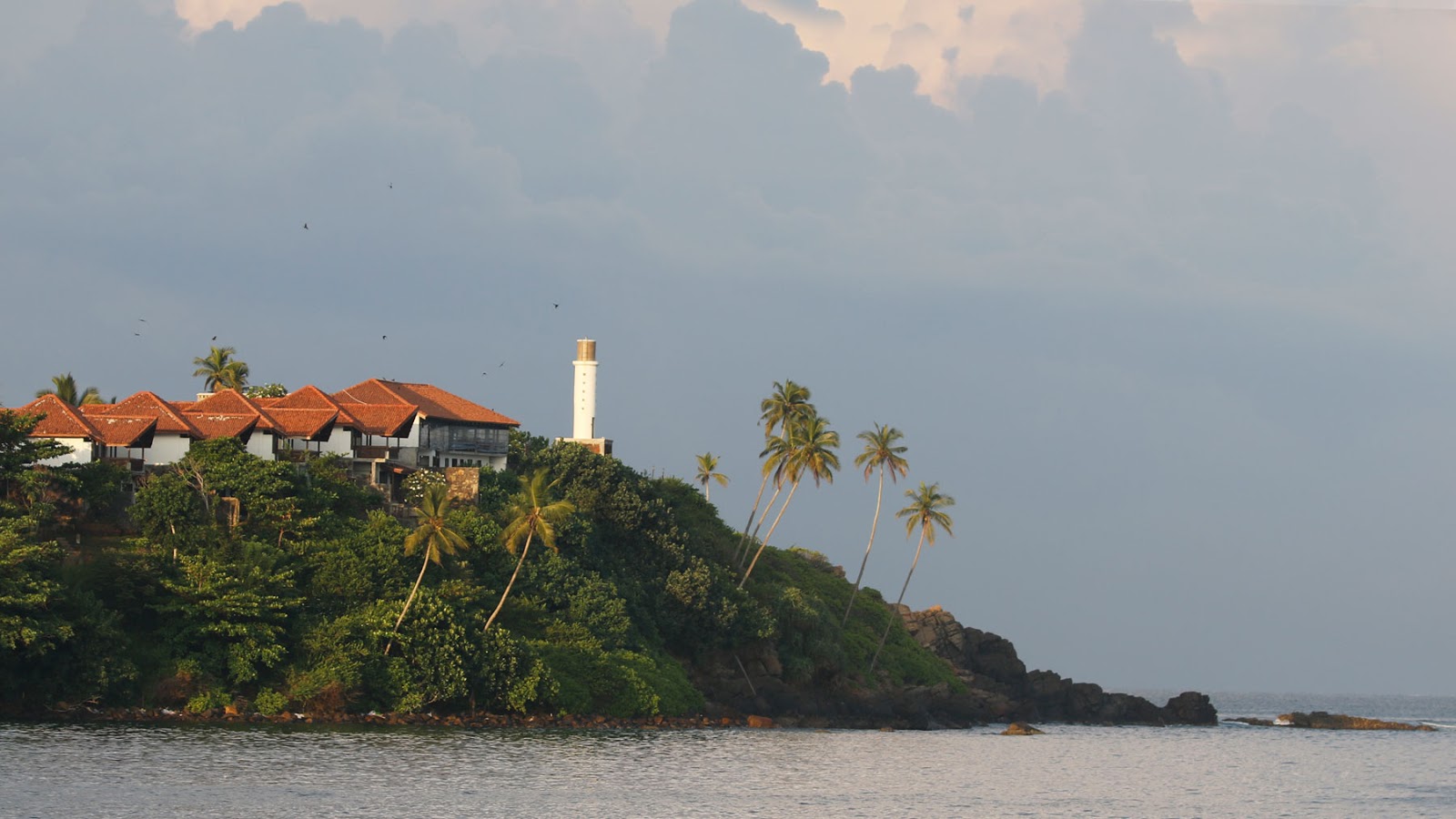


As we headed out, the fishermen, whose lights we had seen out in the bay during the night were returning to the harbour.  To be out all night on these small boats with so many men on board must be dangerous, but they seem more than content.


There was rain about, and away to the east there were some dark clouds on the horizon.


A little further into our cruise the phone rang on the deck, the skipper answered and there was a lengthy discussion in Senegalese, but the other crew members seemed to be quite pleased. On replacing the receiver he turned around and smiled and just said "Sperm Whale".  Amazingly four years to the day we were seeing Sperm Whale again, and I had the chance to get the pictures I lost on the that trip.  The atmosphere on the top deck was very excited as we slowly headed out to meet what we were led to believe was a huge pod of whales.

It started to spit with rain, but still with the sun out, and behind us we could see a Rainbow over the sea.


We came across a group of Dolphins, not the Spinners we had seen on the previous trip, but a new dolphin for me, Risso's Dolphin.  Identified by the crew by the distinctive high dorsal fin.


The dolphins were difficult to photograph, as they would break the water and little else.  Risso's have a broad head with no distinctive beak, and they appear very robust.  Here you can see the broad head of the dolphin on the right.
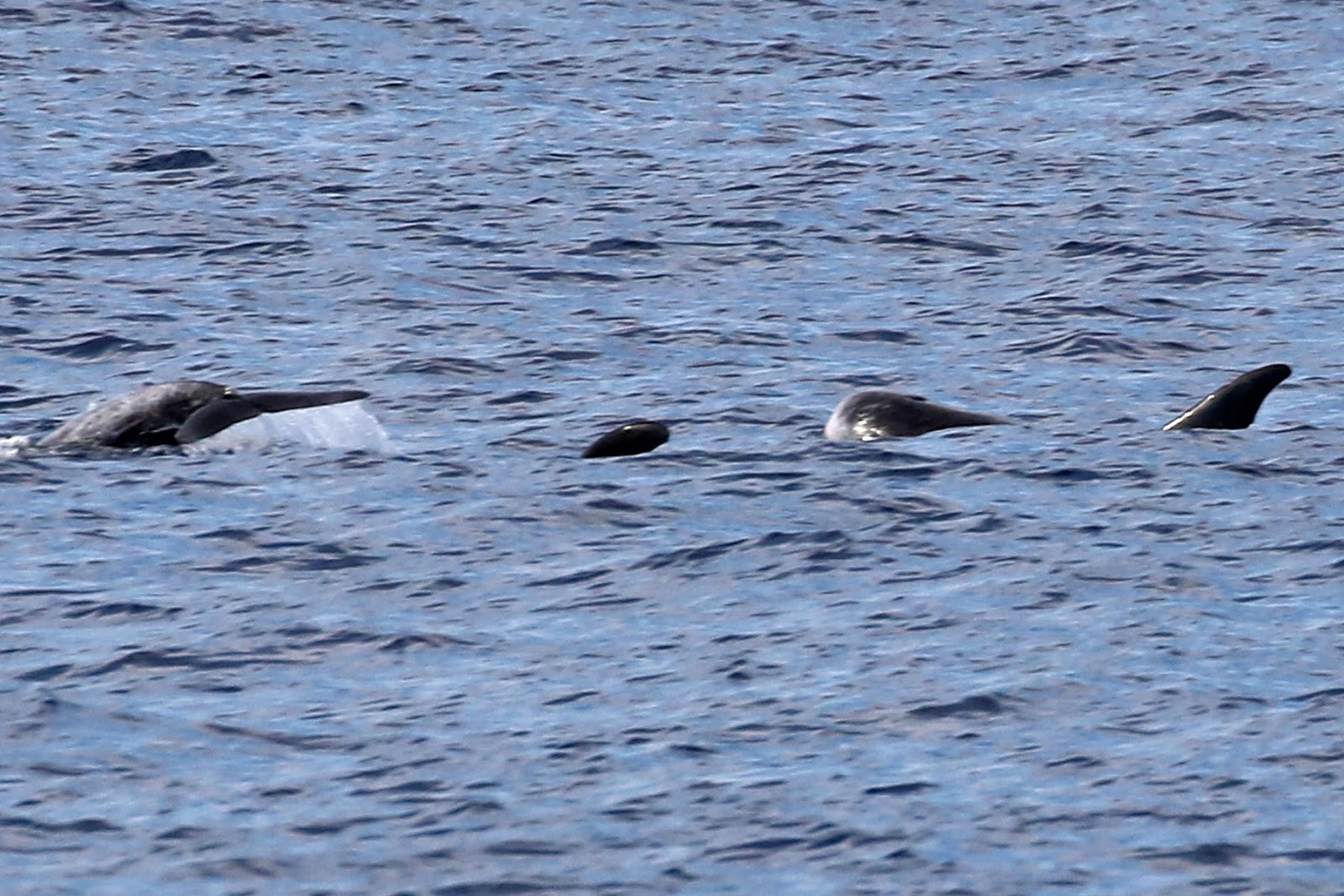


We also encountered Bottlenosed Dolphins that cam along side the boat, and too close to be able to photograph them.

We soon began to see the blows of whales, not the tall columns of spray you see with a Blue Whale, but more of a cloud as the blow of a Sperm Whale is at about 45 degrees and not straight up.  This gives some idea of the number of whales we were approaching.  We were told there was anything up to 100 whales about today


Still a long way off we could see the flukes as the Sperm Whales dived as a part of their movement.


Finally we managed to catch up with the whales, and came along side them, but at a safe distance.  The dorsal fin is rounded and in females has a kind of callous patch.


The dorsal fin is rounded and in females has a kind of callous patch.  Here you can also see the wrinkles on the skin, which is different to the smooth skin of other whales


They would stay on the surface for up to five blows, then arch the back, and the flukes would appear for a dive.


The whales swim close to each other, and some were diving while others would be breaking the surface and blowing.


When they do dive they do so with an impressive fluking of the tail.  The back arches, and the tail breaks the surface trailing water of the whole length of the tail.


Then in amongst the Sperm Whale were the Risso's Dolphins once again.  Here a better view of the head of this large dolphin


They would swim alongside each other, one always leading and blowing first.  


The blowhole is set forward on the head, and skewed to the left.  The head is disproportionately large, and dominates the body of the whale.


Unfortunately we were not the only boat to find the whales, there were many others (but poor Raja could be seen well out at sea, probably looking for Blue Whale).  All these boats though were not behaving as they should, and would steam into the pods and as a result the whales would dive.  Our skipper took the decision to cruise ahead of the whales, and to find another pod away from all the boats.

This tactic seemed to work, and we came across another pod, and the whales were happy to come close as we shut down the engines and drifted.


The whales though would still dive after five blows, but would surface again close by.


Where would be able to get a shot of a superb tail fluke.


We then came across another school of Spinner dolphins, our third dolphin species of the trip.


But the "piece de resistance" was yet to come, a Sperm Whale surfaced along side us, and we were able to cruise at the same speed alongside it, giving some excellent views.


After the head comes the dorsal fin, this whale a male.  You can clearly see the wrinkles down the side, and the dark grey colour of the skin.  In some light the body colour can appear brown.


The blow would come as the head broke through the surface of the water.


The closet head shot I could get, I was hoping to see the eye, but it is set too far back on the head, and remained under the surface.


Then the dive and the tail fluke which signaled the end of the encounter, and time to head back to the harbour.


As well as the still photographs Helen was able to get some video, which really captures the experience and thrill of seeing these whales.  It was very special, and the perfect finale for the holiday.


We were back into Mirissa harbour by 11.30, our earliest return, and we were able to get time at the pool and in the sea during the afternoon.  Clouds came over though around 16.30 so we retired to the room to pack for our journey home the next day.

Looking down from the balcony though, surfers were still making their way out into the sea.


It had been a wonderful holiday, we had seen everything this time we had wanted to see, and maybe more.  I had also managed to get all the lost images from last time, and again maybe more.

We had seen 112 birds, of which 14 were new for the Sri Lanka list, and 10 were lifers.  Of the Cetaceans, we had finally seen Blue Whale, and had the bonus of Risso's Dolphin, and the experience once again of a large migrating pod of Sperm Whale.  Of the rest, Leopard of course was superb, but so were the elephants.

After the stuttering start at the airport, the travel arrangements were superb, the hotels spot on and the transfers on time and comfortable

Sri Lanka is a beautiful country, while having similarities with India, it lacks the crazy noisy and manic situations that wear you out and exhaust you in India.  The people are lovely, always with a smile that looks and feels genuine.  We are already saying we would happily return, there is still a lot more of Sri Lanka we would love to see.

Tuesday, 17 April 2018

4th April - Yala National Park, Day Three, Sri Lanka

We agree that we would meet the jeep a little earlier this morning to try and avoid the long queue at the park entrance, so as we walked down to the pick up area it was very dark, but at the same time the skies were clear, and the moon very bright.  There was good news, although it took some time for Helen to realise, our driver from our first safari was back!

As we drove the road to the park office I used my torch to explore the pools by the side of the road.  I could see Black-winged Stilts and smaller waders feeding in the shallow water.  After picking up the pass we drove to the park entrance where this time we were in a queue due to the fact that the park didn't open until 6.00 am.  Once again there was the opportunity to scan the area.  At first in darkness I could pick out the bright eyes of herds of Spotted Deer, and as the light increased Crested Tree Swiftlets appeared flying around above the bushes and out over the lake.

At bang on 6.00am the jeep engines started up, and the line slowly moved forward.  Once the pass was stamped we moved forward onto the graded road.  As we approached the lakes the pinkish red colour in the sky from the rising sun was reflection in the dead still water of the lake, and right by the side was a Black-winged Stilt.  I called for the driver to stop, and he duly did and I was able to capture this wonderful scene.


A great start too the day.

 
We took the same route as we had the previous morning, An Asian Paradise Flycatcher evaded me once more.  I have seen several of these beautiful birds, but have never managed to photograph them.  There was though very little else of interest on the initial part of the track.  We passed the rocks where we had stopped before and ate breakfast while the Leopard didn't appear, and then eventually pulled up at the first wetland area.  With it being earlier in the morning it was even more still around the pool.  An Indian Pond Heron sat on a branch stretching out over the water, and was set against a background of Lotus flowers.


The Peacock were still on the top of the rock, and the Whiskered Terns continued to circle around the pool.  There was no sign of Green Bee-eater though, and the eagle was not present.  A little further back from the heron was a White-fronted Kingfisher, and close by a White-chested Waterhen.


 We sat watching for a few minutes more before moving on.  The track was familiar, and I guessed we were heading for the other lake we had stopped at yesterday.  Sure enough we pull off the main track, and then up onto the bank.  The Open-billed Stork was still there, but today feeding in the water.  The technique very similar to that of the Painted Stork, the bill submerged and partially open, the head swept back and forth.


As we moved slowly along the bank, a Watercock was disturbed from the side and it flew across the water to an island and tried to hide in the vegetation.  A little larger than a Moorhen it wasa female, the males in breeding plumage being mainly greyish black with a red and yellow knob at the top of the bill.


Once again, with it being much earlier in the morning for our visit it was a different scene.  If anything much more tranquil and calm.  the water still and reflecting a very deep blue from the sky.

Barn Swallows were flying around as well as perched on the dead branches, and a pair of Lesser Whistling Ducks were standing on the thicker boughs of the dead trees.


Close to the bank on a rock was another Indian Pond Heron


 Ahead of us our driver pointed out a pair of Scaly-breastted Munia.


There had been distant views of White-fronted Kingfisher, but on the other side of the bank there were two Common or Eurasian Kingfishers.  A fish was exchanged and the male flew off, leaving the female


We sat taking in the calmness around us, and welcoming the fact that we were the only jeep here.  On the other side of the lake in a bush sat a Black-crowned Night Heron, preening.
 

 Stopping every so often to check all was alright around the lake.


Yesterday I had failed miserably to get a suitable shot of the Whiskered Terns that were feeding over the water.  Today I managed to fair a little bit better, catching them as they twisted and turned over the water.


 Showing amazing agility to pick the insects off the water.


In a tree behind us a Jerdon's Bushlark sang its repetitive high pitched notes that seemed to go on all the time.


Another dominant call that I didn't originally associate with the bird was that of the White-throated Kingfisher.  It was a harsh "krek-krek" call and was continuous around the lake.  We could see one Kingfisher at the top of a dead tree, then another appeared and we could understand what all the noise was about.  These were definitely a pair, and the second bird to appear was carrying a present, an unfortunate lizard.


Unfortunately the exchange took place at the top of the distant tree, and the receiving bird then flew off, the other though flew closer into a branch.


Then it came even close to a branch close to the jeep, and at almost eye level.


As always they figit, bob and turn around while watching the water below.


 It then dived into the water, it wasn't clear if it was hunting as when it returned to the branch it fluffed up the feathers and shook itself quite vigourously.


 It then dived again and returned this time to another branch, in different light, and you could see the impact on the colour of the blue feathers, they are now much darker.


Finally a loud call and it flew off away to the other side of the lake.  It was though a wonderful treat to get so close to a stunning looking bird.

It was back to scanning the lake, a group of Indian Cormorants drying their wings.


An Indian Darter at the back of the lake with its partner on the nest on the left hand side.

  
A Purple Heron flew in, dropped down into the bushes at the back of the water, then a few minutes later flew back out and around us before heading off.


The third kingfisher species arrived, this time a Pied Kingfisher, but unlike yesterday it sat in a dead tree at the back of the lake.
 

 While all this had been going on the Purple-rumped Sunbirds had been flitting about in the surrounding bushes, and the male finally stayed in one place on the branch.


We had been here for sometime, and there was the need to move on, so we slowly backed up off the bank, above us a Peacock sat in the tree, showing off the full set of the impressive tail feathers.


The track we then took brought back memories of our visit in 2014.  We passed the spot where we had a very brief glimpse of an adult Leopard as it shot across the road and into the scrub.  Today though the only thing of interested was a Yellow Wattled Lapwing, the least common of the two Lapwings found in Sri Lanka.


We then turned back, and we found ourselves at the last wetland we had visited yesterday morning.  In the middle of the lotus leaves was another Purple Heron, possibly the same bird we had seen at the previous lake.


From a distance they are very difficult to photograph due to their very snake like head and neck, so I was pleased when it dropped and opened the wings to fly.

  
The Pheasant-tailed Jacana were present in the pools close to us, as was a Redshank and a Wood Sandpiper.  The Sandpiper then flew off, and over us calling, but then bizarrely it dropped down into a puddle close to the side of the jeep and I had the best ever views of this delightful wader.


Nothing on this year's UK migration is going to better these views!


Then with the sun now high in the sky and it getting close to 9.00 am we were off, and down the bone shaking road.  Along with the shaking and rolling we also tried to keep out of the sun as it was very hot.  We passed a Sri Lankan Blue Magpie but it was gone before I could photograph it.  Once we had made it to the park entrance it was back to level roads, and just outside the park buildings we stopped as our driver picked out four Pied Kingfishers sitting on a branch in the middle of one of the streams.

  
Our last safari was to be this afternoon, we had changed the schedule so to give us a more relaxed journey back to Weligama tomorrow.  This meant we had about four hours to spend in the pool, but as before I couldn't resist the birds that we appearing around the lake.

I went down to the edge of the water to photograph a Cattle Egret that had taken to picking the insects out of the cows ears.


But I soon became aware of a loud rattling call that turned out to belong to a small woodpecker at the top of a dead branch, the Brown-capped Pygmy Woodpecker.


Found in sub tropical forests across the dry zone, it has a very distinctive pink rimmed white iris.


Back on the water a couple of Great Egrets were engaging in some synchronised wading.  What looks like an adult and immature bird due to the bill colour would copy each others moves, lifting legs together at the same time, and also turning at almost the same time.  Unfortunately the still photograph doesn't convey the actual action.


It was soon time to join the jeep once again, and coming from the villa a pair of Purple-rumped Sunbirds could be seen alongside the path, the female giving some great views.


The afternoon arrival process is not as manic as the afternoon, there are not so many jeeps about at the offices, and no queue at the entrance.  It was a glorious afternoon with a vivid blue sky.

  
As we passed the first lake the colour of the water was completely different from that we had seen first thing in the morning.

  
We then endured another bone shaking ride along the main track, only coming to a halt when we came across a single Bull Elephant scraping up grass by the side of the track.


It would then use its trunk to dexterously roll the grass that it had kicked up into a large compact ball.


Then take the ball of grass up into its mouth with its trunk.


Hardly any nutrition there to keep an animal of this size going?

Leaving the elephant we were soon aware that jeeps were speeding past us, I saw our tdriver check the text on his phone and we to were off on the chase.  Speed and a spell of dry weather spell dust in Yala, and we were experiencing the first bad spell of dust on the trip.  We passed a small herd of Elephants which was a shame, but hopefully it would be worth it.  We came off the main track, and then along a winding track.

As we slowed I recognised to area from a place we had tried before on the last trip in 2014 to see Leopard but failed as it disappeared.  As we turned the corner we came upon several jeeps all lined up, and the contents all striving to see something in a tree.

Helen saw it first, and I failed miserably to see it despite her trying to describe its position.  Unfortunately a branch is a branch if it doesn't have anything to distinguish it. 

After what seemed to be an age I saw the spots, and this led to an hanging leg and a tail of a Leopard.

  
The Leopard then moved, shuffling down the branch.  With went the jeeps and we edged forward and I could just make it out through the leaves.


Then it stood up, and dropped to the ground.  With this all hell broke lose, jeeps backed up, but we stayed where we were and I was able to lean out of the jeep while hooking my legs around the seat.  I could see the Leopard on the ground drinking at a pool.


Trees and branches were obscuring the view, and affecting the auto focus, so I switched to manual, and as I did so the Leopard stood up.


Turned and walked towards us.


More panic in the jeeps and we edged a little bit more forward.  We saw it go into the bush, just a short glimpse of spots, and then we waited. There was an open patch that if it was travelling in that direction it would have to pass through.  Our driver got us into pole position, and as luck would have it through it came.

  
Last time we had seen two immature cubs, and while they sat nicely on the ground for us, they did not look like this, an adult Leopard.  It walked slowly and majestically across the opening giving some great views.


Then into the bushes again.


We moved forward again, and then stopped by another small pool where the Leopard laid down again.  Once again the view was obscured by the branches and it took some more manual focusing.

  
Annoyingly the jeep two cars up would have had an excellent view, and as the Leopard stayed put tensions were rising amongst the drivers as they wanted him to move to allow them the chance.  He never moved and a lot of jeeps behind us never saw the Leopard, as shortly after this shot it stood up and walked off again and this time out of sight.

  
Some Jeeps decided to wait to see if it would come back, and I suggest that many of those were unlucky.  I am sure there is some kind of code amongst the drivers, but this one guy decided he was going to ignore it which is a shame for many people, but we couldn't complain we had some great views, and when you consider we went on this holiday not worried if we didn't see one, that was a real bonus.

Yala National Park has one of the highest densities of Leopard in the world, with over 40 individuals, and up to 25 in the Block we were visiting, so there is a very good chance of seeing one, how you see, and what you see is always left to chance though, and we were definitely lucky.

We left the melee of the jeeps behind, and paused on a ridge over looking yet another wetland with more distant rocks.


Then once refreshed it was back onto the main road.  We came to a stop again though for a superb Malabar Pied Hornbill.


 When our driver pointed it out he referred at first to a toucan!  He did correct himself.


As the hornbill flew off it was replaced by Black-faced Langar monkeys, the light from the setting sun catching the fur on their tales.


Another brilliant spot by the driver was a pair of Black-necked Storks on the bank on the far side of one of the lakes.

  
We then pulled over for another look at the Brown Fish Owl.


There were in fact two birds present, the other owl a little more obscured by the leaves of the tree.  This one though was quite happy to sit out in the open.


As we left the park, we came across three elephants feeding in the bushes.  The larger could be seen using its trunk to pull the branches down, and the ripping the leaves off with its mouth.

  
One of the younger elephants turned away, and showed a small set of tusks.  There are very few Elephants in the park with tusks, I wonder if this one will grow up to be a tusker?


The smallest elephant was hiding behind a bush but eventually showed a little more of itself.


Once again the ye not betraying any thought 


The sun was setting on the day and on our time in Yala.  


All four safaris had been different, and we had enjoyed some great birds, and plenty of beautiful places.  The Leopard today though was the icing on the cake, and while we had said we were not concerned if we didn't see one, I know secretly that wanted to see a Leopard, come on now, who wouldn't?

Tomorrow we are back on the road, and heading back to Weligama and the Marriott, fortunately we don't have an early start, but we should be there in plenty of time to enjoy the pool , beach and sea.