Saturday, 12 May 2018

6th May - Noar Hill, and Magdalen Hill, Hampshire

At last warm weather, and the opportunity to look for butterflies for the first time this year.  Everything would appear to be much later this year due to the cold late spring.  This time last year I had already seen Duke of Burgundy and Green Hairstreak.  This year the hope was that they were now emerging and that maybe I could find some pristine specimens.  The destination was to be Noar Hill, the Hampshire Butterfly Conservation's lovely little reserve just outside Selbourne.  I arrived around 10.00, and the temperature was already very warm, and I suspected that it would be getting higher through the day.

As I walked up the hill towards the reserve I could hear Blackbirds and Blackcaps singing, and as I entered was confronted with a carpet of yellow Cowslips.  The reserve is sufficiently distant from main roads, and the only noise to be heard was the mixture of bird song, and odd overhead whine of a jet heading south or west.  It really is a little oasis of tranquility surrounded by the endless wild flowers and bird song.

There are a series of paths that wind their way through little grassed quarries.  Around these are hawthorn and Blackthorn bushes, and further in, Holly and Juniper bushes.  On one of these bushes a male Linnet perched singing.


Green-veined White butterflies flew past me, not stopping, as did Orange Tips and small Whites.  As I walked slowly through the cowslips I concentrated on the ground, and eventually this turned up my quarry, the Duke of Burgundy.


This one is a male, it only has four legs, the female six, and was setting out its territory.  Over the last few years I have come to Noar Hill at this time of year to watch the Dukes emerge.  It never fails to impress me, the delightful checked patterns interspersed with the white patches, and you always seem to fail to remember exactly how small they are.


With the first Duke sighting of the year, the pressure was off, next I had to find a Green Hairstreak, I did manage this, but only in flight, I was never able to pin one down.  What was more frustrating was the whole day I would hear "there was one sitting there five minutes ago".  

As I waited to see if any Green Hairstreak would settle I was entertained by at least five Holly Blues, dueling and fighting in and around the Holly and Juniper bushes

Still if it isn't meant to be then so be it.  In my search for the hairstreak I cam across a singing Yellowhammer.


I walked through to the far end of the reserve, normally a good spot for Dukes, and I was advised that they had been about.  However I was not able to find any.  In amongst the cowslips here were several Early Purple Orchids.


The orchids an attraction to the bumblebees


The number of Cowslips was impressive, and with the dips and banks it is possible to get a different perspective on these dainty early spring flowers.  Here with the lovely blue sky as background.


A Garden Warbler sang from within a bush, and played hard to get to, while this Whitethroat delivered its scratchy song from the top of a bush, and shortly after took off in flight display as  the climax to the song


I found another male Duke holding territory.


Here you can see the four legs


The chequered patterns on the upper wing that at one time had them classified as a fritillary, today we know they are closer to the metal mark family.


In another of the little dips there was a gathering of people, the attraction being a mating pair of Dukes.


The male is the foreground, the female, you can just see her two pairs of front legs, at the rear.


By now the numbers of Dukes on the wing was easily exceeding a dozen, and they were easy to pick out.  Here the classic Duke picture sitting on a cowslip.


And sat there for all to see.


This was one of the banks covered in Cowslips.


As I watched one Duke, somebody else came across this Dingy Skipper, another first for the year.


I decided to have lunch and then move on to the other butterfly reserve close by to Winchester.  Magdalen Hill is located between the A31 and the B3404 next to Magdalen Hill cemetery.

I parked just outside and walked up the hill.  An Orange Tip flew past me and settled on some garlic mustard flowers.  My  first thought was a female, but then I noticed some feint orange markings on the upper wing.


And as it closed the wings there was orange on the underside tips


Almost like a Hermaphrodite Orange Tip.


Lovely dappled green patterns on the hind under wing.


Up on the hill the most frequent butterfly was the Brimstone, they could be seen flying almost everywhere.  They settled only occasionally, this one taking a liking to a Cowslip


I followed the path heading west in the old reserve area.  The field to the east has recently been acquired and is now not grazed, there had been sightings there, but I preferred to explore the areas that I knew were territories previously.  

My target was the Grizzled Skipper, and at first there was nothing about other than the Brimstone and the odd Orange Tip.  The finally I disturbed a small grey butterfly from the path.  It flew around and then settled on a leaf in the sunshine.


It sat for a while allowing me to get in close before springing off the leaf and away in a flash.


I circled the field, and do the same on the new part of the reserve, finding one more Grizzled Skipper.  The Brimstone were still very active in what was now very hot sunshine.  At one point three came together, and spiraled, dueling together above me.


The new extension field was covered in Cowslips, and there were signs about referring to the work to try and establish Duke of Burgundy's on this reserve.  With so many cowslips there must be a chance.


I couldn't resist this dandelion seed head.


Just as I left the reserve, a small butterfly caught my eye flying over the bramble.  Fortunately it settled and I was able to at least get a photograph of a Holly Blue.


It was now very hot, and I decided to call it a day, and headed home.  It was though lovely to get amongst the butterflies once again, lets hope the weather plays ball this year and provides us with a bumper season

Tuesday, 8 May 2018

5th May - Portland & Longham Lakes, Dorset

We had arranged this day a few weeks ago, but never expected the weather would be as it was forecast.  I left the house at around 4.30 to meet Ian at Nursling, the skies were completely clear, and light was showing on the eastern horizon.  Reaching the car park at Nursling the birds were in full dawn chorus, and gulls were streaming past overhead.  While the sun was not completely up, it was already clear it was going to be a wonderful day.

Passing into Dorset we passed through some mist around the River Stour, but this cleared and as we came south towards Weymouth the visibility was good looking out at the distant Portland, if not though with a hint of sea fog offshore.  This was Ian's first visit here, and I was hopeful we could at least find something of interest today.  There are always good sightings reported here, but it is a case of being in the right place at the right time.  We pulled into the Bill car park at 6.30, where Wheatear flew across us and out over the grass to our left.  After we sorted ourselves out we walked down to the obelisk, the Bill lighthouse looking splendid in the morning sunshine, the plan was a sea watch first.


Gannets passed close in, the morning sun catching them as they passed the Bill heading west.


In fact this was the main movement to start with, small groups of Gannets passing, 


There was also a steady movement of Fulmar, along with with Guillemots and Razorbills flying up to the West Cliffs.  A Rock Pipit displayed from the nearby rocks and from the Obelisk itself, while a Wheatear watched us from a boulder close by.


Shags would also fly past below us the sun catching the bottle green plumage.


It was not the most stunning sea watch I can recall, but sightings of Kittiwake, plenty of Gannets and the auks and Fulmars were all year ticks, and a group of a group of 22 "commic" terns, was also nice to see.  The best though was the presence of quite a few Manx Shearwaters.  They did not appear to be going anywhere in particular, and would circle around, sometimes quite close in.


There was no indication that anything big was going to happen so we decided to go and explore, heading for the west cliffs.  Crossing the field we found a large Wheatear, from the size and length of wing it was probably safe to assume this was of the Greenland race, Leucorrhoa.


We stopped to view the auks on the rocks, and as we did so Fulmars soared around the cliff face below us.


There were a few Guillemots on the water, and Razorbills and Guillemots were flying up to their nesting ledges.  One rock had a few Guillemots sitting on it.


Walking along the footpath we were passed by Swallows and Sand Martins heading north.  A little further on we came across the egg lying on the path.  It had clearly been predated, the top broken off, and albumen still in the grass.


Shaped like a very straight pear, and sky blue in colour with black lines and speckles, I assumed it must be from a Guillemot, but I was concerned by the size, which seemed very big for a Guillemot.  Looking it up it was definitely from a Guillemot, and had probably been taken by this bird.


A Raven, which we came across perched on the fence around the the grounds of the Maritime Hotel.  It sat with Crows and Jackdaws, and this gave a good opportunity to see the difference in size of these corvids.

We had been told that there was a Redstart in the area around the ploughed fields, so we walked along the footpath towards the scrubby bushes.  On the far side of us I picked up a small bird on the fence.  It dropped down and then appeared on the fence post.  Another first for the year, a male Whinchat.


We could see as many as five of these little chats, while I have seen plenty I have never had the opportunity to get close enough to get some decent photographs.


It suddenly became quite busy in the scrub.  A couple of Whitethroats (amazingly another year tick!) and singing Sedge Warbler and this Chiffchaff.


At the far end of the fence a Kestrel sat scanning the grass below.


Back to the Whinchats and they moved along the line of the fence, stopping to perch on the posts and wire to scan the ground below, and then dropping to pick up any possible food.


Leaving the fields we walked down through the Crown Estates with Green-veined and Large White butterflies on the small patch of rape.  Off in the distance a view of the lighthouse once again and the Coastguards cottages.


We stopped at the Obs quarry to see if the Little Owls were showing, but they were not up yet.  A young rabbit sat in the grass below the rocks where the Little Owl should have been.


We walked back around the Observatory, and then along the road to Culverwell, where again we walked around without seeing very much aside from a warbler in the bushes and a few Goldfinches.  From here we walked down to the cliffs and quarries on the east side, once again the clear blue sky lit up the sea and the coast line.


At the top of the cliffs above the quarry were a pair of Ravens, that turned out to be a family group of three juveniles and the male and female.  What I assume to have been the male, due to the fact that he did keep some distance from the others, sat on a post watching the activity around him.


As we watched the Ravens, I noticed a bird drop into the quarry.  I called Ian to watch as I walked over suspecting that what had dropped might fly out.  This is what it did, and fortunately Ian picked it up as it flew away, it was a Little Owl.  Apparently it flew around the corner, and when I heard this I knew where it had gone.

We made our way around the point and then into another quarry where I immediately flushed it again but it flew up into the rocks where it was mobbed by a Great Tit.  This was exactly where Helen and I had seen it previously two years ago.  I climbed the rocks on the other side of the quarry to get a better view, and was quickly joined by Ian who had been debating whether to photograph an Orange Tip!

It stared at us without moving at all.


A little higher and you could see that it was flattening out its body on the rock.


The stare so intense, it never moved or blinked at all.


After watching for some time we finally moved away, the Little Owl though never took it eyes off us as we dropped down from the viewing point.


It was now very warm, and close to lunchtime so we decided to head back to the cars, passing the quarry once again to look for the owls, but once again without any joy.  We took lunch up to the West Cliffs where we sat and watched the activity on the rock ledges, and the Fulmars soaring around the cliff face.  Inevitably the challenge was to get the perfect shot as they wheeled past us.  This was the best of quite a few attempts.


A Shag was now visible on the rock ledge closest to us.


While below there were small groups of auks, the Razorbills standing out with their jet black plumage against the chocolate brown of the Guillemots.


Everything was lovely, the sun and blue sky above, the deep blue of the sea and the pink of the flowering thrift on the cliff edge.  It was very hard to think this was the may Day Bank Holiday weekend, it normally rains!


As I sat there drinking my tea, and taking in the view around me I heard a rush of wind and then the sight of a grey shape flash past me.  I don't know why but my first instinct was hawk, but then as it climbed in the sky realised it was a Peregrine.  It climbed , and then stooped on the rock face, dropping a very rapid speed, and then pulling up and rising once again.  Here it banked and we could get a good view.


It then turned and banked once again for another attack on the birds below.


The attack was unsuccessful, and it pulled out again, gained height and headed out over the sea, being joined by another, presumably its mate.  They were the lost to sight.  Though all this the Shag had stayed in place, even moving into a sunny spot on the ledge.


Time was moving on, and we headed back to the cars, the intention being to make our way home, but to stop along the way.  However we had only gone a few metres when we came across a pair of Wheatear in the field.


Once again these were long winged and quite large birds, they were though approachable, and would use the anthills as vantage points to hunt from.  Getting down low I could crawl up to them and get some good views.


As its name suggests the Greenland Wheatear breeds in Greenland, and many pass through the UK late in April and early May on a route that takes them through Iceland to the Arctic tundra of Greenland and Northern Canada.  There is debate on identification in the field because characteristics overlap, and the best way to describe them is as "showing characteristics" such as height and wing length.


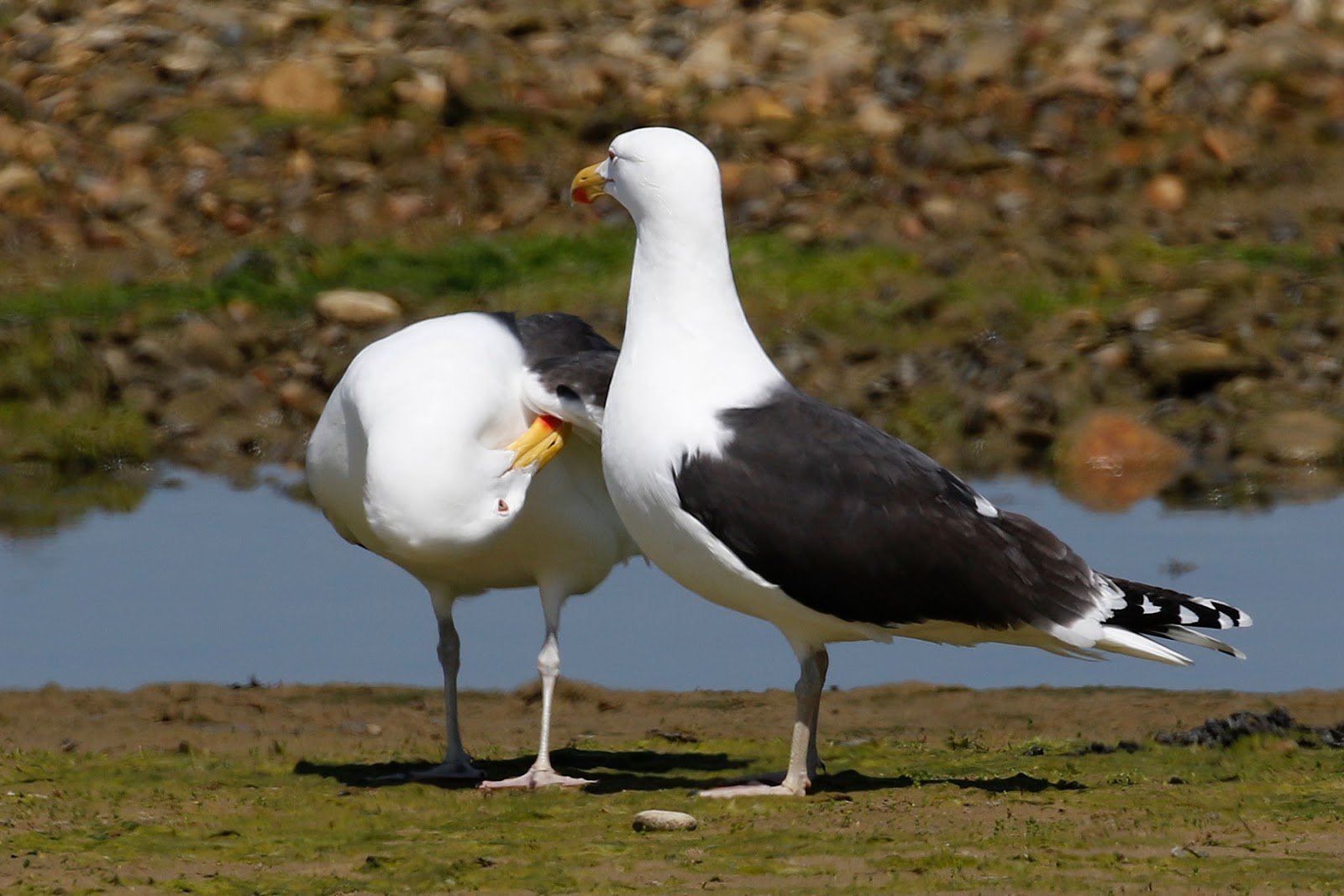
First stop after leaving Portland was at Ferrybridge, the point where the the Fleet that runs alongside Chesil beach runs into Portland Harbour.  We walked in the shadow of the great shingle mound that is Chesil beach, and down close to the water.  The tide was falling and a pair of Great Black-backed Gulls were together on the mud.


Across the shingle there was patches of grass and thrift, and the pink flowers looked spectacular.


Thrift is only with us for short time, and like the bluebells in the woods just has to be enjoyed.


Close in on the mud were five Ringed Plover.


And seven Dunlin, one or two showing the black belly of breeding plumage.


We could continually hear the calls of Little Terns, but seeing them was much harder as they were on the other side of the water.  A group of six though did come down onto the mud to bathe in the shallow water.


The shapes and shadows of the shingle going down to the water caught my eye.


A group then turned up, and pointed out a couple of Whimbrel on the far side.  To get a little closer to them and the terns we walked onto the road leading to the bridge where we were able to watch the Whimbrel closer.


Another year tick on the day.


The Little \Terns though were still a way off, and the best I could do was this pair sitting on one of the mooring buoys.


Our next stop on the journey home was to Longham Lakes.  The lakes in their current form have only been in existence since February 2010, when the southern lake was first flooded after gravel extraction.  The smaller lake on the northern side was filled in 2002.  Walking around though it shows how quickly nature can adapt and provide habitats.  

First though we had to walk along a lane, a Whitethroat was very confiding as it sang in the tree above us.


As we walked around the main path Reed Warblers sang from the small strips of reeds, and in the bushes were Blackcaps and Chiffchaffs.  We were here to see if we could see the Bonaparte's Gull that has been present recently.  A quick scan of the north lake only produced a few Black-headed Gulls, but we could see more on the southern lake.

Before we got there though there was a treat in the form of two displaying Great-crested Grebes, something I have been wanting to capture this year and thought that the opportunity had gone.

The pair swam alongside each other.


Then turned to face each other, shaking the head and fanning out the ear feathers and raising the crest.


They would chatter to each other shaking the head before turning away and heading off away from each other.


One came close to the shore.


On the southern lake there were small gulls catching flies, but we had to look into the sun at birds that would not stay still.  On one or two occasions I thought I had found it but couldn't be sure.  In the field it was difficult, but I took photos of what I thought could be it.  Everything fits here, the all dark bill, the darker hood and the black leading edge on the primaries and the whiter wedge on the outer, upper primaries, and on the underwing the black leading edge and the white lighter patch, I am happy that this is now the Bonaparte's Gull


Time was running out at Longham, so after trying to get better views of Reed Warbler it was time to head back.  I always feel that Portland leaves you wanting more, as there is always the chance of something special.  Weather wise it had been a spectacular day, a fact bourne out by the traffic, fortunately heading in the opposite direction, however maybe the good weather wasn't so conducive to good birding, but never the less it didn't ruin a great day.