It was to be a butterfly day and I had arranged to meet Ian at Bentley Wood in the eastern car park. This is one of those specialised locations that we may visit annually. Once upon a time it was the only place in Hampshire you could find Small Pearl-bordered Fritillary, but over the last three or four years they have all but gone. It is, though a good sight for Pearl-bordered Fritillary that appears earlier than its similar cousin, so we were here to find them and hopefully some others.
It was a beautiful morning and the car park looked quite impressive.
I could hear a Firecrest at the back of the car park, so as I waited for Ian I went in search and found it in probably the darkest part of the wood.
Ian duly arrived and we set off down the main path to the Eastern Clearing, an area of Bracken, Hawthorn and marshy ground, one of the reasons the Pearl-bordered Fritillary can be found here. As we entered a Blackcap was singing from the high point of a dead branch.
Yellow Wave moths were flying around and there were also Broad-bodied Chasers. Here a male settled on the bracken.
A Garden Warbler sang from the bushes and showed typically poorly amongst the leaves. A Willow Warbler was singing behind us and we could also hear Tree Pipit, a guaranteed bird here. We walked to the tall Oak trees where the Pipit was singing and found it at the top, and then realised there was another singing, this one at the top of a dead branch and more accessible.
As I watched the Tree Pipit a butterfly settled on the bracken in front of me, a Pearl-bordered Fritillary, job done!
This is the earliest of the British fritillaries to emerge on the wing and is usually seen from early spring. They are named after the seven silver pearls seen along the underside of the hindwings and obviously not visible here!
The Pearl-bordered differs from the rarer Small Pearl in that its seven "pearls" are edged with red chevrons and not black. From above the patterning along the edge of the wing has a more open appearance than that of the Small Pearl.
Leaving the tree Pipits we walked back to the main area and came across an Orchid, that at first I thought could be a Southern Marsh, but we found spots on the leaves so it has to be an early Common Spotted Orchid.
The Pearl-bordered Fritillaries were quite active and we saw about five or six, but very few were settling, this one did briefly.
The female Broad-bodied Chasers were a little more accommodating
.
A medium sized dragonfly, that is commonly seen in early summer. They prefer standing water and small puddles and pools.
We had hoped we would get some more action here, but it was quiet with few butterflies. Having found the one we were looking for we decided to move on to Martin Down, the other side of Salisbury. My last visit drew a blank on the Marsh Fritillaries, hopefully they would be around today in the warmth and sunshine.
Arriving in the car park we set off down the lane towards the Dyke, Yellowhammer, Corn Bunting and Whitethroats sang along the path, but once again there was no purring from a Turtle Dove.
Along the way, more butterflies, the Dingy Skipper.
Then my first Small Heath of the year.
As is always the way the stunning view out across this wonderful reserve.
The Greater Butterfly Orchids that were just stalks ten days ago, were now showing buds and the start of some petals.
And so it was off along the ditch, and it did not take long before we found the first Marsh Fritillary.
These are a scarce butterfly in the country, being highly localised and have declined severely during the 20th century but have held on in there southern colonies. Bokerly Ditch here at Martin Down provides ideal conditions for them, despite the name they do not favour marshy conditions but damp tussocky grassland that can be found here, and the provision of Devil's Bit Scabious their foodplant
This is a male, they are brighter and slightly smaller than the female.
They are rather slow flying in comparison with other fritillaries, keeping low to the ground. The adults rarely fly more than 100 metres from where they emerge.
In the first stretch of the ditch we saw at least six individuals, all males. Last year we were not able to find any here and only managed one at Bentley Wood. The year before that I only found one individual, so it was great to see them once again in good numbers.
The beautiful upper side pattern of the Marsh Fritillary, with contrasting orange, yellow and brown.
We reached the crossroads with the Jubilee path and amongst the grass in the ditch was another early Common Spotted Orchid.
We walked along the track in search if the Spotted Flycatcher. Last visit they were calling all along the path, today it was eerily quiet. After some extensive searching we finally managed a quick glimpse of one. There was also no sign of any Hare.
Back out on the ditch it was back to the butterflies and a nice Grizzled Skipper.
And a pair of mating Dingy Skipper.
The first Cinnabar Moth of the summer.
Walking along the ditch there were more Marsh Fritillaries and frustratingly a Painted Lady that flew past me and up and over the bank of the ditch.
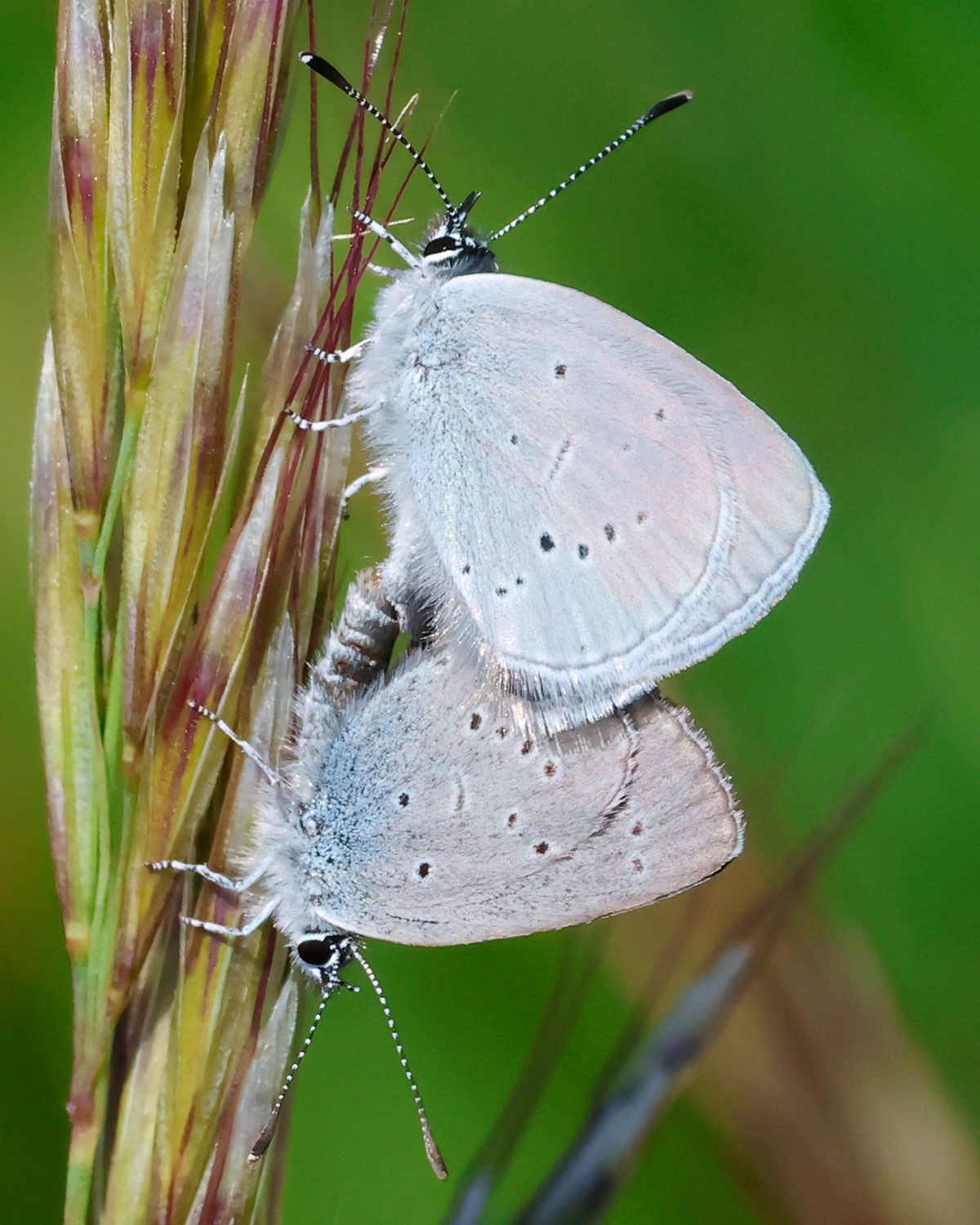
Coming up on to the main path we came across a pair of Small Blue mating on a grass stem.
Once again a highly colonial species, that does not wander far and can almost to be guaranteed to be found in the same locations year after year. It favours sheltered grassland with ample amounts of the foodplant, Kidney Vetch, where the female not only rests but feeds and lays her eggs.
A Brown Argus, the only one seen.
The Burnt TIp Orchids were still looking spectacular ten days on.
One or two clouds were bubbling up to add to the wonderful views.
Approaching the old rifle ranges there is a metal box and here is a good spot for Common Spotted Orchids and there were plenty about, showing very well.
Walking around the old ranges we found a Green Hairstreak, they are now approaching the end of their season so an opportunity to get some photographs before they go away until next year.
An interesting view.
Plenty of grass between the old ranges and there were more Marsh Fritillaries scattered all around. An opportunity to see the butterfly from below. This one looked like it still had to fully open the wings.
The nearest fore wing is not quite fully "pumped up".
Then we came across a mating couple, showing the underside.
Females are mated soon after emergence and are so full of eggs that they crawl in the grass and can only fly small distances, another way to distinguish the sexes.
From the ranges we headed back to the car park across the open grassland. The path has very defined tyre tracks and in places these were flooded with water and mud. In these spots there was a large colony of Small Blue, imbibing on the mud and flying around the vegetation. Up to now we had not been able to capture a Small Blue with its wings fully open. So we waited and eventually one opened those dark blue wings.
Walking back along the edge of the fields we had a Speckled Wood and a Holly Blue, just before the car park, another beautiful Green Hairstreak.
There were a couple of butterflies we had hoped for that were missing today, both Blues, Common and Adonis. They should be out now but there wasn't any sign of them. A really good day and lovely being at both sites in the warm sunshine.