As we started the first real heat wave of the year, Ian and I decided to meet at Martin Down, a location that when it gets hot, can be very hot! Nevertheless we met just before 9.00 in the morning with the temperature showing in the car of 27 degrees celsius! We were here to try and find the Frog Orchid we hadn't managed to locate at Noar Hill last year. The signs were good, a photograph had been reported on Facebook and we had this to go with.
Normally we would walk up the hill towards the ditch on the left hand side of the car park, however today we made our way directly towards the rifle ranges. On the way there were Large kipper in the grasses by the side of the path.
There was a lot of Knapweed in amongst the grasses. Here a Forrester Moth, a day flying species, nectaring on the Knapweed.
Marbled Whites were also attracted.
A Skylark was singing from a small hawthorn bush.
A Small Heath on the Knapweed.
And a female Marbled White.
WE reached the Bokerly Ditch and then turned right heading towards the ranges. As we walked through the grasses there were lots of Dark-green Fritillaries, we counted easily into the fifties, but none of them looked to stop, despite appearing to search the grasses.
Other butterflies in good numbers were the Marbled Whites and Meadow Browns. On the ridge of the ditch was a singing Corn Bunting.
And a male Stonechat.
We reached the chalk area that is on the south side of the largest rifle range. The grass here was short, but with bushes and longer grass around the outside. Looking at the photograph that had been posted, we were able to work out the area where the Frog Orchid had been seen, however we searched and searched without any luck. Eventually we decided to have a break and try the area on the other side of the range, the area where we had found the Frog Orchid last year.
There were plenty of Spotted and Fragrant orchids, in the field and on the banks but we couldn't find any Frog Orchids. We walked away, came back and searched again, still without any luck. A Yellowhammer was singing from a nearby bush and it allowed me to approach quite closely.
We searched some of the other areas that looked suitable without any luck, but did manage to find the only Ringlet of the day, not a butterfly that is common here, and this nice group of Common Spotted Orchids.
We decided to go back and search the original area again. I wondered off to check some parts we hadn't searched before in the hope that maybe there were something there. Ian called out that there was a nice Small Skipper on a flower head and I could see him photographing it. I made my way over, but it had gone as I reached him. As Ian pointed out where the skipper had been, both our eyes drifted to a shape close by and that shape turned out to be the Frog Orchid!
We must have walked past it many times as we searched, there was also the risk we could have stepped on it. The orchid was only about two inches high. There were others in the same area, one other flowering, the others just the basal leaves.
This phot very similar to the one we had seen on the facebook page.
This is the second flowering orchid, maybe a little more advanced that the one we originally found.
The Frog Orchid is a short erect orchid, between 4-20 cm
tall. It has a basal rosette of blunt hairless leaves and very narrow short
leaves up the stem. The short loose-flowered spike has greenish to brown-purple
flowers with a close helmet of sepals. The green-yellow or brownish flower lip
hangs down below the sepals and has three teeth at the tip. Its outside edges
are often chocolate coloured. The green bracts are as long as the flower stalk
and flowers.

The Frog Orchid grows from tubers and flowers from June to
August and grows almost entirely from seed with little vegetative spread. It is a plant of well-drained dry calcareous
soils overlying chalk or limestone, or of calcareous sands in Southern England.
It can rarely occur in more neutral to acid hay meadows, such as Dartmoor and
Bodmin Moor where the vegetation is shorter. Elsewhere in the UK it is
associated with flushes, limestone pavement, screes, rocky ledges, roadside
verges and quarries. It was probably associated with sheep-walks / droves in
the past, where a long continuity of grazing kept the grass permanently short,
just like the conditions we found here.
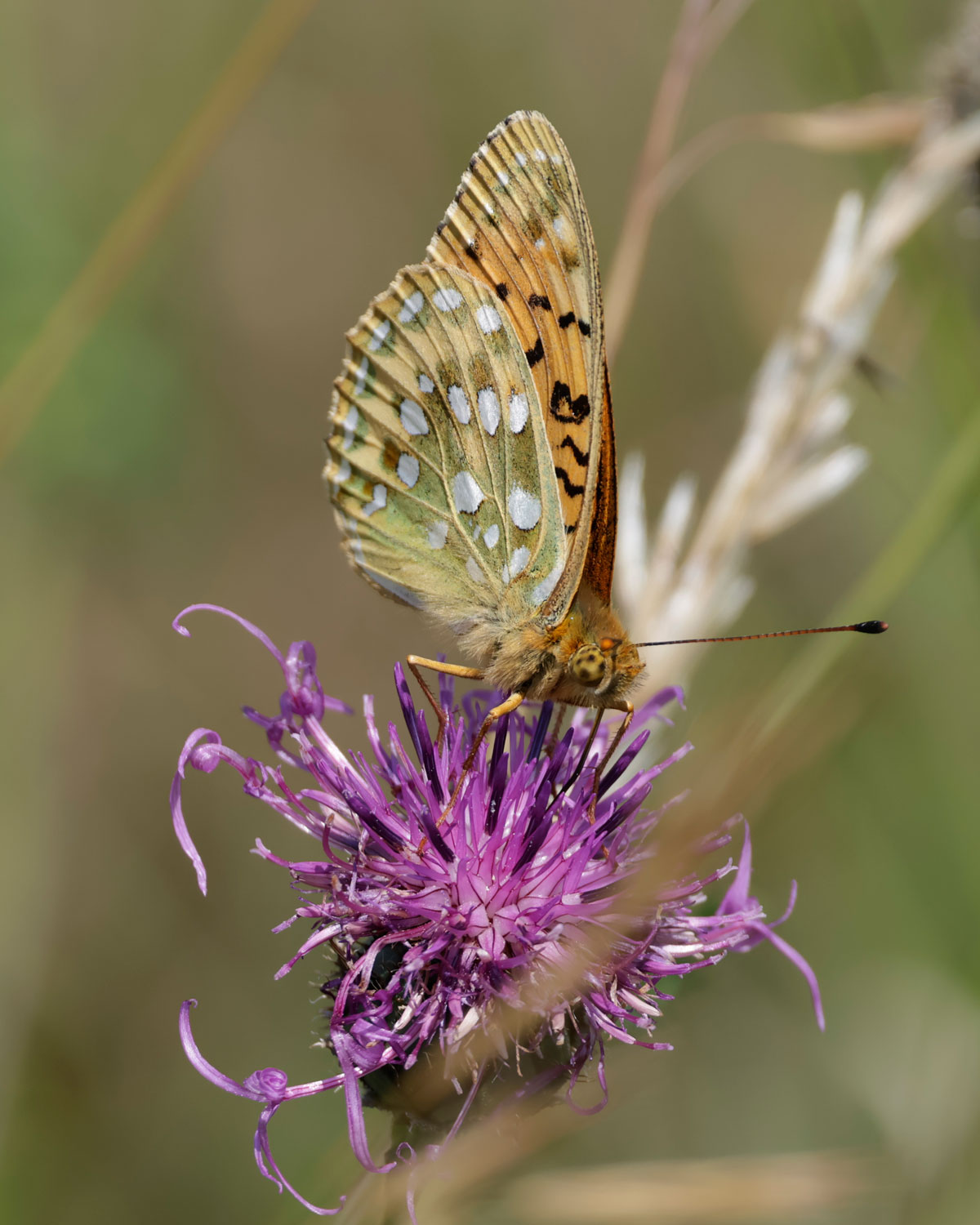
Leaving the ranges we headed back along the ditch, there we still many Dark-green Fritillaries zipping about, but by now they were beginning to run out of fuel and we started to come across them nectaring on the Knapweed.


The Dark Green Fritillary is the most widespread fritillary
found in the British Isles and is a pleasure to see as it flies powerfully over
its grassland habitats, frequently stopping to nectar on Thistles and Knapweed..
This butterfly can be found throughout the British Isles, although it is less
common in central and eastern England. Despite its powerful flight, it is
somewhat surprising that this species is not particularly mobile, staying
within its breeding grounds.
The males are the more conspicuous of the two sexes, and can
be seen patrolling over large areas of habitat looking for a virgin female
which often rest low down in vegetation. Once found, mating takes place almost
immediately. A mating pair may be found resting on vegetation and will even
continue to nectar while coupled.
If you have wondered why an almost all orange and black butterfly is named a "Dark-Green", then you have to look on the underside of the hind wings. Well, it gets its name from the green hue found on the
underside of the hindwings, which are peppered with large silver spots
We reached the point of the ditch that we usually start from. This is a good spot for the Greater Butterfly Orchid. I saw them when they first emerged in mid May and today there were quite a few about, but they are looking to be just about going over.
We sat on the bench, had lunch and enjoyed the "hockley" style view across the grassland and the distant fields.
After lunch we set off back to the car park, heading down the path with the distant field still in view.
The three most numerous butterflies were now well into the hundreds on our count. The Dar-greens the most numerous, we were treated to one more nectaring on the Knapweed.
We brought what was now a very hot day to a close after a very successful Frog Orchid search and plenty of butterflies. The butterfly final count was as follows