On returning from Norfolk we have had rain and it was still with us in the morning. The forecast, though looked positive for the afternoon, so I decided to wait and then pay a visit to Old Winchester Hill once more. The last two visits had not found the butterfly species for which it is known, the Silver Spotted Skipper, but hopefully with sunshine and warmth they will be about this afternoon.
Leaving the car park I walked along the top path, disappointingly there were very few butterflies about a couple of Meadow Browns in the tall grasses and of course Brimstone, this male settled on knapweed.
I walked around the circle path and up to the Hill Fort where I walked to the south slope. Making my way don the slope there were tractors in the harvested fields either ploughing or till the field. Either way the way the tractors were followed by many gulls. They were distant but I could make out at least Mediterranean and Common Gulls amongst them.
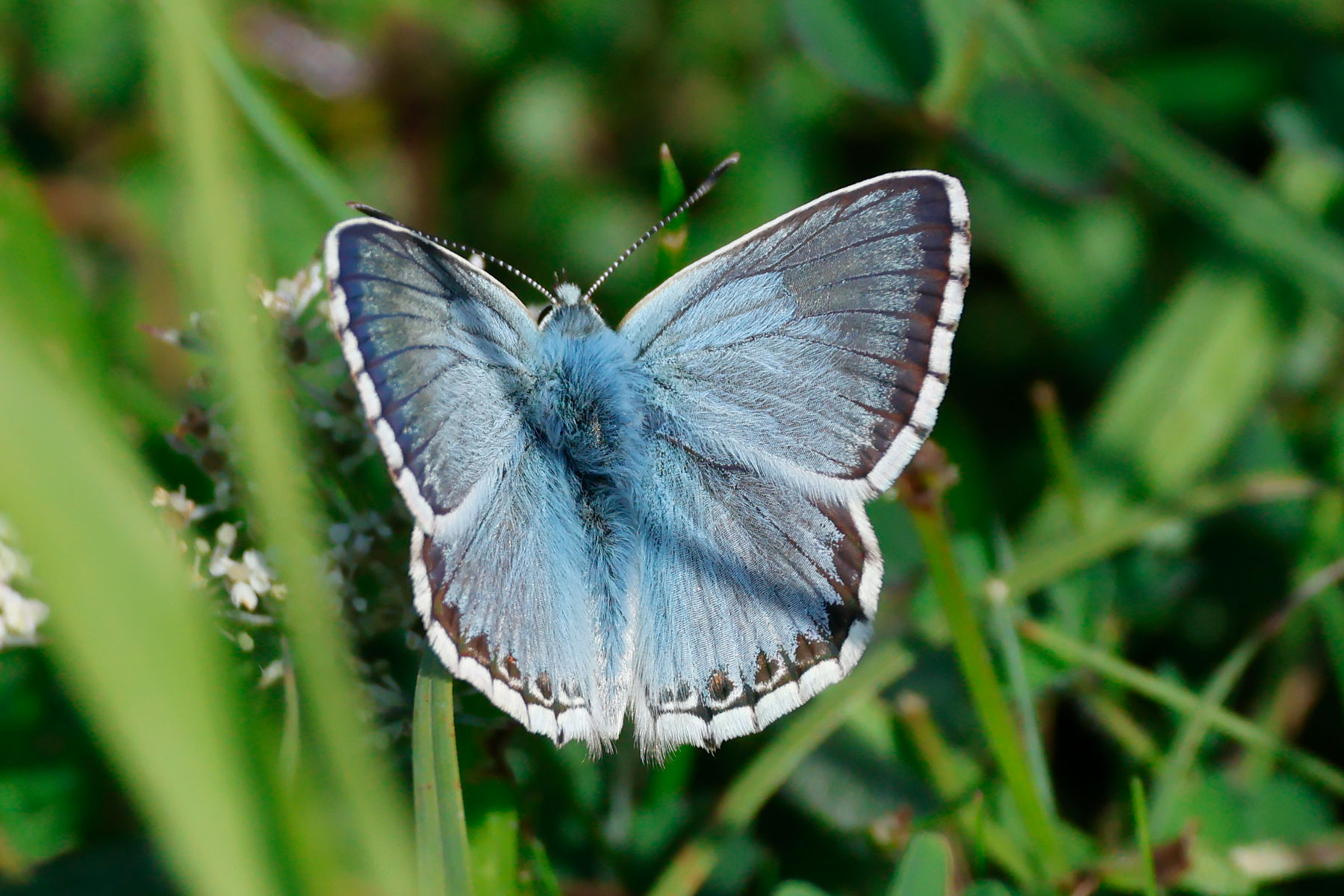
Once past the taller grasses and flowers Chalk Hill Blues appeared whizzing around the the ground thistles. As I walked around the blues the butterfly I was looking for shot past me and settled in the grass, the Silver Spotted Skipper. This is a female and was probably laying eggs.
However she didn't stay long and sprang away from me, you can track them as they fly but once they go past you and you have to turn I lost it, that is why it always good to have an extra pair of eyes with you.
As I looked for the skipper, the Chalk Hill Blues were settling on the Field Scabious.
A lovely view of a male as it moved around the scabious.
A female settled on a ground thistle.
Lats year the Autumn Lady's Tresses were everywhere, today they were very few and far between. I managed to find one, but it was small about three inches high.
Then another in slightly better condition.
A close up of what are very tiny flowers.
Then a fast moving insect once again and it settled on a Field Scabious and this time stayed in place. The Silver Spotted Skipper.
This warmth-loving skipper is relatively-local, but once settled
is fairly easy to identify, since it is the only skipper found in the British
Isles that has the distinctive white spots on the underside of the hindwings,
which give the butterfly its name. Like other "golden" skippers, the
male is distinguished from the female by the sex brand on its forewings, which
is a line of specialised scent scales.
The Silver Spotted Skipper is found on chalk grassland that
contains short, sparse, turf. This warmth-loving butterfly is typically found
on south facing slopes on which its sole foodplant, Sheep's-fescue, grows.
Like most skippers, this is a fast-flying species that flies
close to the ground, and can be difficult to follow when in flight. The male of
this species is more-frequently encountered than the female. Both sexes spend
the majority of their time either basking or feeding, and a wide variety of
nectar sources is used, including various species of Thistle. The butterfly
will find the warmest patches of ground on which to bask, enjoying the warmth
of paths, rabbit scrapes and other patches of bare earth which have been baked
by the sun. This species is inactive in overcast conditions.


The male rests on a suitable sunlit perch, and investigates
any passing butterfly, in the hope of finding a mate. If a virgin female is
encountered, the pair exhibits a tumbling courtship, with the male eventually
forcing the female to the ground where mating takes place. An egg-laying female
locates a suitable patch of bare ground, such as a rabbit scrape, and then
walks to the edge of the patch looking for a suitable location on which to lay
a single egg.
The skipper was springing off the scabious flower, but kept returning, then it sprung once more and I caught it as it left the flower.
It then settled in the grass to reveal it was in fact a female.
I continued to walk around the area, the sun was partly covered by then cloud so while it was warm, it wasn't baking hot and the butterflies were settling on the flowers.
A female Common Blue.
Then another Silver Spotted Skipper, one of now four I had seen. This is a male, you can see the dark scent gland on the hind wings.
Another female Common Blue, good to see numbers of this butterfly after the poor numbers earlier in the year.
Another Blue that struggled earlier in the year was the Adonis Blue. Here a male nectaring on the trefoil.
And then showing off the electric blue colour they are named after.
Distinguished from the Common Blue by the intensity of the blue and the black lines that extend into the white border
Another female Silver Spotted Skipper.
There were also a few Small Heath about.
I left the Hill Fort and walked around the circle path. I picked this Large White out below me on the slope, another species that has been so hard to see this year, let alone photograph.
I walked down the steep slope and through the wood, walking from the wood there were a few Chalk Hills and Common Blues and of course Meadow Browns. I came across this immature Kestrel hunting at the bottom of the car park slope.
It dropped to the grass and came up with something that is not easy to identify, but looks like it was a vole or mouse by the size of a tail.
The area at the bottom of the car park slope has traditionally been a good spot for the skippers, but this year the grass and turf has been high, not the conditions you would expect to find them in. One reason for this change has been put down to the reductions in the rabbit populations.
As I walked up the slope I took a welcome stop for this Common Blue on scabious.
Back at the car I reflected on a successful visit, probably my last of the year here unless there looks like some good migrant fall conditions.


_MG_0374.jpg)


_MG_0495.jpg)
_MG_0504.jpg)