Showing posts with label Golden-ringed Dragonfly. Show all posts

Friday, 3 July 2026

2nd July - Brownwich Cliffs and Titchfield Haven, Hampshire

We are now into the second half of the year, July is upon us.  I was returning to Titchfield, mainly on the back of a report yesterday of a Wall Brown on the cliffs at Brownwich.  I met Ian at Cliff road and then we walked up to the cliffs.  The morning had been overcast with some drizzle, but now the cloud was breaking up and there was some sunshine, although we did have some more drizzle.

Up on the cliffs there was a fresh breeze and out in the Solent a very large feeding flock of gulls and terns.  We reached the area where the Wall Brown had been seen and other than a few Marbled Whites, Meadow Browns and Small Skippers, there wasn't any sign of the Wall.  In this area there are two paths and on the sheltered path there was a smart Gatekeeper with wings fully open.

We walked on to the next opening, out over the fields Skylarks sang, but again no Wall Brown.  There was though a bonus in the appearance of a Golden-ringed Dragonfly that finally perched on the hedge.


A very distinctive dragonfly with the black and yellow patterning on the abdomen.  The female has a needle like ovipositor, but here there are two protrusions so this is a male.  These dragonflies hunt well away from the breeding sites, such as hedges like here and around bracken and gorse.


Despite the fresh breeze there were plenty of Marbled White winding their way through the grass stems occasionally stopping to nectar on the knapweed.


The Painted Lady year continues with this rather worn individual on the hedge out of the wind.


Much has been made about the Painted Lady year but for me this year so far has been all about the Holly Blue.  We are now into the second brood and they were everywhere today.


Its blue sitting on a Holly leaf!


We walked back to the reserve and went on to the west side and the Meon Shore hide. As we walked through the gate there were several Linnet around the piles of sand and brick including this smart male, Linnets are late breeders and the males acquire their breeding plumage later on in the summer.


It was much the same from the hide as it was on Monday with the Common Tern still sitting on the nest in front of the hide and plenty of activity around the Black-headed Gulls while Avocet and Black-tailed Godwits were feeding at the back of the scrape.

Some interest was provided by this pair of Common Terns scrapping in mid air in front of the hide.


It was time to search for some dragonflies, so we headed around to Darter's Dip.  On the path along the way a very nice Small Copper.


The recently cleared area along the path has opened up some pools and there were Black-tailed Skimmers showing well.  This a male.


There were more butterflies along the path, a very smart Red Admiral.


And the butterfly that gets passed over as a 'Cabbage White', but close up looks very nice with the creamy white underwing, a Large White.


Plenty of Common and Azure Blue Damselflies around the pond, but also some interesting dragonflies.  My firs Ruddy Darter of the year.  Different from the Common Darter by the curved shape of the abdomen and the red eyes.  They are frequent here at Titchfield, but not that common.


Last visit there were plenty of Four-spot Chasers, and they were about today.


It is worth checking through the blue Damselflies as they are not all the Commons and Azures.  There were several Blue-tailed, but the highlight was this Small Red-eyed Damselfly.  It was only found in Britain in 1999, but since then colonization has been rapid, being locally abundant in south east England bgy 2002.  It has since spread west and north as far as Devon.

It likes ponds with a mosaic of floating mats and pond weed that cover the surface from mid summer.  They appear to prefer settling on the weed on the surface of the water.


The Norfolk Hawker remains the star and this one was patrolling the pond with intermittent breaks to settle on the reed stems.

For lunch we headed into the Pumfrett hide, the conditions on the north scrape look ideal for waders, lets hope it doesn't dry up too much.


Plenty of Avocet about still despite another poor breeding season here with many chicks having been predated by gulls and maybe even foxes.


For some reason everything on the scrape was put up and this shuffled the pack and as a result some new waders appeared.  There have been two Spotted Redshank around on an off over the last few weeks, one of which was a summer plumaged individual, the other an immature.  The shuffling produced a Spotted Redshank, but unfortunately the immature bird.


The Bar-tailed Godwit also appeared, here alongside a Black-tailed Godwit.


And finally the green Sandpiper, here at the north east corner through the heat haze!

Leaving the hide we stopped at the pond for this lovely male Ruddy Darter.


Walking around the sea wall an adult Lesser Black-backed Gull stood on one of the posts close to the Black-headed Gulls and Common Terns.  Mud covered its bill and hid the bright yellow legs.


We started to walk up the east side, but stopped for this smart male Beautiful Demoiselle.


This was the first male I have seen this year, but I have seen females who have a bronze and green metallic appearance.  The males are all blue.


Ian had found the Sparrowhawk nest at the weekend and was now able to help me to get on it, once I did I was pleased to see one of the three chicks showing well as it stood up on he edge of the nest.  Those famous eyes already looking menacing.

When Ian photographed them last weekend they were all in their white downy feathers.  Today they were showing their actual feathers coming through, they will probably be fledging in a week's time.

We walked on to the Knight's Bank hide.  It was quiet with Black-headed Gulls fly catching over the meadow.  As I sat there looking out over the meadow we both recalled the state of this meadow five months ago on 2nd February.  When the sluise in the harbour closed the river Meon flooded out over the meadow as I recorded in this photo from then.


Today the meadow is a lush green full of many wild flowers with butterflies all over the place.


The young Kestrels were about but there wasn't any sign of the adults and we wondered if they have now been left to their own devices.  They were dropping to the ground frequently, probably chasing insects, an easier prey.  Here all three together on the telegraph pole close to the nest box.


Walking back to the cars we came across this Southern Hawker, yet another dragonfly that completed a very good day.

Another varied and interesting visit.

Monday, 23 September 2024

21st September - Hill Head and Titchfield Haven, Hampshire

The days are getting shorter and shorter as we approach the autumn equinox, I arrived at the sea wall at Hill Head just after seven and the tide was at its lowest.  Off shore nine Brent Geese flew west, the first of the year for me here.  Fisherman were standing in the shallow water and just beyond them were seven male Eider.  On the beach there were a couple of Dunlin a Ringed Plover and good numbers of Redshank and Turnstone.

Two Glossy Ibis flew from the beach and across the sea wall to land in the South Scrape on the reserve.  At the back of the reserve there were two Marsh Harriers, female types hunting over the reeds.  Pinging calls from the reeds close to the road revealed the Bearded Tits once more, a male showing very well.


With the tide low there was mud around the base of the reeds in Duck Bay and there were three Water Rials visible.  At one point two had a fight in a manner similar to Coots, it was quite vicious.


Another Glossy Ibis flew up from around the Sailing Club area and flew to the pools on the beach.  There have been three about so this must have stayed on the beach when the other two flew into the reserve earlier.

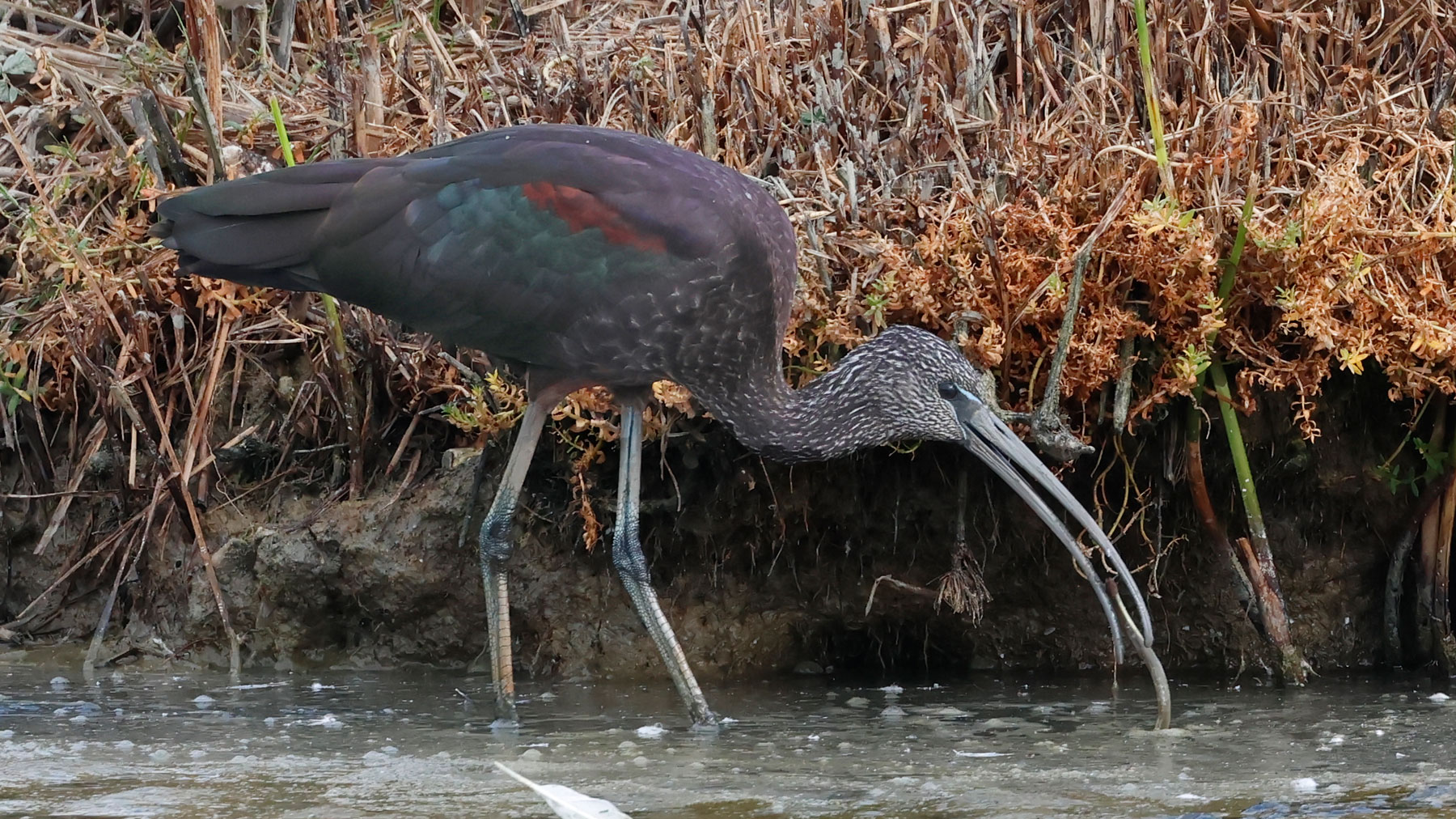
Ian and I walked along the sea wall to get the sun behind us that would allow us to get the best views and allow the sunlight to highlight the glossy plumage.


The curved bill is used in the same manner as a Curlew, turning the head to push it into spaces around the rocks to search for food.


This is the winter plumage with streaks on the neck, but the white lines at the base of the bill.


from the beach the Ibis flew over the sea wall and dropped down on to Duck Bay where it was quite close to the road.


One of the primary feathers appeared to be loose.


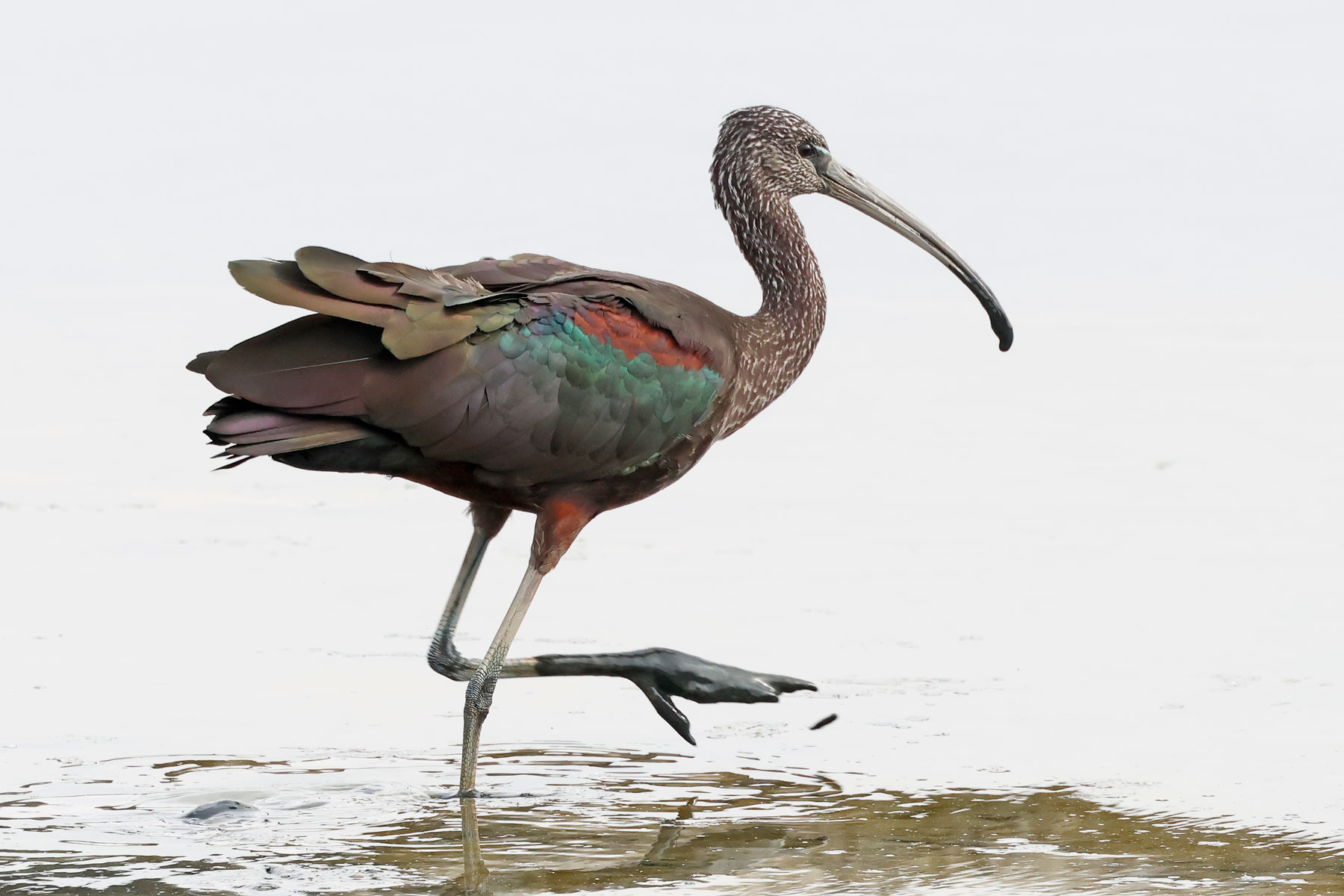
As it turned the light would produce different colours on the feathers.


I was distracted away from the Ibis by a juvenile Water Rail that appeared at the base of the reeds close to the road.


Another distraction from the Ibis was the "pinging" calls from the reeds once more and a pair of Bearded Tits.


A classic pose.


The pair together.


The male then flew to a reed stem and gradually made its way up the stem.


And gave me some great views.


Some of the best photos I have taken of Bearded Tit, and I don't apologise for taking so many.


We checked in and went to the west side of the reserve and the Meon Shore Hide once again.  The three Glossy Ibis were on the south scrape two together and the other feeding around one of the islands.


Once again the light bringing out the petrol colours that give the Ibis its name.


A Sparrowhawk on the west side of the scrape put up some of the birds on the scrape, but a little later everything went up and cruising over the scrape was an Osprey.


It was an unringed bird and headed north towards the Frying Pan area of the reserve.


It made several dives on to the river, but was not successful and settled in a tree before disappearing from sight.


So it was back to the Glossy Ibis that had moved closer to the hide.


The birds on the scrape were still nervous, here all the Black-tailed Godwits went up.


The Osprey then appeared at the back of the reserve, over the Frying Pan area once again, it was still trying to catch a meal.


Then success as it appeared with what looks like a large Grey Mullet hanging from one claw.


We watched it fly up the valley, but then turn to the west where it continued above the trees with us willing it to come to the scrape, but eventually was lost to view as it headed towards Warsash.

Once again back to the Glossy Ibis.


It crossed the scrape to the small island on the left hand side of the hide.


The foraging action with its long curved bill.


It ten caught what looks like a small eel, which didn't want to be swallowed and wrapped around the bill.  The Ibis though managed to position it so that it could be dispatched.


Standing with one of the Snipe that calls the island home.


A turn and some stunning colour in the wings.


The mud was quite sticky.


The other two Ibis remained at the back of the scrape, but did fly in a little closer.


Three Little Egret at the back of the scrape caught my eye in the black water.


A single Mediterranean Gull flew in.

The morning had been quite special so far, so we decided to try our luck in the Spurgin Hide.  On arrival a Kingfisher flew in and was chased by another.  A Great Egret was seen coming from the Frying Pan Area, calling as it arrived.


It dropped on to Eleven Acre Mere at he back close to the reeds where it hunted with the "snooty" head up approach.


Then the Kingfisher arrived as expected and showed well again on one of the many posts.


Interestingly a male that was ringed.


Love the way the wind blows the feathers.


The wind then catching the crown too.


Then rather than fishing from a perch it decided to hover over a calm patch of water.


Then after the show from the Kingfisher, a Hobby appeared hunting dragonflies over the mere.  Unfortunately I wasn't in the best place to get good views but managed a record as it zipped past.

The Spurgin Hide wasn't finished though, a Grass Snake was picked up swimming across the open water, heading for the reeds.


Tasting the air as it swam.


Having not seen a Grass Snake for many years, I have seen two well this year.  This was a small one probably around three feet long, they can grow to as much as six feet.

Time was against us with the reserve closing soon.  We left the Spurgin Hide after one of the best times I can recall in there for sometime.  We walked along Kathy's Path and found a very smart Golden-ringed Dragonfly.  This is the country's largest dragonfly and for me one of the most spectacular.

A really good day, maybe not the rarer birds you would expect at this time of year, but some quality birds and the surprise of the Grass Snake.