Showing posts with label Leadenhall. Show all posts

Monday, 18 October 2021

16th October - Leadenhall New Forest, and Blashford Lakes, Hampshire

The third weekend of October, so it has to be a trip to Black Gutter Bottom and then up the slope to Leadenhall in the New Forest.  It was overcast, but mild and very still as I set off from the car.  The sun was not quite up and it was murky.  Overhead there were the calls of Redwing and from the bracken, Meadow Pipits.  Heading up hill I could see Stonechats on the top of the bracken too.

This is a right of passage for both myself and the birds.  Ring Ouzels were reported in the week, for some reason every year, drawn to the berries on the Whitebeam trees on the edge of the plateau.  For me it also means the tree on the horizon, I couldn't resist it.


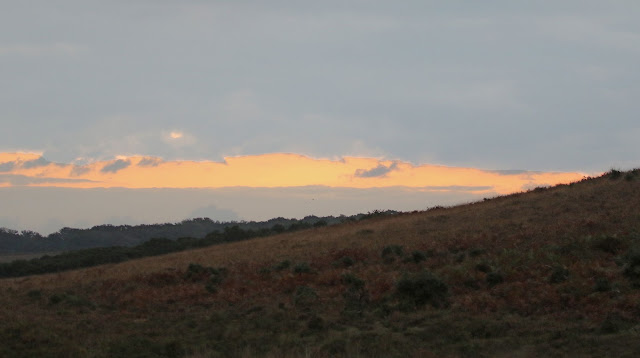
Away to the east looking along Black Gutter Bottom the sun was just beginning to colour the sky.


A Robin started singing from the top of one of the bushes.


I stood looking at the trees where Blackbirds were feasting on the berries and you could hear their calls, then above the Blackbirds the distinctive deeper "tuts" of a Ring Ouzel, I could see where the the calls were coming from and then the bird came into view and then promptly disappeared.  I walked around the trees and gorse but couldn't see anything.  Several Redwing were feeding in the trees as well and one or two could be seen on the edge of the  trees.


So it was back to watching the branches and trees.  A Chiffchaff was fly catching around the branches, flitting in and around the berries, giving short snatches of visibility


More calls from within the tree indicated that they were on the move again, then suddenly both birds flew out from the tree and across the plateau towards a silver birch, where there was a group of a dozen Starlings.  The Starlings and a single Song Thrush didn't like the presence of the Ring Ouzel and it was pushed from the tree, the female disappearing, but the male moved to a bush where it showed briefly, very well, if a little too distant.


Then began the usual game of cat and mouse as we searched and chased what were thought to be the Ouzels around the plateau.  Here a view of the plateau as the sky started to break up with the sun coming through.


The Whitebeam trees, the focus of attention when the Ring Ouzels are around.


The chase and search took me to the far side where the flock of Starlings were feeding on the grass.  The female Ring Ouzel flew up from the bracken and into the trees and I followed, then lost it completely.  

As I walked around the the trees and bushes I was struck by the fungi growing around the bracken, these are Brown Birch Boletes.


The Ring Ouzel were now in the trees at the south end of the plateau.


One flew off, the silver in the wings showing well and making it easy to pick them out from the Blackbirds.  I followed through the burnt remains of the gorse.

I flushed the female once again, but then lost it.  All through the morning I had been hearing the grunts and barks of the Fallow Deer in Ashley Hole, there must have been four stags calling across the open bracken.  I decided that I would go after the deer and come back later for the Ring Ouzel, they would return to the berries and would not be going far.

I walked down the slope towards a small group of Fallow Deer, the stag lying down in the bracken with the females around him.


They were watching me and as I tried to get a little closer, the stage stood up, still watching me.


Then I clearly got a little too close and he started to slowly move away.


But then paused along with the hinds to watch me.

I moved again and this time they were off, I had come too close and the whole group raced away through the bracken and along the valley bottom.

I walked on, I could hear distant barking, it seemed a long way off and probably not close by.  Overhead I heard the call of a Raven.


Then quickly followed by another, also calling.

I reached a copse of pine and oak, and was alerted to the calls of Goldcrests.  Walking into the copse the birds were calling above me, but the first bird I managed to get onto was a Firecrest.


With the birds being mobile it was difficult to know how many there were, but at least two with also a pair of Goldcrests.


A Nuthatch calling showed briefly, and then a Treecreeper the copse coming alive.


Then as quickly as the calls had started they stopped and the trees fell quiet.  I walked on, heading up to Ashley Walk.  I could see a bird at the top of a bush and for a moment I thought it could be a small bird of prey, but as I got closer I could see it was a Mistle Thrush.


Looking west the colours in the bracken and bushes was just beginning to take on an autumnal look.


The sky too was also as impressive.

As I walked along the main path back towards Leadenhall Dartford Warblers could be heard calling from the gorse on both sides of the path, there was also a brief view of the white Fallow Deer stag before it was mobbed by a pair of crows and disappeared into the gorse.

There was a small group of birders present, standing so far back and using scopes to watch the trees.  I walked past and then went to the back of the trees, experience built up over several years coming to this sight to see the Ring Ouzels, told me that they would move from the berries in the trees to the boggy area behind the gorse to drink.

As I walked around the gorse I heard the distinctive call, but unfortunately both birds flew up and headed to the Whitebeam.  I could see them in the centre of the tree and every so often they would call.  There were also quite a few continental Blackbirds, their bills lacking the bright yellow of the local birds.

I stood watching the trees, a couple of Chiffchaffs and a Willow Warbler were flitting about amongst the bracken and the birch trees and a pair of Bullfinches were feeding on the hawthorn berries.  Then another cluck and the male appeared in the Crab Apple tree, but behind the branches.  


I was able to edge a little closer without disturbing the bird.


Then it flew off across the gorse and probably down to the small pools of water there.

I would walk around to the plateau to see if it was possible to see them in the tree and at one point I thought we would get the view I hoped for as the male came briefly to the berries, but it was gone as quickly as it appeared.  I was though able to watch a Peregrine zip through, which lifted the spirits a little.

It was coming up to five hours I had been here and chasing these very elusive birds in hope of that killer view, I had to make a decision do I continue or move on.  The weather was now superb, the sky blue and the sunshine warm.  I doubted there would be very much about anywhere, but finally decided it was time to move on.

I headed down towards Black Gutter Bottom with Red Admiral and Common Darters on the path, it could have been August or September.

The view as I waded through the stream was beautiful , again the autumn colours beginning to show through.


I decided to visit Blashford lakes, it was relatively close and the last time I had visited the reserve was back on the 16th March 2021.  A week later the world changed and lockdown was upon us, the reserve closed for a lengthy period and when it did open up the hides remained closed, finally opening on the 19th July this year.  Viewing the lakes is difficult even with the hides but without them there was no real interest in going.  That last visit was a good one though with the Bittern showing really well.

I felt I owed it a chance and maybe something might have turned up.  I decided to take lunch with me to the Goosander hide, a chance to sit and watch. The walk to the hide has changed a lot, where there used to be bulrushes and small pools that Snipe liked was now a small plantation of birch trees.  The view from the hide was very much the same though, very little about.

I scanned Ibsley Water with the scope, on the far bank I counted four Great Egrets, five Herons and a single Little Egret, there were also several Pochard.  Of the other duck there were Tufted Duck, Gadwall, Mallard and a few Teal.  Probably the most numerous water bird was the Coot

I was prepared to photograph anything that came close to the hide.  Here a Great Crested Grebe, a young bird going into winter plumage

Then something of interest threatened to come close, a Grey Wagtail flew in and walked along the edge of the water, but after threatening to come close it turned around and flew off.


One of the Tufted Ducks came close, still showing a fair amount of eclipse plumage.

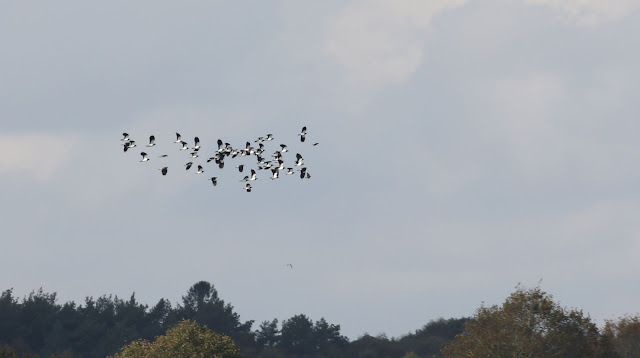
A flock of Lapwing flew up from the west shore of the water.
Lunch finished I walked back to the car and dumped the 'scope.  I walked across the road towards the visitor centre and then tried the Woodland Hide.  There was a little activity here with mostly Goldfinch on the feeders and a very quick appearance of a Nuthatch.

Leaving the Woodland Hide I scanned the reeds around the Silt pond, a Bittern had been photographed here a few weeks back, but all was quiet today.  The black water of the Silt Pond provides the ideal reflections for the roosting duck, in this case Gadwall, at the back of the pond.


The next stop was the south hide on Ivy Lake, this like the Goosander has windows that open.  I was hoping a Kingfisher would appear on the many sticks in the water, one did put in an appearance, flying back and forth in front of the hide, but never settling on the convenient perches.

I was left then to contend with another Great Crested Grebe that conveniently appeared in front of the hide despite the noisy comings and going of the visiting public.


Walking back I came across this lovely set of Common Puffballs in the leaf litter, the afternoon sun catching them delightfully.

With the warm weather conditions it was no surprise that there were butterflies about.  I managed to see several Red Admiral, a single Small Copper and a Peacock that tried to get into one of the hides.  None of these settled though and it wasn't until I decided to just check the Tern Hide that I managed to find this lovely male Brimstone.

There was nothing new of interest from the Tern Hide, the only thing that caught my eye was the broken window on the left hand side.  It was broken the last time I visited in 2019, either it gets broken a lot or it just hasn't been fixed

Always nice to catch up with the Ring Ouzels and once again they led me a merry dance.  The forest is beginning to take on the beautiful autumn feel and it was lovely to walk around in the warm sunshine.  Blashford doesn't change, lets hope the Bittern returns to entertain later in the year, I look forward to a fight over an open window!

The weather conditions have been pretty benign so far this October, lets hope for something a little more active over the next few weeks to shake things up

Monday, 19 October 2020

17th October - Leaden Hall, New Forest and Hook with Warsash, Hampshire

It was a case of picking up where we left up last weekend, arriving just before dawn at the footpath that leads down to Black Gutter Bottom and then back up to Leadenhall.  It was overcast and on the way there had been pockets of drizzle.  Away to the east we could see a break in the clouds, but also signs that the drizzle was not done with us yet.

We crossed the stream at the bottom of the valley and headed up hill towards the plateau.  The first Redwing of the year flew overhead along with Meadow Pipits.  On arriving on the plateau there were more Redwing in the hawthorn trees.  These were our initial target the bushes covered with red berries and already busy with the Redwing and Blackbird feeding, but was there the Ring Ouzel we had sought last weekend and hoped we would catch up with today?

We stood watching the coming and going of the Blackbirds, checking each one for the silvery grey tints in the wings as they flew into the cover of the denser bushes from the more exposed hawthorn.  There was at least one confirmed sighting of a Ring Ouzel, now to get some better views.

Behind us the skies were boiling up, the small break in the clouds allowing the sun just below the horizon to come through were a vivid red and with the misty cloud it was almost as if there was a huge fire in the east.


Every year Ian and I make this pilgrimage, sometimes once, but mostly like this year several times in the hope of securing that crippling view of the Ring Ouzels that stop over here on the way south to their wintering grounds in Morocco and Tunisia.   Why will always remain a mystery, but you could guess it has something to do with the landscape, moors and bracken and the preponderance of berries on the bushes around the plateau.

There are two ways of approaching the search for these birds.  One is to stand still, stare at the bushes and wait for one to appear, or move around the area searching for them.  Every year Ian and I tell ourselves that we will be patient, and every year we seem to not be able to take the patient approach, this year not being any different.  This morning though we did have the distraction of the sun rise.  Here the sun above the horizon producing an orange smokey affect.

We did stand around but soon the need to search set in.  Ian went off first while I stood watching the bushes.  A call from him had me running to the back of the bushes on the north side of the plateau.  Just as I arrived a male flew past me.  It was still gloomy but Ian had managed to get a shot.  We now knew they were here and of course headed back to where we thought they had gone.

More time passed watching the bushes, drizzle set in for a while and I had to cover the camera up.  It was my turn then to wander off.  I returned to the other side of the bushes and almost immediately came across what I though at first was a Blackbird in the Crab Apple, but as I edged closer I could see it was a Ring Ouzel.

I called Ian but had to be careful shouting too loud.  I edged closer still, the light was poor and the background even worse, requiring to over expose.  The third complication was the fact the bird was sitting in the middle of the tree and was behind several branches


It was a start, and when it finally flew off I made my way back out on to the plateau.  A Song Thrush appeared in another of the trees on the edge of the plateau.

The drizzle had now eased and the sun was creating a very impressive rainbow away in the distance towards Godshill.

Here a "full bow" across Black Gutter Bottom

At times the colours were very intense making for an impressive scene 

Framing the hawthorn bush we were watching intently

The attraction of the rainbow wore off and it was back to the matter in hand, where were the ?Ring Ouzels.  Once again I walked off thinking that the scrub at he back of the main bushes was probably going to be the best place to see them.  I pushed through the bramble and gorse and could see some birds ahead of me in a rose bush.  One of these was definitely a Ring Ouzel and I stopped to get a few shots before calling Ian once again.

Slowly I edged closer.


I could hear Ian coming through the bushes but he was still away off.  I was now as close as I considered to be best.  Ring Ouzels are very easily flushed and I didn't want to lose them.


This was better, but still I had to deal with the nuisance of the branches, here a lot thinner but still obscuring the bird in places.

As Ian finally arrived the birds were off.  They seemed to like to flooded area of heather and the a clump of gorse.  They would move from here over our heads to the berries on the plateau.  This time we decided to stay and play the patience game, it proved to be the right decision.

As we stood watching the birds returned, the trip to the gorse was interrupted, one bird perching at the top of a bramble bush next to the rose bush.


Once again we had to contend with the white background, trying to figure out the right exposure while hoping that the bird didn't fly

The typical thrush pose with the beak point upwards.


At last some great views without the annoying branches that they seem to like to perch behind


Not sure here if it was calling, they have a similar high pitched warning or contact call similar to that of the Blackbird.  This doesn't require the beak to be completely open the sound coming from with the throat

The Latin name for the Ring Ouzel is Turdus Torquatus, Turdus meaning thrush while Torquatus comes from the Latin Torquis which means collar.  The collar is seen very well here


 Then it moved into the bush, once again hiding behind the branches, but we were able to move to get a view where the branches were removed.

Here you can see the silvery grey edges to the wings that show up so distinctly when they fly


Then it was gone low across the heather and bracken and out of sight in the gorse.  We decided again to wait it out, other Ring Ouzels came and went, we estimated at least four birds, when they left the gorse they would fly low over the heather, allowing only  views of the white collar and the silvery edges to the wings.  They were joined by Blackbirds and Song Thrushes.  This Song Thrush appearing in the same place as the Ring Ouzel


The views across Black Gutter Bottom towards the road and beyond were quite spectacular, the sun highlighting parts of the bracken and a distant tree in autumn colour.

After a while we finally decided that we had just experienced the best views of this bird that brings us here each year and made our way to the plateau to brag with others and then on Ashley Hole in the vain hope of finding that other specialty here, the Merlin, which also manages successfully to avoid us.

The Merlin did it once again, and the only reward for a walk down to Ashley Hole and then along the Black Gutter Bottom was this dark Fallow Deer stag that was barking out warning any other deer that wanted to try and take his hinds that he was the boss.


Another superb Fallow Deer stag.


And dark and brooding horizons.


As we walked up the hill the only birds we had seen on the circuit were, a flushed Snipe, Blue, Great and Coal Tits and one or two Crows.  As we approached the car a bird flew up into a bush, a Reed Bunting.


Where to next was now the topic of discussion, we opted to go to Hook with Warsash, yesterday there was a Yellow Browed Warbler reported, there had not been any reports so far today but we thought it would make a change from the other sites we regularly visit.

Parking near the sub station we walked to Workman's Lane.  This is a site from which Little Owl is reported although not so much lately.  All the reports refer to a usual tree which we have determined is to have your back to Beam Cottage and then view the trees along the fence line.  This we did and we saw nothing but trees and a Wood Pigeon.  We have been trying for this bird for years so it was not a surprise when we didn't find it.

From Workman's Lane we walked through to Crow Lane, the site from which the Yellow-browed Warbler was seen.  There was a large group of Long-tailed Tits, Chiffchaff and a Goldcrest, which caused a little rush of excitement, but no warbler.

It was then down to the coast and a walk along the beach to the Links.  Here it was almost bird-less apart from a lone Little Egret.  The tide was very high, and it seemed that here it would not fall at all, the tide timetables stating three consecutive high tides with a massive difference of 30 centimetres!.

At the Lake we tried to coax out some Bearded Tits, we could hear them every so often at the back of the reed bed, but they never showed.  In front of us several Chiffchaffs fed in the reeds and a secretive Cetti's Warbler would burst into song every so often.  This Reed Bunting was the only bird that showed well enough to photograph.


The sun was now quite pleasant and this warmth brought out a Small Copper that never stopped and what was probably a Southern or Migrant Hawker around the reeds.  With the high tide there was a small wader roost of around fifty plus Ringed Plover, the odd Dunlin several Grey Plover and a Greenshank.

With no chance of the tide falling to bring the waders out we started back.  Another butterfly flying over the scrape turned out to be a Clouded Yellow, but it was impossible to get anywhere near it.

At the scrape numbers of duck had increased, we counted 38 Pintail, some of which were in perfect breeding plumage while others still showed signs of eclipse plumage.  Under the reeds were four Snipe.

As we watched one Pintail swam across the water towards us.


It hauled out of the water onto a little island.  Here it started to preen which ended with a serious of wing flaps to sort its feather out.


This Pintail still had feathers on it's cheeks that needed to come out properly, the white being the sheath that covers the new feathers as they grow.


We had been moaning about the lack of photographic opportunities here so it was nice to get the chance to catch the Pintail.  

The scene across the scrape was quite spectacular, the skies clear to the west but in the east dark clouds were building.


A little further on it was possible to get a view of the island with the Pintail on it.  As we watched a Little Egret flew in.  Earlier we had the challenge with the Ring Ouzel of a dark bird against a white background, this time it was a white bird against a dark background.


The water was calm and what I thought to be a piece of wood turned out to be a Grey Seal

For the first time this autumn we could see a constant movement of Brent Geese flying from the other side of the Solent and heading towards the direction of Hill Head.


With water high in Southampton Water the assumption was that they were heading to an area where the tide was falling


From the beach we headed inland along side the horse fields and paddocks at the sub station

At the back of the horse paddocks there were Stonechat and a Whinchat while in the paddock Pied Wagtails, this very smart male.

And a female 


As we approached Workman's Lane once more we came across a flock of Long-tailed Tits and at least one Chiffchaff.  Thinking there still might be a chance to find something good we stopped and watched the flock move through.

Then there was a call like someone stepping on a dogs toy from behind us.  I looked at Ian and for some reason he said Jackdaw (I can only assume some had flown over!).  Then we both realised who the owner of the call was, it was a Little Owl and it was coming from the Oak trees in the garden of Beam Cottage.

There was also several alarm calls of Mistle Thrush and by following these we were able to track down the Little Owl.  My first view was poor it was behind a branch (something of a theme today), then it flew which is when Ian saw it.  We rushed up the lane to see if we could get a view into the garden.  The Mistle Thrushes were still calling as was the Owl.  We knew it was close but finding it was not easy.  Then I saw a shape on a branch.

We couldn't believe it was there sitting out in the open looking at us

Here in the next two photographs you can see the Mistle Thrush mobbing the owl, the owl completely unmoved by the noise and aggression


Who doesn't love a Little Owl?


The Mistle Thrush was joined by a Great Spotted Woodpecker and the Owl turned, but still appeared to not be too concerned, I suppose its a way of life for owls.


Then it flew off and we lost it for awhile, but Ian relocated it at the back of the garden again still in the open, and still attracting the attention of the thrush and woodpecker.


Us making squeaking noises caught its attention.


The woodpecker then put in an appearance


I have tried several times to see the Little Owl here, but not as many times as Ian has.  We have remarked about the "usual tree" many times and had given up any hope of seeing it, then we are blessed with these close ups and not even in the "usual tree".  


Then I think the mobbing was just too much and it was gone.  As it flew there was a call from the other side of the field in the trees where the owl should have been.  Ian had been told that there was only one bird now but this was confirmation that there were two here, lets hope they breed once again.

Brilliant stuff and the great end to a day that was perfect at the start and end but a little quiet in the middle