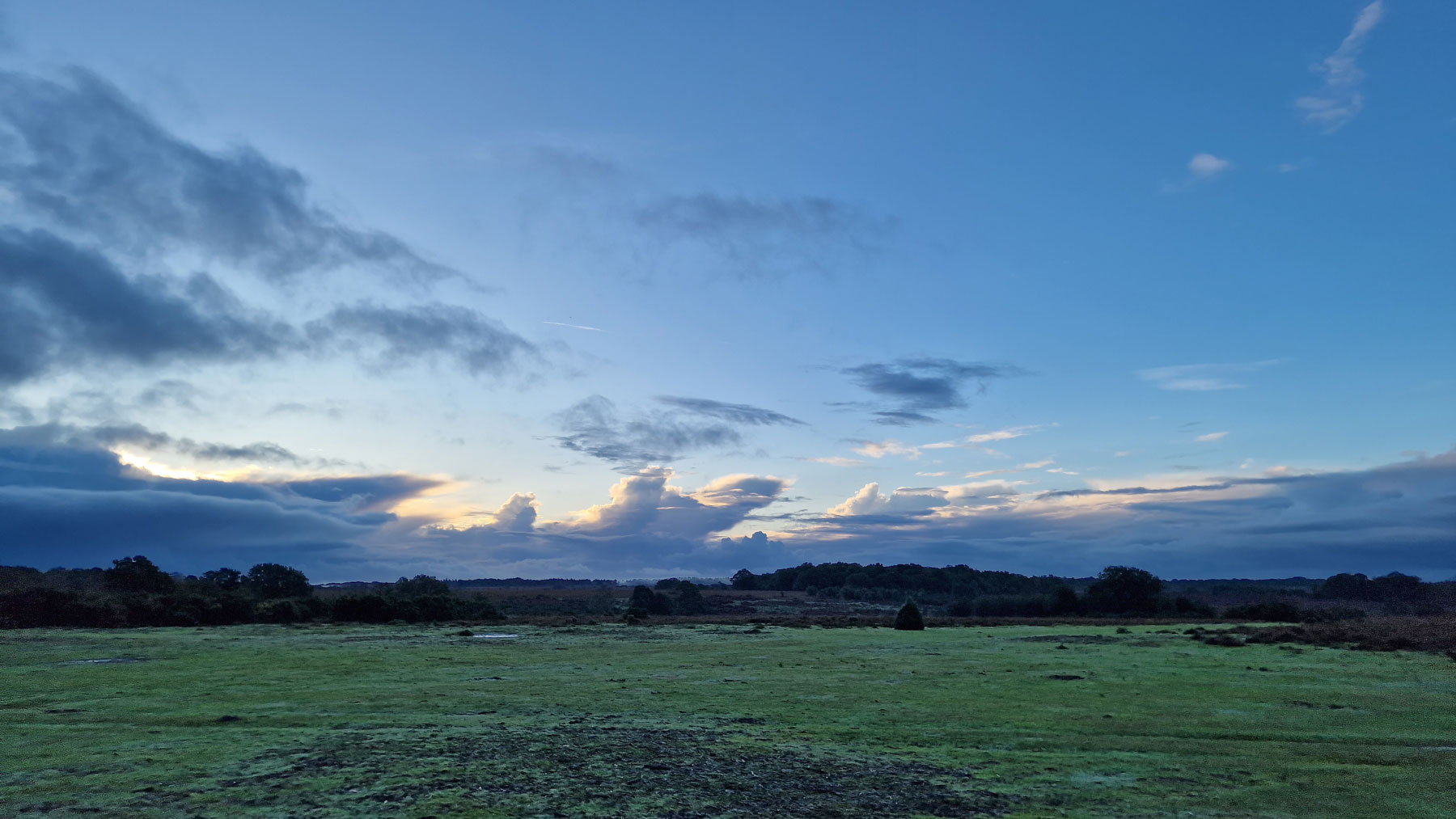
The weather forecast was initially iffy for this Saturday, the predictions swapping and changing almost every hour. In the end Ian and I opted to meet at the Bramshaw Telegraph in the New Forest. As I arrived in the car park the skies were clear above, but with surrounding cloud that was subduing the sun rise.
Rain on Friday and overnight was producing a hanging mist around the hollows of the open moor. Away to the north the electricity pylons added to the moody scene.
We set off from the car park in the direction of Ashley Hole. Immediately in the gorse we were aware of a number of Goldcrests and Blue Tits, quite possibly they had arrived overnight and were now busily searching for food in the gorse.
A little further along we heard the chatter of Fieldfare and the "seep" calls of Redwing over head, these thrushes were then joined by several Mistle Thrush. The light was difficult, but this can be seen as a Mistle Thrush.
It was a stunning morning, the sun now having broken free of the surrounding clouds, being behind us as we walked west it was lighting up the distant trees and bracken. I stopped to take in this lovely reflection in one of the pools created over the last few days by the heavy rain.
The mist was still holding in places, but where the sun reached it was burnt off almost immediately.
Ian remarked on the lack of wind and how that may play in our favour by keeping the bad clouds away. I came back with if it does rain it may take a while to clear, we laughed and didn't consider this happening.
Winter thrushes were everywhere, we searched amongst the Fieldfare and Redwing for any sign of a possible Ring Ouzel, but with no luck.
The sun was now breaking through the trees to the south of our path creating a lovely morning scene with the reddish brown of the wet bracken and the trees.
As the sunlight crept across the bracken it picked out two ponies grazing.
It really was an idyllic morning and there was no indication of any bad weather to come.
Absolutely stunning light.
Away to our left as we walked towards the west there were many Redwing, Fieldfare and Blackbirds, the latter mainly the continental birds with black bills. As we stopped to watch the thrushes a Dartford Warbler called at first then produced snippets of sub song. This one silhouetted amongst the bracken.
The silhouette unmistakeable.
We were then lucky to get one appear at the top of the gorse, the purple and wine colour picked out by the morning sunshine.
It then dropped down into the gorse but appeared again to continue singing.
Then it was gone, but just as we were about to walk on it appeared once again at the top of a Holly Tree.
We had been hearing the belching calls of buck Fallow Deer, the rutting season now in full swing. Finally we managed a glimpse of a buck resplendent with a full set of the palmate antlers.
A doe appeared from behind the bracken.
Fallow Deer were brought to Britain in the 11th Century from the eastern Mediterranean for hunting, today the Fallow Deer is the most widespread and abundant of our introduced deer, found through out England, and more patchily in Wales and Scotland.
The buck was then joined by several doe and younger deer.
The buck, having seen us then led it's does away down the slope and into the wood and out of sight. The calling though continued.
These two young deer looked to be separate from the others.
We walked on and noticed that cloud was building up, and away to the south west they looked quite menacing. Ever confident we returned to our search of the bushes and trees for the thrushes. Once in a tree they seem to become invisible, this one Redwing proved to be a little different.
Despite it being the third week of October, the trees were still holding on to green leaves, the bracken was turning the reddish brown, but there was still no sign of autumn colour in the trees. One reason for this was the lack of cold nights, while the changes are influenced by day length, they also require a change in temperature and that hasn't happened that often so far this year. What was clear though was that it was a n excellent year for berries and all seeds on the trees such as acorns and beech mast.

WE came across a small copse on the edge of the main wood. Here there were Crab Apple trees and Holly bushes and they were all laden with fruit and berries. We could see all five common species of thrush at this time of year, but not the sixth that we hoped for. Blackbirds and Song Thrush would call as they moved from tree to tree and Redwing Mistle Thrush and Fieldfare would move from the bracken to to the trees, we assumed they must vary the diet, searching for invertebrates in the bracken.
As well as the thrushes there were quite a few Chaffinch and Greenfinch and I also managed to get a quick glimpse of a Hawfinch. Some of the finches were feeding at the base of the trees in the copse and we quietly approached them in the hope of finding something interesting amongst them. As we walked into the copse it started to rain, light at first, but gradually it became heavier, and we sheltered under one of the trees, but as the rain fell the tree was just as wet. After about half an hour the rain eased slightly and even to the point where it almost stopped. We set off in the hope we could continue our walk.
Coming out of the copse we joined the path, but stopped once again as many thrushes pored out of some holly trees. As we watched we debated where to go, fortunately the thrushes held our attention and it started to rain again, this time much harder. If we hadn't been pre occupied with the birds we may have set off for Pitts Wood Inclosure, and that walk would not have had any shelter. As it was we had some but the rain was getting heavier and the paths around us were now turning into fast streams.
A group of ponies came into the copse, probably looking for cover, but moved off when they saw us. We were then visited by a buck Fallow Deer, very distinctive with a superb rack of Antlers and a very dark colour.
He stopped to look at us as if wanting to use the trees were under for cover. I chanced the camera despite the rain. The grainy appearance is actually the rain falling!
In summer the coat is a reddish brown with numerous white spots and a white horizontal line on the flank, in winter they are duller and spotless. However coat colour is variable within herds and may contain entirely black, like this buck and also creamy white individuals.
There was no sign of a hareem so maybe he was on the look for a fight, or had just lost one. The rut takes place in October and early November. Some bucks gather hareems of does while others may wander in search of receptive females and mate opportunistically.
The mating strategies are diverse, but most establish their stands and attempt to attract females by calling, in some case there may be leks with males holding small area and attempting to attract the females.
As he walked away I was able to attract him to stop and look back at us, or where the noise came from. This put him into the best light despite the relentless rain.
After the black buck had moved on, a little later we were visited by another buck, this time the antlers were not so developed probably a younger buck and it had the more usual coat appearance but the rain didn't help the light.
It would brighten to the south west and we hoped the rain would ease, but it didn't. Sheltering under trees became pointless, the trees leaves so wet that they were falling on us. I was beginning to get a little worried about the camera equipment but there was little I could do than what I had done already. The sun appeared through the clouds, but the rain continued. All around us pools were appearing and the water ran past along the track like a torrent.
Finally it began to ease and then enough to allow us to set off back to the car park. It was still drizzling though while away to the south there were glimpses of blue sky, we were just unlucky we were on the edge of a storm that was very slow moving. We tramped back through huge pools of water, it was amazing how the landscape had changed some much, so quickly.
Back at the car park we were able to dry out a little and we took the time for lunch. It was then a case of what do we do next. Neither of us had the appetite to head back out into the forest, so we opted to visit Blashford Lakes and the cover afforded there of the hides.
We headed for the Tern Hide, walking in there was very little about and what was in front of the hide, two male Pochard immediately flew away to the far side of Ibsley Water. Scanning through the duck there were Wigeon, Gadwall, Shoveler, Teal and Mallard around the edges while in open water quite a few Tufted Duck and one female Goldeneye
On one of the exposed islands at the back of the lake stood a lone Great Egret, a bird that was once only found here at Blashford, but now seems to be everywhere.
Surprisingly there were no Canada Geese but instead a group of 31 Egyptian Geese. On the right hand side of the hide there were a few Meadow Pipits and Linnet on the ground and along the sure there was a Buzzard which was quickly dismantling a bird, but we were not able to identify it, possibly a duck, and probably one that was already dead and the Buzzard had found it.
With little else on offer we drove into the main car park and headed for the Woodland Hide. Nothing special here but the usual subjects, Blue, Great and Coal Tit, Goldfinch and this very smart Greenfinch.
The Great Tits were also looking quite smart.
A visit to the Ivy Lake South hide was not much better, a couple of Great Crested Grebes, Jays flying back and forth and a fly past Kingfisher the highlight.
Not one of the better days, but looking back the Dartford Warblers and deer were excellent and I wonder if we would have got so close had it not been raining. And my did it rain!




_MG_2134.jpg)