Monday, 13 January 2020

11th January - South East Hampshire

The start of a new year and the time to revisit some of those sites that you always go to at the start of the year, and an opportunity to see some new ones too, that was the plan for today.  The forecast wasn't too bad, a bit windy maybe but we were promised a dry day but overcast.  As I pulled up in the Pyramids car park in Southsea it was still very gloomy, and the wind was picking up.  When I left home it was still, but with an annoying drizzle, thankfully in Southsea it was dry.

I was meeting Ian here to catch up with the Purple Sandpipers that frequent the rocks and sea weed around the sea wall at Southsea castle.  Something we only seem to do at the start of the year, a one off pilgrimage.  As we walked along the promenade towards the area where they normally can be seen it was empty save for a Rock Pipit calling in the gloom and offshore a couple of passing Shags, a welcome year tick.

We walked along the promenade scouring the rocks and sea wall but there was nothing other than a few feral pigeons. We walked to the end of of the promenade and then back, a couple of Shag flew past once again, additional to the earlier birds, that made four in all, Shag appear to be regular here and replace the cormorants that probably move inland for an easier meal.  The light was a little better now.


One settled in the water, the distinctive snake like head and neck appearing above the waves.


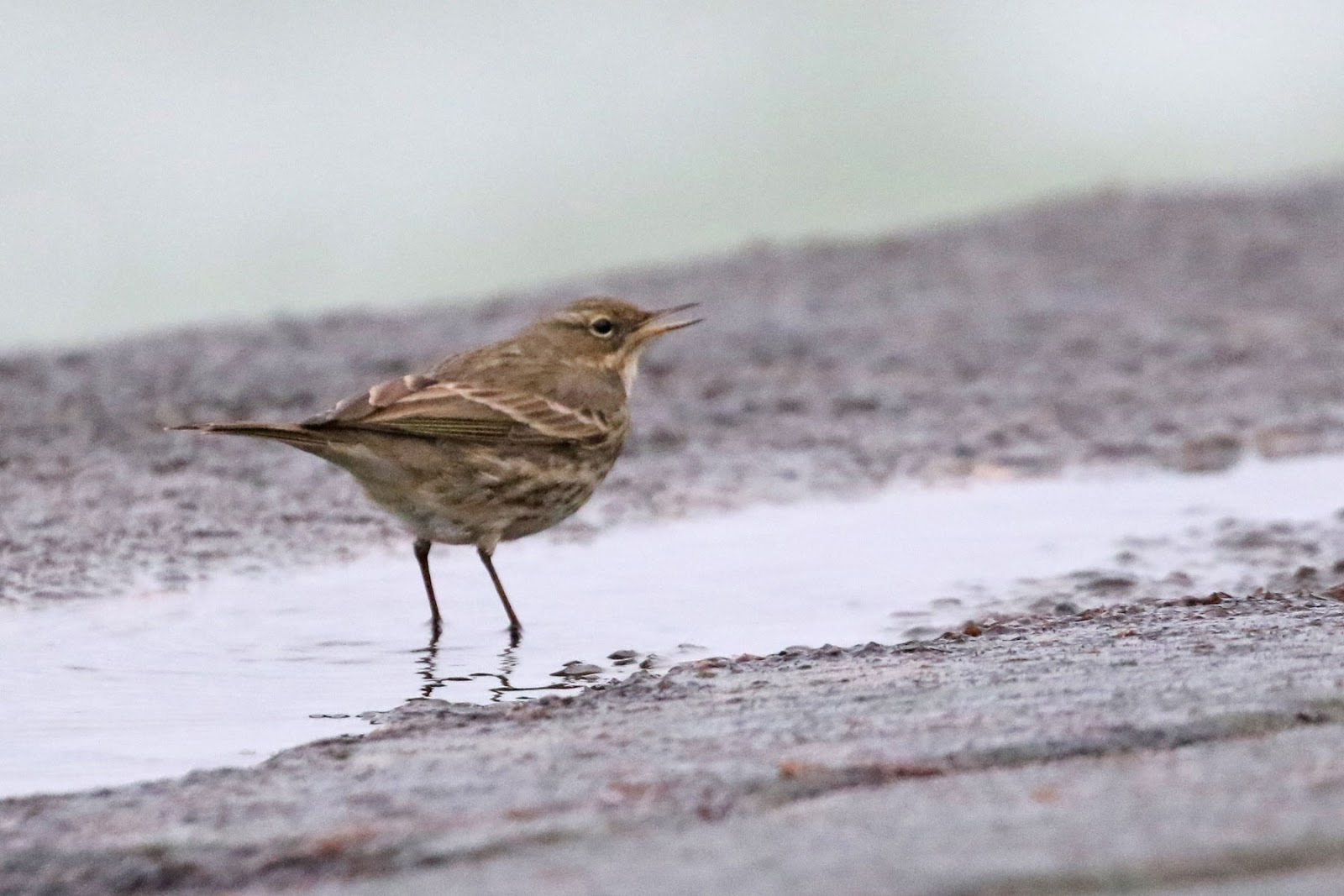
We walked back in the direction of the pier, and debated checking there for the sandpipers as they may have roosted there, we also tried to check the area below the sea wall but the sea weed made it very slippery.  A Rock Pipit flew in and checked the edges of a puddle for any chance of food.


Calling above the noise of the crashing surf.

We continued the search, walking back around the castle once more.  As we reached the end of the curve as the sea wall winds around the castle I noticed movement below on the rocks.  There was a procession of waders coming towards us, where they had come from we had no idea.  It was as if a trap door had opened and they had been sent out to go about their business.  As they moved towards us I counted nine, but it turned out later as they flew out across the sea there were in fact ten present.  Here there are six having moved from the dry rocks into the sea weed to forage at the edge of the surf.

 
We settled down as close as we could safely get and sat on the iron bars to watch as the Purple Sandpipers moved in and out of the surf, while trying to keep out of the wind amongst the rocks and concrete.


Not only were they busily foraging amongst the sea weed and keeping away from the tumbling surf, there was also the need to keep a look out above, danger could come from anywhere.


The Purple Sandpiper is a medium-sized wading bird, slightly larger, stockier and darker than a Dunlin. Despite its name, it appears mostly slate-grey in winter, with only a faint purplish gloss, and shows no purple at all in breeding plumage.  It has a slight down-curved beak and distinctive short bright orange legs. In flight it shows a thin white wing-stripe on otherwise dark wings.


Three separate populations of Purple Sandpiper winter in Britain and Ireland, those in the north and west originate from those breeding on northern tundra on Arctic islands in Canada and from coastal areas in Greenland, and those wintering in eastern and a few in southern England, from northeast Europe in Scandinavia and Svalbard.


These birds forage on rocky coasts, picking up food by sight.  They mainly eat arthropods and molluscs, also some plant material. One of the main staples are insects known commonly as "seaweed flies" because they feed, mate, and create a habitat out of beached seaweed which is common near the Purple Sandpiper's habitat.


The flock would move between spending time foraging amongst the sea weed and digging deep into the cracks in the concrete and resting out amongst the rocks.  When still and hunkered down close to the rocks it was difficult to pick them out.


When foraging they are busy little birds and totally approachable, the only thing that prevented us from getting closer was the slippery rocks, neither of us was looking for an early morning dip!


This lack of fear of us was tested as a large labrador dog came bouncing down the sea wall, past us and into the middle of the flock, at one point I thought the dog was going to grab one in its mouth but they flew off in time out over the sea.  They flew around and came back towards us, but veered off to the right heading over the rocks and away out of sight.  We looked for them again but couldn't find them, maybe they had returned to safety through the trap door!

So it was farewell to Southsea's Purple Sandpipers for another year!

Up on the sea wall we met an old gentleman who was feeding the foxes in the castle moat.  There were three foxes, and all of differing condition, one large male with a thick brush, a smaller individual, probably a vixen, and this one with a very mangy tail.


The old gentleman is regular here, and as well as the foxes will feed the crows.  Everywhere he went the crows would follow, there were four of them and they would perch on the wall and fence as we stood talking to him allowing the opportunity for some lovely portraits against the grey sky.


Extremely intelligent birds.


FRom Southsea we headed west back towards Porchester and the area of Wicor Lake.  Here we were hoping to catch up with a Scaup and Great Northern Diver that had been present all week.  On arriving the weather decided to go against the forecast, and there were waves of heavy drizzle pouring in and along with a now quite strong south westerly wind it made visibility very difficult.  There was a large flock of Redwing feeding on the open grass alongside the shore, with Goldfinches and Bullfinches in the bushes.  Out on the water though there was very little with most of the duck, Wigeon and Shelduck on the far side sheltered from the wind.

There was no sign of the Diver or Scaup, and only a couple of Great-crested Grebes.  With the tide high there were flocks of waders wheeling around looking for a dry place to roost.  On the islands there were large numbers of Oystercatchers and in the air a few Dunlin, and a large flock of around 300 Golden Plover.


We walked around to Cams Lake in the hope that the shelter would support some more birds but we could only find a few Red-breasted Mergansers.  A first visit to this spot was not celebrated with success.  The drizzle looked like it would be moving away east, and we decided to head that way too, this time to close the county border at Warblington, there our quarry were the Cattle Egret that now seem to be resident.

As we drove towards the church on Church Lane I noticed that I had lost Ian, turning around I found him pulling his camera out of the van, the Cattle Egret were in the field along with Little Egrets and of course some cattle.

The cattle egret is a cosmopolitan species of heron found in the tropics, subtropics, and warm-temperate zones.  Originally native to parts of Asia, Africa, and Europe, it has undergone a rapid expansion in its distribution and successfully colonised much of the rest of the world in the last century.

Cattle egrets exploit drier and open habitats more than other heron species. Their feeding habitats include seasonally inundated grasslands, pastures, farmlands, wetlands, and rice paddies. They often accompany cattle or other large mammals, catching insect and small vertebrate prey disturbed by these animals.


The cattle egret has a relatively short, thick neck, a sturdy bill, and a hunched posture. The non-breeding adult has mainly white plumage, a yellow bill, and greyish-yellow legs. During the breeding season, adults develop orange-buff plumes on the back, breast, and crown. The positioning of the egret's eyes allows for binocular vision during feeding and physiological studies suggest that the species may be capable of crepuscular or nocturnal activity.  Adapted to foraging on land, they have lost the ability possessed by their wetland relatives to accurately correct for light refraction by water.


The cattle egret has undergone one of the most rapid and wide-reaching natural expansions of any bird species. It was originally native to parts of southern Spain and Portugal, tropical and subtropical Africa, and humid tropical and subtropical Asia. At the end of the 19th century, it began expanding its range into southern Africa, first breeding in the Cape Province in 1908. Cattle egrets were first sighted in the Americas on the boundary of Guiana and Suriname in 1877, having apparently flown across the Atlantic Ocean. In the 1930s, the species is thought to have become established in that area. It is now widely distributed across Brazil.

The species first arrived in North America in 1941 (these early sightings were originally dismissed as escapees), bred in Florida in 1953, and spread rapidly, breeding for the first time in Canada in 1962.  It is now commonly seen as far west as California. It was first recorded breeding in Cuba in 1957, in Costa Rica in 1958, and in Mexico in 1963, although it was probably established before then.  In Australia, the colonisation began in the 1940s, with the species establishing itself in the north and east of the continent, with them regularly visiting New Zealand in the 1960s.


In Europe, the species had historically declined in Spain and Portugal, but in the latter part of the 20th century, it expanded back through the Iberian Peninsula, and then began to colonise other parts of Europe, southern France in 1958, northern France in 1981, and Italy in 1985. Breeding in the United Kingdom was recorded for the first time in 2008, only a year after an influx seen in the previous year. In 2008, cattle egrets were also reported as having moved into Ireland for the first time.  This trend has continued and cattle egrets have become more numerous in southern Britain with influxes in some numbers during the nonbreeding seasons of 2007/08 and 2016/17. They bred in Britain again in 2017, following an influx in the previous winter, and this has continued with Cattle Egrets breeding in more counties, including Hampshire in 2019. 


The massive and rapid expansion of the cattle egret's range is due to its relationship with humans and their domesticated animals. Originally adapted to a commensal relationship with large grazing and browsing animals, it was easily able to switch to domesticated cattle and horses. As the keeping of livestock spread throughout the world, the cattle egret was able to occupy otherwise empty niches.  When I have seen them in India they have also learnt to exploit man, hanging around markets and open air food stalls


There were five present here at Warblington.  Last year a pair bred but I am not sure how many fledged, two of these birds were showing signs of developing the orange buff breeding plumage on the crown and breast, while the others were mostly white.  The adult birds also appeared to chase off the other birds, maybe these were that family.


They fed with the Little Egrets but the style was very different, they walk with a bobbing action and look much smaller, while the Little Egrets appear much more elegant.


There is also a good number of birds at Sidlesham, and there may be movement between the two areas.  There have been reports of eight and nine feeding here which but five appears to be the consistent number.  It could be a result of misidentification or maybe birds coming over from West Sussex.


We had found a hole in the fence that allowed us to watch them close up, but as the cattle came closer they flew to the other end of the field and this required other means to try and photograph them.


They eventually all fed together but at the back of the field, here three together.


While this is a distant view of all five, the bird on the far right is a Little Egret.


While watching the Cattle Egrets there were tits in the hedgerow and a female Sparrowhawk put up everything as it cruised over the field.

After some lunch we decided to head back west and parking just off the Langstone bridge in the Ship Inn.  From their we crossed the bridge and walked to the Oyster Beds.  It was very quiet everywhere.  Around the beds were a few Brent Geese and Oystercatcher and Curlew, but no duck what so ever.  The tide was high and the wind very strong.  A scan of the sea did not even produce a Great crested Grebe, so we missed out on the Black-necked Grebes reported in the week.  A Greenshank was roosting along with Turnstone on one of the islands in the lagoons, and there were four pairs of Red-breasted Mergansers, this drake being very close in for once.


The trick was to wait for it to dive, and then try and get closer.  It worked for a couple of dives then it headed out to the open water.


We headed back across the bridge and were stopped by a smart Common Gull in the water close in.


It took to the air and gave some close views and a chance for some aerial shots in the afternoon sunshine that had just appeared.


Common gulls have that dove like appearance, maybe not as much as the Kittiwake but enough to make them presentable.  It used the strong wind to hold it up as it dropped into the water.


we crossed the bridge in sunshine and took the path to Southmoor.  Here we hoped that the reported Short-eared Owls would find some sheltered spots to hunt later in the afternoon.  First though we walked around the sea wall where there were some ducks on the sea, Gadwall, Wigeon Pintail and a single female Goldeneye.  We could not find the reported Long-tailed Duck though, once again further out there was very little if anything on the water.

The path leads around in a loop and passed a gravel pit where there were Teal, Gadwall, Shoveler and Mallard.  We made our way to the two fields where the owls have been reported from.  We set ourselves to wait, and wait we did.  The time dragged on, the wind remained strong and the light became increasingly gloomy.  As the clock passed four o'clock we decided that they were not going to show, if they did there would be no chance for any photos so we decided to call it a day and head back to the cars.

Not a bad day, and despite the gloomy conditions some great photographs of the Purple Sandpipers and the Cattle Egrets.  The year is up and running with plenty more opportunities, we hope.

Monday, 6 January 2020

2nd - 3rd January - Avalon Marshes, Somerset

A New Year and the start of a whole new list for the year.  This year the first bird I saw as I pulled back the curtains in our hotel room at Langstone on New Year's Day was a Woodpigeon sitting in a puddle I hope its not an omen.  Back home there was Red Kite, Sparrowhawk, a male Blackcap and a female Bullfinch in the garden, a little bit better.

Like last year we decided to go away after New Year, and like last year we would be staying in the Litton in Somerset.  This year though we decided to go via Blandford Forum, I had received some advice about how easy it was  to see Otters there on the river Stour that flows around the town, I had even been shown photographs and video of a female and three cubs.  What could go wrong?  Apparently all we had to do was turn up and there they would be.  However our record with seeing easy to find otters is not good.  We had failed with the easy to see otters in Thetford

The weather was damp and very gloomy, whilst the temperature was not too low it felt cold, the dampness getting into your bones as they say.  We pulled into the Stour Meadows Car Park, which is behind the Hall and Woodhouse brewery and changed into boots and walked along the path to the river.  The best place to see them was between the West street bridge and the A354 bridge.  We walked towards West Street.  The river was high and there were signs that it had been much higher in recent days.  The only wildlife present were two adult Mute Swans and six juveniles, the adult male showing signs of aggression to a group of canoeists attempting to get over the weir.

We walked along the tow path scouring the water and the edge of he banks with nothing showing.  At one point we disturbed a Kingfisher that flew off but there was no sign of any otters.  After awhile we decided to go and get some coffee and warm up.  After we walked the river once again, this time there were other photographers about, but still no luck.  Time was moving on and we decided to call it a loss once again, Blandford Forum is added to the Thetford loss!  I will try again.

It was then a case of where t next and we opted to head for Ham Wall, the RSPB reserve in the Avalon Marshes, and the Starlings, the weather wasn't great but we would take the chance.  On arriving the car park was half full, we set off to walk a few of the trails before taking up a suitable position to see the murmuration.  There were few birds of note around.  A Marsh Harrier flew over the car park, and there were the usual duck on the open water.  Despite the recent wet weather the trails were all open but very much birdless.

Just after 15:15 we made our way to the first viewing platform.  The visitor centre was giving instructions that the second platform was where they could be seen best, the starling using the Loxton's reed bed to roost in previous days, however we decided to stick to the area we had seen them in before, opposite Walton's Marsh.  The numbers of visitors had now increased and some gathered with us.  As we waited a Marsh Harrier hunted over the reeds, and a Great Egret flew across the wall.

At around 15:45 the first groups were seen around the water tower to the north, gradually these build up and a mass of birds could now be seen over the trees that lead to the Avalon Hide.


It was gloomy, but still quite acceptable to see, the spectacle is always added to by the noise of the Starlings calls, but also the sound of the their wings as they twist and turn together.

They would stream back and from the wall, swarming over the reeds and the trees, it was becoming clear that platform two was the place to be.


Then came the raptors, Marsh Harriers flew below the cloud while above were smaller birds, either Sparrowhawk or Peregrine it was difficult to the tell at the the distance but this changed the dynamic of the murmuration and the swarm started to twist and turn oscillating  with darker shades as the starlings evaded to attacker.


Estimating numbers is extremely difficult, I heard estimates being quoted as 350 thousand to millions, who knows, but all I can say is that there are a lot, and they put on a incredible show even if were were in the wrong place.


The main party were going to roost at Loxton's but behind us there were Starlings dropping into the reed bed at Walton's.  Not in the same quantity but a significant number and they could be seen in the reeds lining the edge of the water

Then the flying came to an end, but the sounds didn't we could hear the Starlings at Loxton's but had a better experience passing those that had broken away.  As we headed back to the car park, we could see them and hear them, the question everyone was wondering was why have this group split from the others, and more importantly but unanswerable who made the decision?.  Back in the car park there seemed to be cars everywhere, a considerable difference to when we had arrived.  We were able to get away easily though, and made our way to the Litton, about a 30 minute drive.

The forecast for Friday was for sunshine, but when we awoke it was raining.  We didn't rush and had a leisurely breakfast before setting out once again to the marshes.  Our first stop was on the Shapwick Heath reserve and specifically the Canada Farm area.  We walked down the path, which was surprisingly quiet, to the hide that overlooks an expanse of water.

As usual all the duck were on the far side.  On one previous visit we had a nice afternoon watching Kingfisher and maybe otter. This time we sat waiting. The lake was transformed when the sun came out, the reeds turning a golden colour in the winter sunshine.    

Marsh Harrier hunted the distant reed beds and would stop in the trees.  Here a dead tree allows for an Osprey impersonation


While another female sat in another tree, all very distant.


The harriers would drift over the water upsetting the duck, which would then fly around but still settle a long way off.  Mostly though the two female harriers would hunt over the reed bed to our right and as I followed one I picked up a Bittern flying just above the reeds it never gave great views and disappeared into some scrub, but it was a Bittern, not always a guaranteed year tick.

A male Marsh Harrier then appeared from over the hide and flew across the water turning to the left but never came back around the island in front of the hide.


We gave it a good go but finally had to concede defeat, maybe the fresh breeze that was making the water choppy had something to do with the lack of birds.  Walking from the hide there was a lot more bird song, the sun enticing them to become a little more vocal.  Blue and Great Tits could be seen in the Alders while a group of Goldfinch and Siskin fed at the top of the trees.

In one of the fields a Grey Heron used a mound as a watch point, the field probably flooded.


From Canada Farm we stopped for a warm drink, then headed back to the Ham Wall car park.  The skies were almost clear now and the good weather would no doubt bring the hoards to see this evening's Starling show.  Pulling into the car park the numbers were already building but there was still plenty of places.

We had time today so set off into the Shapwick Heath reserve following the main permissive path that at one time was the railway line. Reed beds are on either side and in places open out into open water.  On the far side a single Great Egret sat amongst the reeds.


The duck were using the shelter afforded by the copse, present were Shoveler, Teal, Wigeon, Mallard, Gadwall, Tufted Duck and Pochard.


The whole Avalon Marshes are managed and use a lot of grazing animals, in the morning we had seen a huge herd of Red Devon cattle being herded through the fields.  These are hardy cattle that can handle the winter conditions.  Another grazer are the Highland Cattle, they will tackle the reeds and scrub and are an important part in keeping back the advance of the reeds.  This bull was lazily following a herd of cows that had already disappeared into the scrub.


We made our way to the Noar Hide, an elevated hide looking out over a large expanse of water and reed bed.  A huge number of duck were present on the water, mostly Wigeon, but also Teal, Gadwall and Mallard.  Once again Marsh Harrier were hunting on the far side and every so often this would send panic through the duck, and they would take to the air like a mexican wave stretching across the water.


Sunlight at this time of year is incredible, it touches everything with a golden light and transforms everything from a monochrome appearance to one of glorious colour.  Looking around the water in front of the hide this was so evident.


But back lit by  the low sun the reeds can also look splending in a black and white world.  There is something about the shadows they cast.


With the sun dropping in the sky it was time to head back to Ham Wall to get in place for the Starlings, the clouds were fading and it had all the hallmarks of a good showing.

Waling back the low sun was picking out Glastonbury Tor away in the distance.


We decided that this time we would walk down to the second viewing platform.  A lot of people were already in place.  Rather than jostle with the crowds we dropped down to the bank of the canal, the reed bed in front of us lit up by the winter sun.


The warm up acts for the Starlings were the wildfowl out on the water.  Shoveler sat in the shade of the reed reflections.


And could be seen flying around in pairs.


While the Teal conducted their own little air show circling the reeds and open water attempting to land before going around once again.


Finally dropping down into the many pools hidden amongst the reed bed.

Drake Mallards showed off their bottle green heads as the sunlight caught them out in the open.


While On Glastonbury Tor it was as if people were standing and waiting there for the show.


The crowds continued to arrive, young babies cried, dogs barked and boys ran around the area going dangerously close to slipping into the ditch.  The Starlings were late, there were murmurs amongst the crowd have we missed them?  Will they come tonight?  Would they go somewhere else? 

People were also not sure what they were going to see, they had come because they had heard about it, but really didn't know what to expect.  Last night they started to appear around 15:45 but it was gloomy then, today it was clear and still quite bright at 16:00, then like last night a group appeared around the water tower.  Distant to start with they were only visible with binoculars, and the majority in the crowd did not have binoculars, then as the numbers grew they became visible to naked eye and the chatter began to die away, but not the screaming kids and barking dogs!  In front of the water tower the numbers were building.


The swarm grew and grew, but unlike last night did not move from the area close to the water tower, in fact if we had stayed at the first viewing platform.  With the numbers now having built up the birds of prey arrived.  The Marsh Harriers glided below the Starling flocks, it reminded me of the way sharks swim around the bait balls in the ocean, while above there were Sparrowhawks and one Peregrine.


It then became quite clear the Starlings had changed their minds and would not be using the Loxton's reedbed today, we could see them heading over the wall, and heading towards the reed bed that the breakaway starlings had used last night.  Maybe the discussion during  the day changed the majorities mind, or maybe this was a tactic to evade the many raptors that were about yesterday.  We made a quick decision to head back, as we did so the Starlings were swarming against the evening sky.


Arriving back at the first platform we thought we may have missed the spectacle then from over our heads thousands and thousands of Starlings black against the indigo sky and bright quarter moon.


In front of us peering through the gloom the reeds were black with roosting Starlings, prime position being in the middle, lower down the risk of drowning overnight high up the risk of being taken by a later harrier of owl overnight.


The flocks continued to twist overhead, joined by birds in the reeds not comfortable with their positions.


The flocks above continued to behave as if one huge organism, twisting and turning, then swooping low and into the reeds.


Eventually the activity in the sky is subdued and the noise levels increase from the reeds.


And it is left to the stragglers arriving in small groups of up to a dozen to try and find a safe space in amongst the thousands already in place.


We made our way back to the car park in our own flock, amongst us the children were still running about, the babies cold and tired and making sure their parents knew.  The dogs were a little happier now they were moving, and the men negotiated their buggy charges around the many flooded potholes.

Back in the car park the headlights lit up the place and out on the road the bright rear tail lights as cars queued to leave gave the site the air of Christmas lights.  There were many more cars than the previous night and once again I thanked the fact that we only had to get ourselves in the car and get away.  Any later and we would be sitting still for some considerable time.

This was the fifth time we have seen the murmurations here at Ham Wall, and everytime they are different.  The two days we have witnessed though were very good, the numbers seemed much higher than last year.  I don't think I will ever tire of the spectacle, it is amazing and well worth taking the opportunity to see